
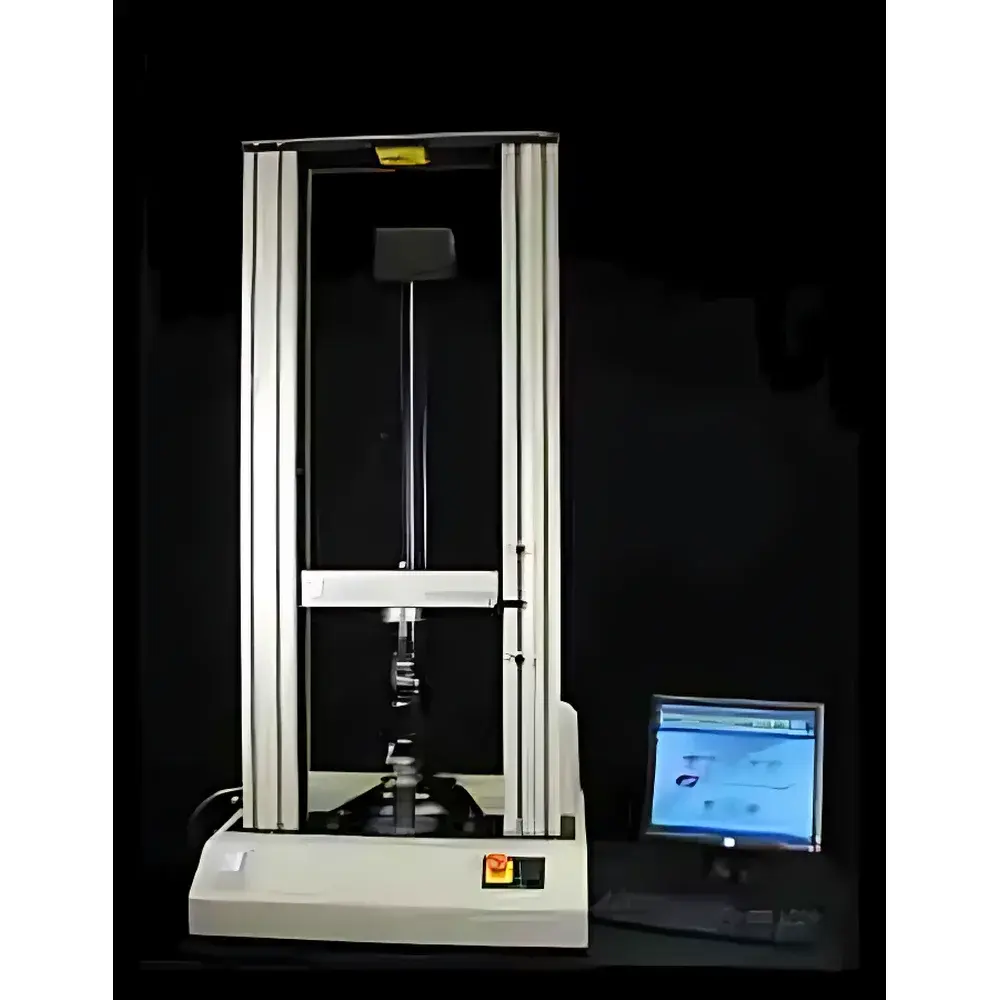
ALPHA T2020DC Universal Testing Machine
| Brand | ALPHA |
|---|---|
| Origin | USA |
| Manufacturer Type | Authorized Distributor |
| Origin Category | Imported |
| Model | T2020DC |
| Pricing | Upon Request |
Overview
The ALPHA T2020DC Universal Testing Machine is a high-precision, fully programmable electromechanical system engineered for static mechanical characterization of polymeric and fibrous materials under tension, compression, flexure, and shear loading conditions. Based on servo-controlled load frame architecture with closed-loop digital force and displacement feedback, the T2020DC implements fundamental principles of uniaxial stress–strain analysis in accordance with classical solid mechanics theory. Its modular design supports standardized test protocols across elastomers, thermoplastic elastomers (TPEs), textile fabrics, and rubber compounds—making it a core instrument for R&D laboratories, quality assurance departments, and contract testing facilities operating under ISO/IEC 17025-accredited environments.
Key Features
- Electromechanical dual-column load frame with precision-ground ball screws and high-resolution encoder-based crosshead positioning (±0.001 mm repeatability)
- Integrated high-elongation extensometer with optional non-contact video-based strain measurement (capable of tracking >1000% elongation with sub-pixel resolution)
- Modular fixture interface supporting rapid interchange of pneumatic grips, compression platens, cord-and-yarn clamps, and shear fixtures
- Programmable environmental integration—compatible with standard temperature-controlled chambers (-70 °C to +250 °C) for ASTM D412, D575, D790, and D885 compliance testing
- Dual-range load cell configuration (e.g., 100 N / 5 kN options) with automatic range switching and <0.5% full-scale linearity error
- Real-time data acquisition at up to 1000 Hz sampling rate, synchronized with video capture and environmental chamber telemetry
Sample Compatibility & Compliance
The T2020DC accommodates specimens ranging from thin elastomeric films (<0.1 mm thickness) to reinforced rubber composites (up to 50 mm wide × 10 mm thick) and woven/nonwoven textile substrates. It meets essential requirements for conformance with ASTM D412 (tensile properties of vulcanized rubber), ASTM D575 (compression set of rubber), ASTM D790 (flexural properties of plastics), and ASTM D885 (tensile properties of tire cord and fabrics). All test methods are implemented via pre-validated Blue Hill software templates aligned with ISO 37, ISO 815, ISO 178, and ISO 2062. The system supports audit-ready documentation per FDA 21 CFR Part 11 when configured with electronic signature and user access control modules.
Software & Data Management
Blue Hill software provides intuitive workflow-driven test setup, real-time visualization of stress–strain curves, and automated calculation of modulus (Young’s, secant, tangent), yield point, elongation at break, tensile strength, compression set, and flexural modulus. Data export formats include CSV, XML, and PDF reports with embedded metadata (operator ID, calibration timestamp, environmental conditions). Version-controlled method libraries ensure traceability across product development cycles. Audit trail functionality logs all user actions—including parameter edits, result overrides, and report generation—with time-stamped, immutable records compliant with GLP and GMP documentation standards.
Applications
- Characterization of natural rubber, SBR, EPDM, silicone, fluorosilicone, and TPU formulations during formulation screening and aging studies
- Textile performance evaluation including warp/weft tensile strength, seam slippage resistance, and dynamic fatigue under cyclic loading
- Quality control of extruded rubber profiles, molded gaskets, and coated fabrics used in automotive, aerospace, and medical device applications
- Research into viscoelastic recovery behavior using multi-step relaxation and creep protocols
- Validation of adhesion strength between rubber-to-metal or rubber-to-fabric laminates using peel and shear fixtures
FAQ
Does the T2020DC support ISO 17025-compliant calibration procedures?
Yes—the system accepts third-party accredited calibration certificates for load cells and extensometers, and Blue Hill supports calibration interval tracking with automated reminders.
Can the machine perform cyclic fatigue testing?
Yes—programmable waveforms (sinusoidal, triangular, trapezoidal) enable controlled low-cycle fatigue testing with variable frequency, amplitude, and dwell periods.
Is Blue Hill software validated for regulated industries?
When deployed with optional 21 CFR Part 11 compliance modules (electronic signatures, role-based permissions, audit trail encryption), Blue Hill meets FDA and EMA validation expectations for QC labs.
What environmental chamber models are compatible?
Standard integration is available with ESPEC, Angelantoni, and Weiss chambers; custom interfaces can be developed for other OEMs upon request.
How is sample alignment verified prior to testing?
The system includes a built-in optical alignment aid with laser crosshair projection, and Blue Hill offers auto-zeroing routines that detect initial contact force to minimize preload artifacts.




