
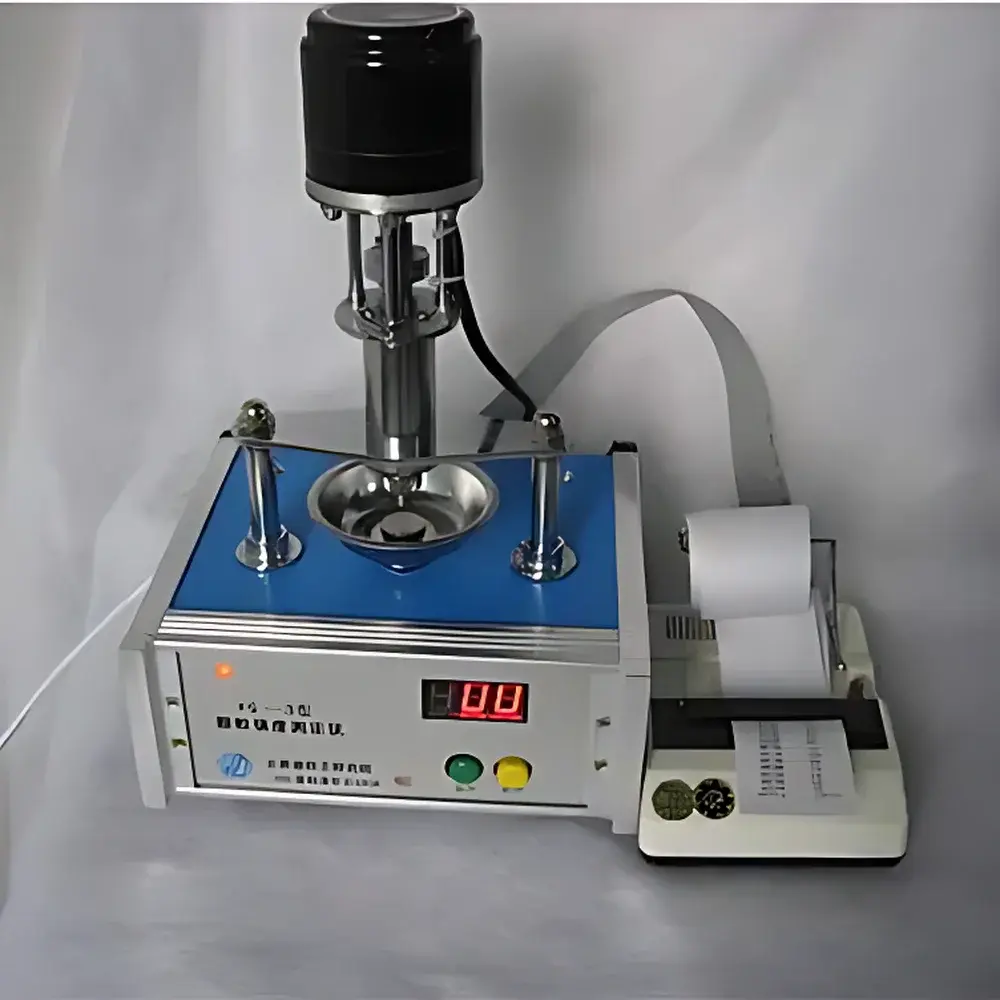
GuanYuan KQ-3 Automated Granule Crushing Strength Tester
| Origin | Beijing, China |
|---|---|
| Manufacturer Type | Authorized Distributor |
| Origin Category | Domestic (PRC) |
| Model | KQ-3 |
| Pricing | Upon Request |
| Measurement Range | 0–300 N (selectable full-scale: 15 N / 100 N / 300 N) |
| Particle Diameter Compatibility | 1–15 mm (custom up to 25 mm) |
| Resolution | 0.01 N (≤100 N range) / 0.1 N (>100 N range) |
| Display | 4-digit LED |
| Accuracy | ±0.5% FS |
| Power Supply | AC 220 V ±10% |
| Operating Temperature | Ambient to 50 °C |
| Relative Humidity | ≤85% RH |
| Dimensions (W×D×H) | 180 × 260 × 350 mm |
| Overload Protection | Yes |
| Auto-zero Function | Yes |
| Data Output | Integrated thermal printer |
| Statistical Processing | Automatic mean calculation across multiple measurements |
Overview
The GuanYuan KQ-3 Automated Granule Crushing Strength Tester is a microprocessor-controlled mechanical testing instrument engineered for the quantitative determination of compressive crushing strength in free-flowing, discrete solid granules. It operates on the fundamental principle of uniaxial quasi-static compression: a calibrated load cell applies controlled, linearly increasing force perpendicular to the longitudinal axis of an individual particle until fracture occurs. The peak load recorded at the point of structural failure—expressed in newtons (N)—is defined as the crushing strength. This methodology conforms to standardized mechanical characterization protocols widely adopted in catalyst development, pharmaceutical excipient qualification, fertilizer quality control, and adsorbent performance validation. Unlike manual or analog testers, the KQ-3 eliminates operator-induced variability through motorized actuation and real-time digital signal acquisition, ensuring high reproducibility across sequential measurements under GLP-aligned laboratory conditions.
Key Features
- Automated compression cycle initiated by single-button operation—no manual loading or timing required.
- Digital auto-zero calibration eliminates mechanical potentiometer drift and reduces setup time between samples.
- Real-time load display with 4-digit LED readout; resolution optimized per selected range (0.01 N at 15 N/100 N scales; 0.1 N at 300 N scale).
- Onboard statistical engine computes arithmetic mean, standard deviation, and count of valid measurements per test batch.
- Integrated thermal printer provides immediate hard-copy output of raw data, calculated statistics, date/time stamp, and operator ID field (user-entered).
- Hardware-based overload protection prevents sensor damage during accidental overloading or misalignment.
- Modular load cell design supports three factory-calibrated full-scale options (15 N, 100 N, 300 N), enabling optimal resolution across diverse material classes—from fragile zeolite beads to dense sintered catalyst pellets.
Sample Compatibility & Compliance
The KQ-3 accommodates cylindrical or near-spherical granules with diameters from 1.0 mm to 15.0 mm (custom fixtures available for particles up to 25 mm). Its platen geometry and alignment mechanism ensure consistent contact area and minimal lateral shear during compression—critical for adherence to ASTM D4179 (Standard Test Method for Determination of Crush Strength of Catalysts and Catalyst Carriers) and ISO 10012 (Reference materials — General requirements for reference materials used in chemical analysis). The instrument directly supports compliance with multiple Chinese national standards including GB/T 102012–1988 (Determination of average crushing strength of granules), GB/T 3635–1983 (Crushing strength test for fertilizer catalysts, molecular sieves, and adsorbents), GB/T 2945–1989 (Agricultural compound fertilizers), GB/T 10516–2012 (Crushing strength of nitrophosphate granules), HG/T 2782–1996 (Granular heavy superphosphate), and GB/T 21633–2008 (Compound BB fertilizers). While not FDA 21 CFR Part 11–certified out-of-the-box, its deterministic measurement logic, audit-ready print logs, and non-volatile result storage support retrospective verification required under GMP and ICH Q5C frameworks.
Software & Data Management
The KQ-3 operates via embedded firmware without external PC dependency. All measurement parameters—including scale selection, zero offset, and sample count—are stored in non-volatile memory. Each printed report includes timestamp, selected range, individual readings, computed mean, and pass/fail flag (if user-defined threshold entered). For laboratories requiring digital archiving, optional RS-232 serial interface enables ASCII-formatted data export to LIMS or Excel-compatible spreadsheets. No proprietary software installation is required; raw data streams follow standard SCPI-like syntax for seamless integration into automated QA workflows. Firmware updates are performed via USB-to-serial adapter and manufacturer-provided configuration utility—documented in the technical manual with version-controlled release notes.
Applications
- Quality assurance of extruded or pelleted catalysts (e.g., Ni/Mo/Al₂O₃ hydrodesulfurization catalysts) prior to reactor loading.
- Batch release testing of pharmaceutical tablet granules to ensure downstream compaction integrity and dissolution consistency.
- Evaluation of mechanical stability in silica gel, activated carbon, and ion-exchange resin beads under transport and handling stress.
- Formulation optimization of nitrogen-phosphorus-potassium (NPK) compound fertilizers to minimize dust generation during pneumatic conveying.
- R&D screening of novel porous ceramic supports for thermal shock resistance and attrition minimization.
- Validation of coating integrity on controlled-release agrochemical granules via correlation between crush strength and dissolution profile.
FAQ
What particle shapes can the KQ-3 accurately test?
The instrument is validated for near-spherical, cylindrical, and ellipsoidal granules with aspect ratios ≤ 2:1. Irregularly shaped particles require pre-screening to remove fragments or highly angular specimens that may induce non-axial loading.
Is calibration traceable to national standards?
Yes—each unit ships with a factory calibration certificate traceable to CNAS-accredited metrology institutes (equivalent to ISO/IEC 17025). Annual recalibration is recommended using certified dead-weight test loads.
Can the KQ-3 be integrated into a networked QA system?
Via optional RS-232 or USB-to-serial interface, it supports automated data capture into SQL-based LIMS platforms using configurable delimiter-separated output.
Does the instrument comply with ISO 9001 internal audit requirements?
Its documented calibration history, printable audit trails, and defined maintenance schedule meet clause 7.1.5.2 (Monitoring and measuring resources) of ISO 9001:2015.
What maintenance is required beyond routine cleaning?
Annual verification of load cell linearity and zero stability is advised; no lubrication or mechanical adjustment is needed under normal operating conditions.
Related Products




