
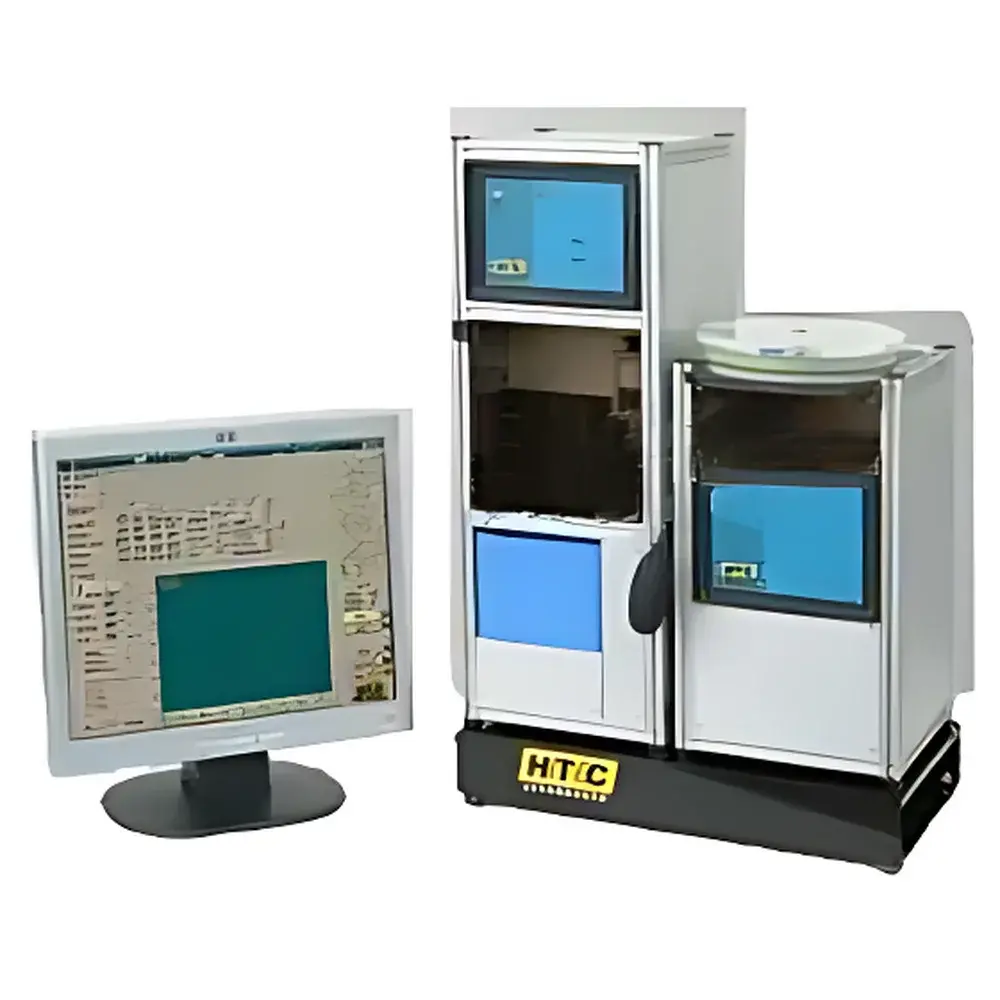
HITEC IPHT-Type Single-Particle Strength Analyzer for Carbon Black
| Origin | Germany |
|---|---|
| Manufacturer Type | Authorized Distributor |
| Origin Category | Imported |
| Model | IPHT-Type |
| Price | Upon Request |
Overview
The HITEC IPHT-Type Single-Particle Strength Analyzer is a precision mechanical testing instrument engineered specifically for the quantitative assessment of mechanical robustness in individual granulated carbon black particles. It operates on the fundamental principle of controlled uniaxial compression—applying either constant-speed or constant-force loading to a single particle until fracture occurs—thereby yielding reproducible metrics of particle hardness, structural integrity, and resistance to attrition. Designed in strict conformance with ASTM D5230 (Standard Test Method for Determining the Crush Strength of Pelleted Carbon Black) and ASTM D3313 (Standard Test Method for Determining the Compressive Strength of Carbon Black Agglomerates), the IPHT system delivers traceable, standards-compliant data essential for process validation, formulation optimization, and regulatory documentation in carbon black manufacturing and downstream rubber compounding applications.
Key Features
- Two standardized test modes: constant-velocity compression (ASTM D5230) and constant-load compression (ASTM D3313), selectable via software interface
- High-resolution force transduction with 0–300 g measurement range and ±1 g accuracy, calibrated per ISO/IEC 17025-accredited procedures
- Optimized particle dimension compatibility: accepts spherical or near-spherical granules from 0.8 mm to 3.0 mm in diameter, with dimensional tolerance of ±0.02 mm
- Integrated vibration isolation platform (IPHT-DTBL) featuring passive damping architecture, reducing ambient mechanical noise below 0.1 Hz to ensure measurement stability in industrial environments
- Modular design supports both manual single-particle operation and automated batch testing workflows without hardware reconfiguration
- Compact footprint (≤450 × 350 × 300 mm) enables benchtop deployment in QC labs, pilot plants, or production control rooms
Sample Compatibility & Compliance
The IPHT analyzer is validated exclusively for granulated carbon black materials meeting ASTM D1765 specifications, including N110, N220, N330, N550, and N660 grades. Particle geometry must be predominantly spherical with surface roughness < Ra 3.2 µm to ensure consistent contact mechanics during compression. The system complies with electromagnetic compatibility (EMC) requirements per EN 61326-1 and electrical safety standards per EN 61010-1. All test reports generated include full audit trails compliant with GLP and GMP principles, supporting FDA 21 CFR Part 11 readiness when deployed with validated software configuration.
Software & Data Management
The proprietary IPHT Control Suite runs on Windows OS (v10/11, 64-bit) and communicates with the IPHT-BASU main unit via RS-232 serial interface or Ethernet (TCP/IP). Up to four analyzers can be daisy-chained to one host PC using standard COM port virtualization. The software implements all calculation algorithms mandated by ASTM D5230 and D3313—including peak load identification, deformation curve integration, and statistical summarization (mean, SD, CV%, min/max) across user-defined sample sets. Raw force-displacement time-series data are stored in .csv and binary .ipht formats with embedded metadata (operator ID, timestamp, calibration certificate ID, environmental temperature/humidity). Export modules support direct integration into LIMS platforms via ODBC or RESTful API endpoints.
Applications
- Quality assurance of carbon black pellets during final packaging and before shipment to tire or industrial rubber manufacturers
- Correlation studies between pellet strength and downstream dispersion performance in polymer masterbatches
- Process parameter optimization in fluidized-bed granulation and rotary drum agglomeration lines
- Stability monitoring of storage-aged batches exposed to humidity or thermal cycling
- Root-cause analysis of premature extruder screen clogging linked to low-strength agglomerates
- Supporting technical documentation for ISO 9001:2015 clause 8.5.1 (control of production and service provision)
FAQ
What environmental conditions are required for reliable operation?
The IPHT analyzer itself is rated for operation in ambient temperatures of 15–30 °C and relative humidity ≤70% non-condensing, and tolerates airborne carbon black dust concentrations up to 10 mg/m³. However, the host computer must reside in a clean, air-conditioned environment (ISO Class 8 or better) to prevent contamination of internal components.
Is the IPHT-DTBL vibration isolation table mandatory?
Yes. Installation on the IPHT-DTBL platform is required to meet the instrument’s specified measurement repeatability (RSD < 2.5% at n = 10 for 1.5 mm N330 pellets). Without it, floor-borne vibrations exceeding 5 µm RMS at 10–50 Hz will compromise force resolution and fracture event detection.
Can the IPHT-RASB random sampling station be retrofitted to an existing IPHT unit?
Yes. The IPHT-RASB is a field-upgradable module requiring only mechanical mounting brackets, pneumatic supply (6 bar clean, oil-free compressed air), and a dedicated USB-to-serial adapter for stepper motor control. Firmware update and software license activation are performed remotely by HITEC support.
Does the system support multi-user access with role-based permissions?
The Control Suite includes configurable user accounts with three permission tiers: Operator (run tests only), Supervisor (edit methods, calibrate), and Administrator (manage users, backup databases, configure network settings). All actions are logged with timestamps and user identifiers.
How often does the force sensor require recalibration?
Annual recalibration is recommended and traceable to national metrology institutes (e.g., PTB Germany). Field verification using certified reference weights (10 g, 100 g, 250 g) is supported daily via the built-in verification routine.
Related Products




