
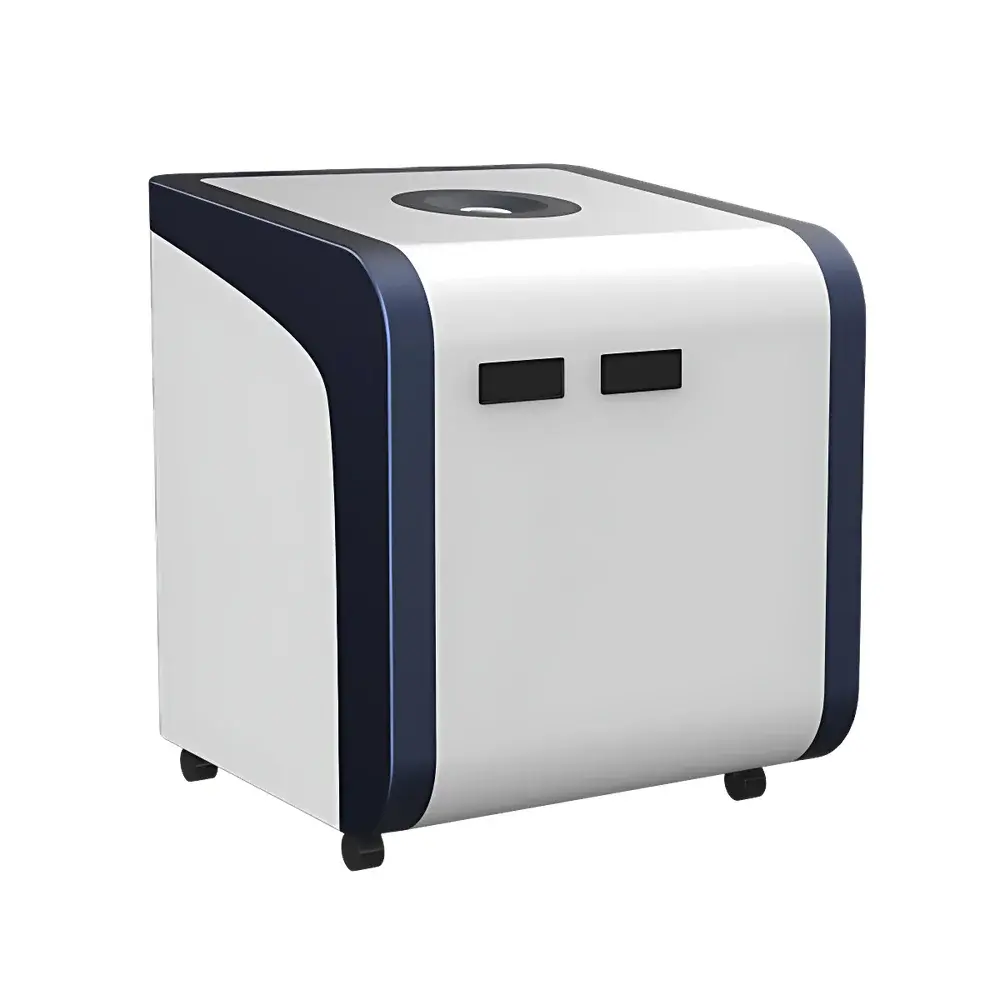
HTNMR HT-PNMR12-9 90 MHz Pulsed Fourier Transform Nuclear Magnetic Resonance Spectrometer
| Brand | HTNMR |
|---|---|
| Origin | Shanghai, China |
| Manufacturer Type | Direct Manufacturer |
| Instrument Type | High-Field Benchtop NMR Spectrometer |
| Sample Form | Liquid |
| Operating Frequency | 90 MHz (¹H) |
| Data Acquisition Method | Pulsed Fourier Transform (PFT-NMR) |
| Sensitivity | 10,000:1 (S/N, CH₃ peak of 98% ethanol, 32 scans) |
| Resolution | 0.5 Hz (0.011 ppm at 90 MHz) |
| Magnet System | Permanent Rare-Earth Magnet (No Cryogen Required) |
| Nuclei Supported | ¹H, ¹³C, ¹⁹F, ³¹P (software-selectable) |
Overview
The HTNMR HT-PNMR12-9 is a compact, high-stability benchtop nuclear magnetic resonance (NMR) spectrometer operating at a proton resonance frequency of 90 MHz. Engineered for routine structural analysis and quantitative characterization of small organic molecules in solution, it employs a permanent rare-earth magnet system—eliminating the need for liquid helium, nitrogen, or active cryogenic infrastructure. This design enables deployment in standard laboratory environments, quality control labs, teaching facilities, and even industrial process monitoring settings where space, power, and operational simplicity are constrained. The instrument operates on the fundamental quantum mechanical principle of nuclear spin excitation: atomic nuclei with non-zero spin quantum number (e.g., ¹H, ¹³C, ¹⁹F, ³¹P) experience Zeeman splitting in a static magnetic field; application of a resonant radiofrequency (RF) pulse induces coherent spin transitions, and the resulting free induction decay (FID) is digitized and Fourier-transformed to yield a frequency-domain spectrum. Chemical shift (ppm), peak multiplicity, coupling constants (J), and integrated signal intensities provide direct insight into molecular connectivity, conformational dynamics, functional group identity, and relative concentration.
Key Features
- Permanent magnet architecture: Stable 90 MHz field homogeneity (< 0.011 ppm over 10 mm DSV) without cryogens or shimming coils — ideal for low-infrastructure environments.
- Multi-nucleus capability: Hardware and software support for ¹H, ¹³C, ¹⁹F, and ³¹P spectroscopy via selectable RF channel tuning and pulse sequence libraries.
- High sensitivity: Signal-to-noise ratio of 10,000:1 (CH₃ resonance of 98% ethanol, 32 transients, 5 mm sample tube), enabling detection of sub-millimolar concentrations in optimized conditions.
- Rapid acquisition: Standard ¹H spectrum acquisition completed in ≤10 seconds per scan; automated parameter optimization reduces method development time.
- Robust thermal management: Passive temperature stabilization maintains field drift < 0.1 Hz/hour, ensuring reproducibility across multi-hour sessions.
- Modular pulse programming: Supports user-defined pulse sequences including inversion recovery, DEPT, HSQC (via optional upgrade), and quantitative single-pulse experiments compliant with ASTM E2949 and ISO 17025 traceability requirements.
Sample Compatibility & Compliance
The HT-PNMR12-9 accepts standard 5 mm outer-diameter glass NMR tubes with sample volumes of 0.5–0.6 mL. It is validated for use with common deuterated solvents (CDCl₃, DMSO-d₆, D₂O) and non-deuterated matrices where solvent suppression is applied. All hardware and firmware comply with IEC 61010-1 (safety) and IEC 61326-1 (EMC) standards. Data integrity features include audit-trail-enabled acquisition logs, electronic signatures per FDA 21 CFR Part 11 (when used with validated LIMS integration), and GLP/GMP-ready reporting templates. Applications include QC release testing of pharmaceutical intermediates (e.g., aspirin, ibuprofen, ethyl crotonate), fluoropolymer analysis (perfluoropolyethers, AF materials), phosphine ligand verification in catalysis, and routine structure confirmation in synthetic chemistry workflows.
Software & Data Management
The instrument is controlled via HTNMR’s proprietary NMRStudio™ software suite, running on Windows 10/11 x64 platforms. Core modules include real-time spectrum preview, automatic phasing and baseline correction, peak picking with chemical shift referencing (TMS or internal standard), integration with customizable tolerance thresholds, and export to JCAMP-DX, Mnova, and CSV formats. Raw FID and processed data are stored with full metadata (pulse sequence, acquisition parameters, instrument ID, operator, timestamp). Optional cloud-sync module enables secure, encrypted transfer to centralized analytical data repositories. Software validation documentation (IQ/OQ/PQ protocols) is available upon request for regulated environments.
Applications
- Pharmaceutical QA/QC: Identity confirmation and purity assessment of APIs and excipients using ¹H and ¹⁹F NMR fingerprinting.
- Materials science: Quantitative ¹⁹F NMR for fluorinated polymer degradation studies and end-group analysis of PFPE lubricants.
- Catalysis research: ³¹P NMR monitoring of phosphine ligand coordination states and oxidative addition kinetics.
- Academic teaching: Hands-on NMR pedagogy covering spin physics, chemical shift trends, J-coupling, and 2D correlation concepts (with optional advanced pulse packages).
- Industrial process analytics: In-line or at-line verification of reaction completion in fine chemical synthesis batches.
FAQ
Is liquid nitrogen or helium required for operation?
No. The HT-PNMR12-9 uses a passively stabilized permanent magnet system and requires no cryogens.
Can the instrument perform quantitative analysis?
Yes. With proper calibration standards and consistent pulse parameters, it supports quantitative ¹H and ¹⁹F NMR per USP <724> and ASTM E2949 guidelines.
What is the typical field homogeneity specification?
0.011 ppm over a 10 mm diameter spherical volume (DSV), verified by line width measurement of the CH₃ singlet in 98% ethanol.
Does the system support 2D NMR experiments?
Basic 2D sequences (e.g., COSY, TOCSY) are available as optional software modules; HSQC requires additional RF channel calibration and is offered under extended service agreement.
How is data security and regulatory compliance ensured?
Audit trails, user access controls, electronic signature support, and raw data immutability are implemented in accordance with FDA 21 CFR Part 11 and ISO/IEC 17025 requirements.






