
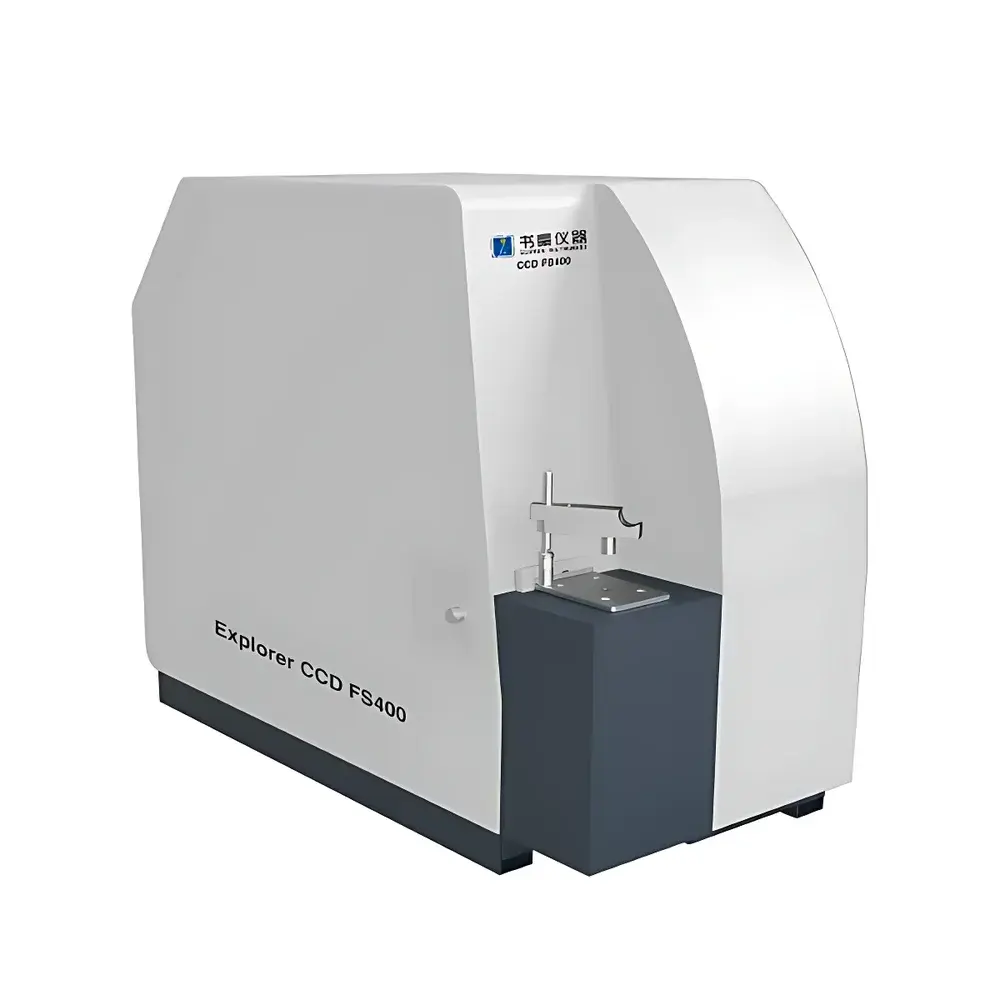
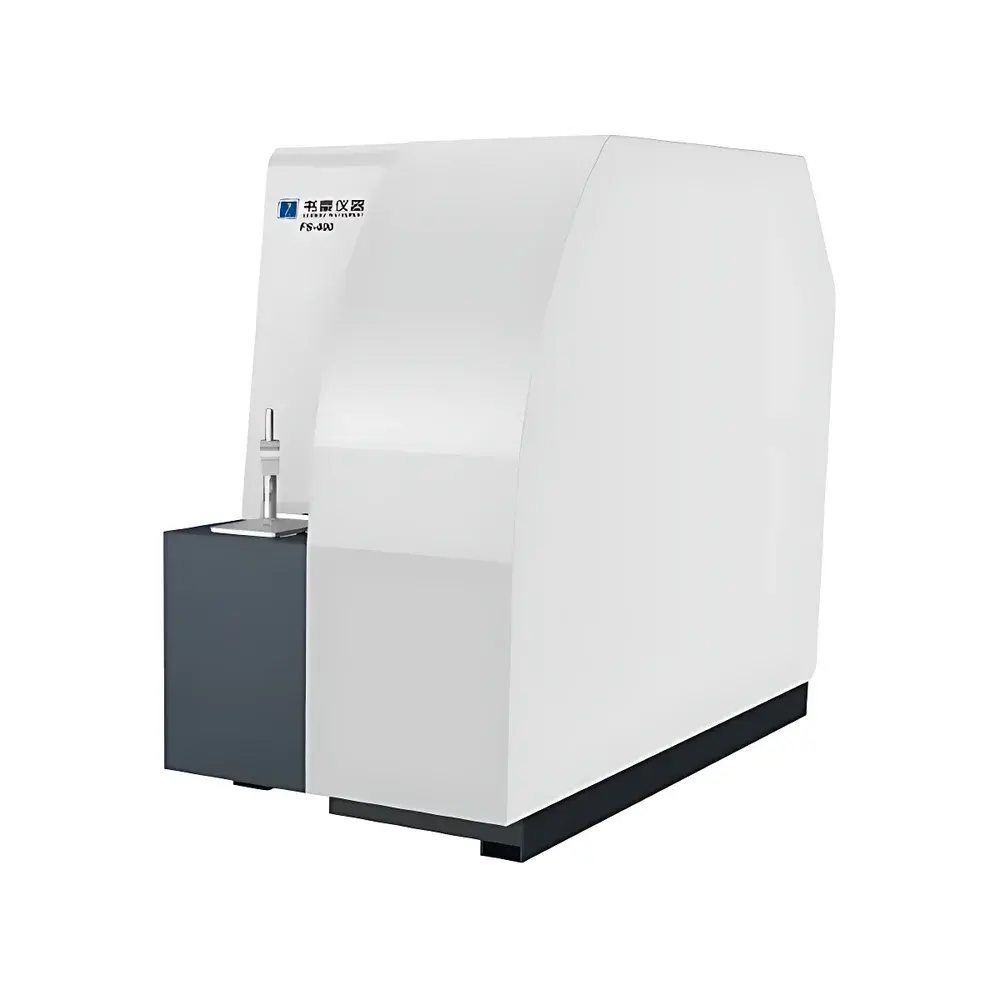
SOOHOW FS400 CCD Full-Spectrum Direct-Reading Optical Emission Spectrometer
| Brand | SOOHOW INSTRUMENT |
|---|---|
| Origin | Jiangsu, China |
| Manufacturer Type | Manufacturer |
| Instrument Type | Benchtop |
| Excitation Method | Spark |
| Detector Type | Charge-Coupled Device (CCD) |
| Focal Length | 400 mm |
| Grating Groove Density | 2700 lines/mm |
| Wavelength Range | 170–430 nm |
| Argon Consumption | Low-flow argon purging for spark stand |
Overview
The SOOHOW FS400 is a benchtop full-spectrum direct-reading optical emission spectrometer (OES) engineered for high-precision elemental analysis of metallic alloys. Based on the principle of spark-induced atomic emission spectroscopy, the instrument generates controlled micro-plasma discharges on the sample surface under inert argon atmosphere, exciting atoms to emit characteristic line spectra. These emissions are dispersed by a high-resolution Czerny-Turner optical system featuring a 400 mm focal length and a 2700 lines/mm holographic grating, then simultaneously captured across the entire spectral range (170–430 nm) by a thermoelectrically cooled CCD detector array. This architecture eliminates mechanical wavelength scanning, enabling true multi-element quantification in a single exposure with sub-second acquisition times. Designed for routine QC/QA laboratories in foundries, metal fabrication facilities, and materials R&D centers, the FS400 delivers trace-to-major constituent detection — from low-ppm concentrations of residual elements (e.g., N, O, P, S) to weight-percent levels of major alloying components (e.g., Fe, Al, Cu, Ni, Mg, Zn, Ti) — without reconfiguration.
Key Features
- Full-spectrum acquisition via high-sensitivity, back-thinned CCD detector ensuring uniform quantum efficiency across UV–VIS range (170–430 nm)
- Benchtop robust mechanical architecture with integrated spark stand optimized for stable plasma generation and minimal spectral drift
- Low-flow argon purging system (< 3 L/min during analysis, < 0.5 L/min standby) minimizing operational cost and environmental footprint
- High-energy pre-spark (HEPS) technology with PC-controlled frequency modulation for reproducible sample conditioning and oxide layer removal
- Real-time temperature and atmospheric pressure compensation algorithms embedded in firmware to maintain calibration stability across ambient fluctuations
- Open-access calibration architecture supporting user-defined standardization using certified reference materials (CRMs) traceable to NIST or ISO 17025-accredited sources
Sample Compatibility & Compliance
The FS400 accommodates solid metallic samples up to Ø40 mm × 30 mm height, including irregular geometries via optional precision mini-clamps and adjustable electrode holders. It supports standardized analysis of ferrous (cast iron, carbon/low-alloy steels), non-ferrous (Al-Si, Al-Mg, Cu-Zn, Ni-based superalloys), and reactive light metals (Mg, Ti) per ASTM E415, ASTM E1086, ISO 11577, and GB/T 4336. The optical chamber and spark stand conform to IEC 61000-4-3 (EMC immunity) and UL 61010-1 (electrical safety). Data integrity protocols comply with ALCOA+ principles; audit trails, electronic signatures, and user-level access control align with FDA 21 CFR Part 11 requirements when deployed in regulated environments.
Software & Data Management
Controlled via Windows-based SpectraSuite software, the FS400 provides intuitive workflow navigation, real-time spectrum visualization, and automated peak identification using a built-in line database (NIST Atomic Spectra Database v2023). Quantitative analysis employs inverse regression models (type II calibration) with matrix-matched standards. Software features include method cloning, batch reporting (PDF/CSV/XLSX), statistical process control (SPC) charting, and GLP-compliant data archiving with timestamped raw spectra, calibration logs, and instrument parameter history. Export modules support LIMS integration via ASTM E1384-compliant ASCII or ASTM E1482 XML formats.
Applications
- Routine grade identification and sorting of incoming raw materials and scrap metal
- Final product verification in heat treatment and casting operations (e.g., verifying Cr/Ni ratio in stainless steels)
- Trace impurity monitoring (e.g., O, N, P, S in titanium alloys per ASTM B348)
- Research-grade compositional mapping of intermetallic phases via sequential spark positioning
- Process validation for additive manufacturing feedstock powders (Al, Ti, Ni variants)
- Compliance testing against RoHS, REACH, and MIL-STD-882 material declarations
FAQ
What sample preparation is required prior to analysis?
Flat, clean, and conductive surfaces are required. Grinding with SiC paper (P180–P400) under coolant-free conditions is recommended; no acid etching or polishing is necessary.
Can the FS400 analyze non-conductive materials such as ceramics or coatings?
No — the instrument requires direct electrical contact for spark excitation; it is strictly limited to conductive metallic solids.
Is external cooling water needed for the CCD detector?
No — the detector uses thermoelectric (Peltier) cooling, eliminating dependency on external chillers or tap water.
How often must recalibration be performed?
Typical recalibration interval is 8–12 hours of continuous operation or after every 50–100 samples, depending on matrix homogeneity and environmental stability.
Does the system support remote diagnostics and firmware updates?
Yes — secure HTTPS-based remote access enables OEM-assisted troubleshooting and over-the-air firmware upgrades compliant with ISO/IEC 27001 data handling policies.
Related Products



