
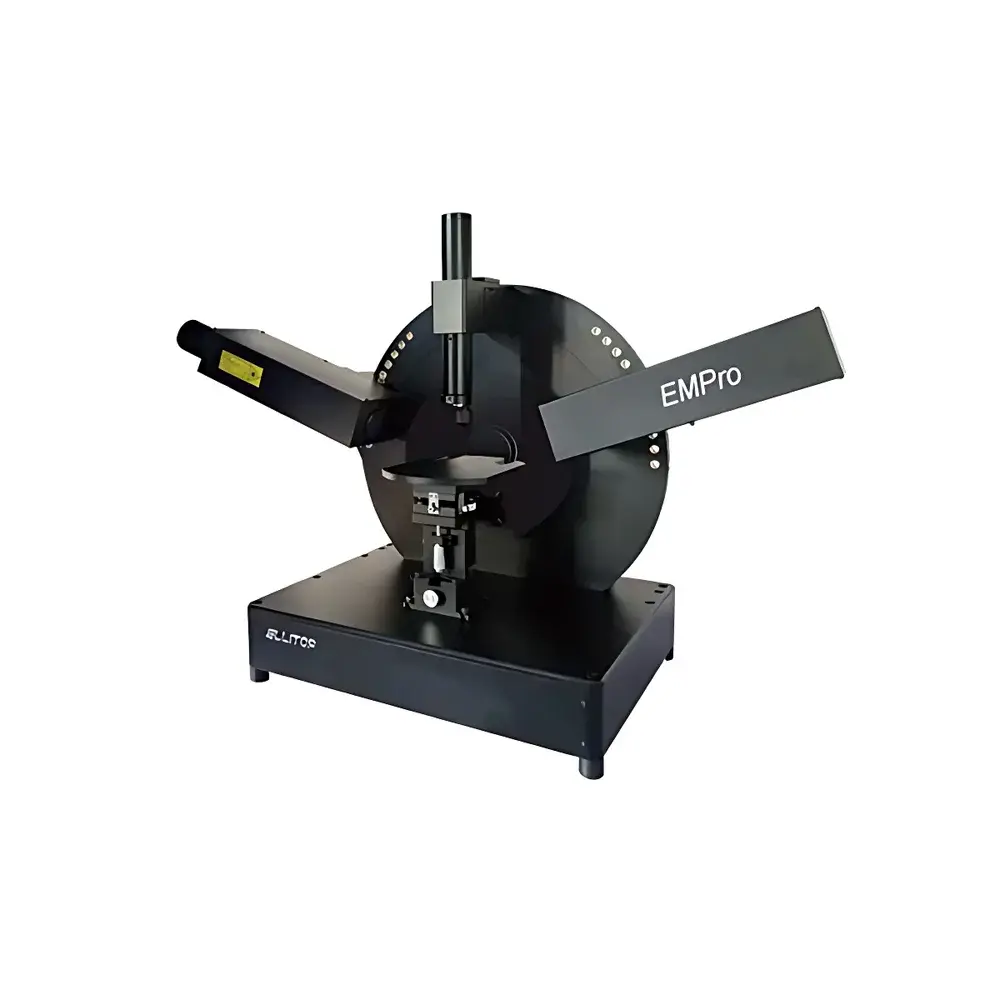
ELLITOP EMPro Advanced Multi-Angle Laser Ellipsometer
| Brand | ELLITOP |
|---|---|
| Origin | Beijing, China |
| Model | EMPro |
| Incidence Angle Range | 40°–90° (manual adjustment in 5° increments) |
| Single-Measurement Time | ≤0.6 s (typical) |
| Measurement Principle | Null-ellipsometry with rotating analyzer (RA) configuration |
| Delta Range | 0°–360° continuous |
| Sensitivity | Sub-angstrom thickness resolution for ultra-thin films |
| Alignment System | Integrated high-resolution video auto-collimation stage |
| Software Architecture | Windows-based, compliant with FDA 21 CFR Part 11 audit trail requirements |
| Compliance | Supports ISO/IEC 17025-compliant calibration documentation and GLP/GMP traceable reporting |
Overview
The ELLITOP EMPro Advanced Multi-Angle Laser Ellipsometer is a precision optical metrology instrument engineered for quantitative characterization of thin-film and bulk optical materials at the nanoscale. Operating on the fundamental principle of null ellipsometry—where polarization state changes induced by reflection from a sample surface are measured to extract the complex dielectric function—the EMPro utilizes a stabilized He-Ne laser source (632.8 nm) and a rotating analyzer (RA) detection scheme to determine the amplitude ratio (Ψ) and phase difference (Δ) with high spectral fidelity. Its multi-angle incidence capability (40°–90°, adjustable in precise 5° steps) enables absolute thickness determination without reliance on optical model assumptions alone, significantly reducing parameter correlation in multilayer stack analysis. Designed for R&D laboratories and production QC environments, the EMPro delivers sub-angstrom thickness sensitivity and full 0°–360° Δ coverage—eliminating ambiguity zones near Δ = 0° or 180° that commonly degrade accuracy in conventional ellipsometers. The system is optimized for both static characterization and real-time in-situ monitoring of dynamic processes such as ALD, CVD, and sputtering.
Key Features
- Multi-angle incidence optics with motorized or manual angular positioning (40°–90°, 5° step resolution), enabling robust dispersion-independent film thickness extraction.
- Full 0°–360° Δ measurement range via high-stability RA architecture—no dead zones, even at critical phase boundaries where conventional systems suffer signal degeneracy.
- Sub-angstrom thickness resolution on SiO₂/Si reference stacks, validated per ASTM F1599 and ISO 15901-2 protocols.
- Integrated video-based auto-collimation alignment stage with 5-micron spatial registration repeatability, minimizing setup-induced systematic error.
- Single-measurement acquisition time ≤600 ms at full precision—enabling high-throughput mapping across wafers up to 200 mm diameter.
- Modular software architecture supporting administrator/operator role separation, electronic signatures, and 21 CFR Part 11–compliant audit trails for regulated environments.
Sample Compatibility & Compliance
The EMPro accommodates planar substrates ranging from 10 mm × 10 mm to 200 mm wafers, including silicon, fused silica, sapphire, glass, and flexible polymer films (PET, PI). It supports transparent, semi-transparent, and absorbing substrates, as well as patterned or textured surfaces—provided surface roughness remains below 2 nm RMS to maintain ellipsometric coherence. All hardware components comply with CE electromagnetic compatibility (EMC) Directive 2014/30/EU and RoHS 2011/65/EU. Calibration certificates traceable to NIM (National Institute of Metrology, China) are provided; optional ISO/IEC 17025 accreditation support is available for laboratory validation workflows.
Software & Data Management
The EMPro Control Suite is a native Windows application built on .NET Framework 4.8, featuring modular modules for measurement acquisition, optical modeling (via Cauchy, Sellmeier, Tauc-Lorentz, and B-spline dispersion models), and statistical process control (SPC) charting. It includes over 120 pre-validated material optical constants (n, k) spanning UV–VIS–NIR (190–1700 nm equivalent), plus user-defined database expansion. Raw Ψ/Δ data, fitted parameters, and residual maps are exportable in CSV, XML, and HDF5 formats. All user actions—including model edits, parameter constraints, and report generation—are logged with timestamps, operator IDs, and hash-verified integrity checks to satisfy GLP and GMP documentation requirements.
Applications
- Quantitative thickness and optical constant (n, k) extraction for single- and multi-layer dielectric stacks (e.g., SiO₂/TiO₂, Al₂O₃/HfO₂) used in AR coatings, MEMS passivation, and semiconductor gate oxides.
- In-situ real-time monitoring of atomic layer deposition (ALD) growth kinetics, including nucleation delay, growth-per-cycle (GPC), and interfacial mixing quantification.
- Characterization of 2D materials (graphene, MoS₂, h-BN) on arbitrary substrates—distinguishing monolayer vs. bilayer coverage and strain-induced bandgap shifts.
- Quality assurance of anti-reflective, hydrophobic, and conductive thin films in display, photovoltaic, and optical filter manufacturing.
- Research into plasmonic nanostructures, metamaterials, and chiral thin films where anisotropic optical response must be decoupled from geometric contributions.
FAQ
What is the minimum measurable film thickness on silicon wafers?
For thermally grown SiO₂ on Si(100), the EMPro achieves reliable quantification down to 0.3 nm with ≤0.02 nm repeatability (3σ, n=10) under controlled lab conditions.
Does the system support variable-wavelength measurements?
No—the EMPro is a fixed-wavelength (632.8 nm) laser ellipsometer. For spectroscopic capability, consider the ELLITOP SE series.
Can it measure rough or patterned surfaces?
Yes, provided RMS roughness is <2 nm and feature pitch exceeds the optical spot size (100 µm diameter). For highly textured samples, Mueller matrix extension is recommended.
Is remote operation supported?
Yes—via secure RDP or VNC over LAN/WAN; all remote sessions enforce two-factor authentication and session logging.
How often does the system require recalibration?
Annual factory recalibration is recommended; drift verification using NIST-traceable Si/SiO₂ reference wafers can be performed quarterly in-house.






