
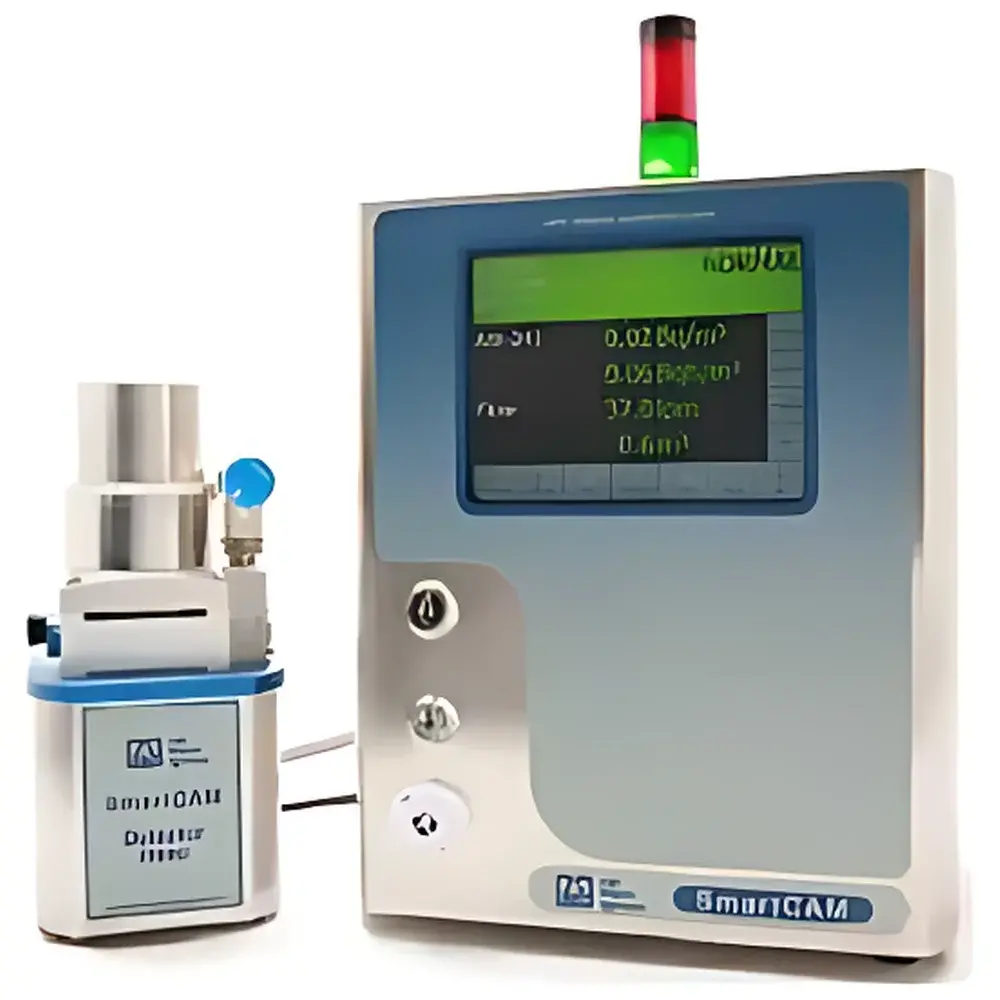
Labimpex Systems SmartCam Advanced Continuous Airborne Aerosol Monitor
| Origin | UK |
|---|---|
| Manufacturer Type | Distributor |
| Origin Category | Imported |
| Model | SmartCam |
| Pricing | Upon Request |
| Instrument Type | Dose Rate / Activity Concentration Meter |
| Detector | Dual 450 mm² PIPS Silicon Detectors |
| Filter Options | Card-Type or Strip-Type Filter Cartridge |
| Pump Flow Rate | Adjustable 20–50 L/min (Typ. 37 L/min) |
| MCA Channels | 1024 |
| Display | 132 × 100 mm Backlit LCD Touchscreen |
| Alpha Range | 10⁻² – 10⁵ Bq/m³ |
| Beta Range | 1 – 10⁷ Bq/m³ |
| Detection Efficiency | ~25% (Am-241, Sr-90/Y-90) |
| Background Compensation | Dynamic Rn/Tn Peak Fitting + γ-Anti-coincidence |
| Data Interfaces | RS232/RS485, TCP/IP, Digital Output |
| Operating Temp | −10 °C to +50 °C |
| Base Unit Dimensions | 256 × 192 × 432 mm |
| Base Unit Weight | 6.5 kg |
| Card-Type Probe | 120 × 127 × 272 mm / 3.5 kg |
| Strip-Type Probe | 256 × 182 × 260 mm / 4.5 kg |
Overview
The Labimpex Systems SmartCam Advanced Continuous Airborne Aerosol Monitor is a high-sensitivity, real-time alpha and beta activity concentration measurement system engineered for regulatory compliance, nuclear facility monitoring, environmental surveillance, and emergency response applications. It operates on the principle of continuous air sampling through a precision-controlled flow path onto a moving or static filter medium, followed by in situ alpha/beta spectrometry using two large-area (450 mm² each) Passivated Implanted Planar Silicon (PIPS) detectors. Unlike conventional gross-counting monitors, SmartCam implements real-time pulse-height analysis with 1024-channel multichannel scaling (MCA), enabling nuclide-specific identification via peak-fitting algorithms—particularly critical for discriminating short-lived radon (²²²Rn) and thoron (²²⁰Rn) progeny from target isotopes such as ²³⁹Pu, ²⁴¹Am, or ⁹⁰Sr/⁹⁰Y. Its integrated environmental sensor suite continuously measures ambient temperature and pressure to correct for spectral drift, ensuring long-term energy calibration stability without manual intervention.
Key Features
- Dual high-efficiency PIPS detectors with optimized geometry for maximum solid-angle coverage and low-energy alpha detection (≥25% efficiency for ⁵.⁶ MeV alpha from ²⁴¹Am)
- Real-time alpha/beta spectral acquisition and dynamic peak fitting—enabling automated Rn/Tn progeny subtraction and reducing false alarm rates by >90% compared to fixed-threshold systems
- Intelligent flow control architecture with carbon-vane pump (57 L/min max, adjustable 20–50 L/min) and laminar-flow conditioning to ensure uniform particle deposition and reproducible collection efficiency
- Embedded Windows CE OS with intuitive 132 × 100 mm resistive touchscreen interface—supporting on-device configuration, live spectrum visualization, and alarm threshold setting across user-defined energy windows
- Modular probe design: detachable probe unit connected via 6-meter shielded cable—enabling remote deployment in hot cells, gloveboxes, or elevated sampling locations while maintaining full spectral fidelity
- Flexible filtration options—card-type cartridges for discrete grab sampling or strip-type continuous tape feed for unattended 7-day operation with auto-advance and timestamped archive
Sample Compatibility & Compliance
SmartCam is validated for airborne particulate monitoring of radioactive aerosols across ISO 2889:2010 (nuclear facility air sampling), IEC 63006:2019 (radiation protection instrumentation), and ANSI N42.22-2020 (performance criteria for radionuclide identification). Its dual-detector geometry and anti-coincidence gamma compensation meet the background rejection requirements specified in IAEA Safety Standards Series No. RS-G-1.8 for continuous environmental monitoring. The system supports traceability under GLP and 21 CFR Part 11-compliant data logging when paired with optional audit-trail-enabled software. Calibration is traceable to NPL (UK) and PTB (Germany) reference sources, with documented linearity over five orders of magnitude (10⁻² to 10⁵ Bq/m³ for alpha emitters).
Software & Data Management
The SmartCam firmware includes embedded spectral processing routines for automatic energy calibration, peak centroid tracking, and isotope-specific activity calculation per ICRP Publication 137 methodology. Raw spectra and processed results are exportable via RS232/RS485 serial interface or Ethernet (TCP/IP) to central SCADA or LIMS platforms. Optional SmartCam Connect software provides remote diagnostics, multi-instrument fleet management, configurable alarm escalation (email/SMS), and PDF report generation compliant with EURATOM Directive 2013/59. All spectral data include embedded metadata (flow rate, T/P, filter ID, UTC timestamp), satisfying ALARA documentation requirements and facilitating retrospective dose reconstruction.
Applications
- Continuous stack emission monitoring at nuclear power plants and reprocessing facilities per 10 CFR 50 Appendix I and EU Directive 2013/59/Euratom
- Workplace air monitoring in radiopharmaceutical manufacturing, cyclotron labs, and decommissioning sites
- Environmental baseline surveys and post-incident atmospheric dispersion modeling support
- Mobile deployment on survey vehicles or UAV-mounted configurations (with custom mounting kit)
- Research applications requiring time-resolved aerosol speciation—e.g., distinguishing volcanic ash radioactivity from anthropogenic fallout
FAQ
Does SmartCam require periodic recalibration with radioactive standards?
No—its real-time temperature/pressure compensation and self-calibrating MCA eliminate the need for routine source-based recalibration. Annual verification against certified check sources is recommended for QA/QC.
Can SmartCam distinguish between ²¹⁰Po and ²³⁹Pu based on alpha spectra?
Yes—its 15 keV FWHM energy resolution at 5.3 MeV enables clear separation of ²¹⁰Po (5.305 MeV) and ²³⁹Pu (5.157 MeV) peaks, provided sufficient counting statistics (>1000 net counts per peak).
Is the system compatible with existing plant-wide radiation monitoring networks?
Yes—native Modbus TCP and OPC UA support allow seamless integration with Siemens Desigo, Honeywell Experion, or Emerson DeltaV DCS environments.
What maintenance intervals are required for the pump and filter mechanism?
Carbon-vane pump service is recommended every 12 months or after 5000 operating hours; filter cartridge replacement frequency depends on aerosol loading but averages 2–7 days for strip-type and 1–3 weeks for card-type under typical urban background conditions.
Does SmartCam support external gamma detector integration?
Yes—an optional NaI(Tl) or LaBr₃(Ce) scintillation module can be daisy-chained via the same RS485 bus for simultaneous alpha/beta/gamma spectroscopy and coincidence rejection.







