
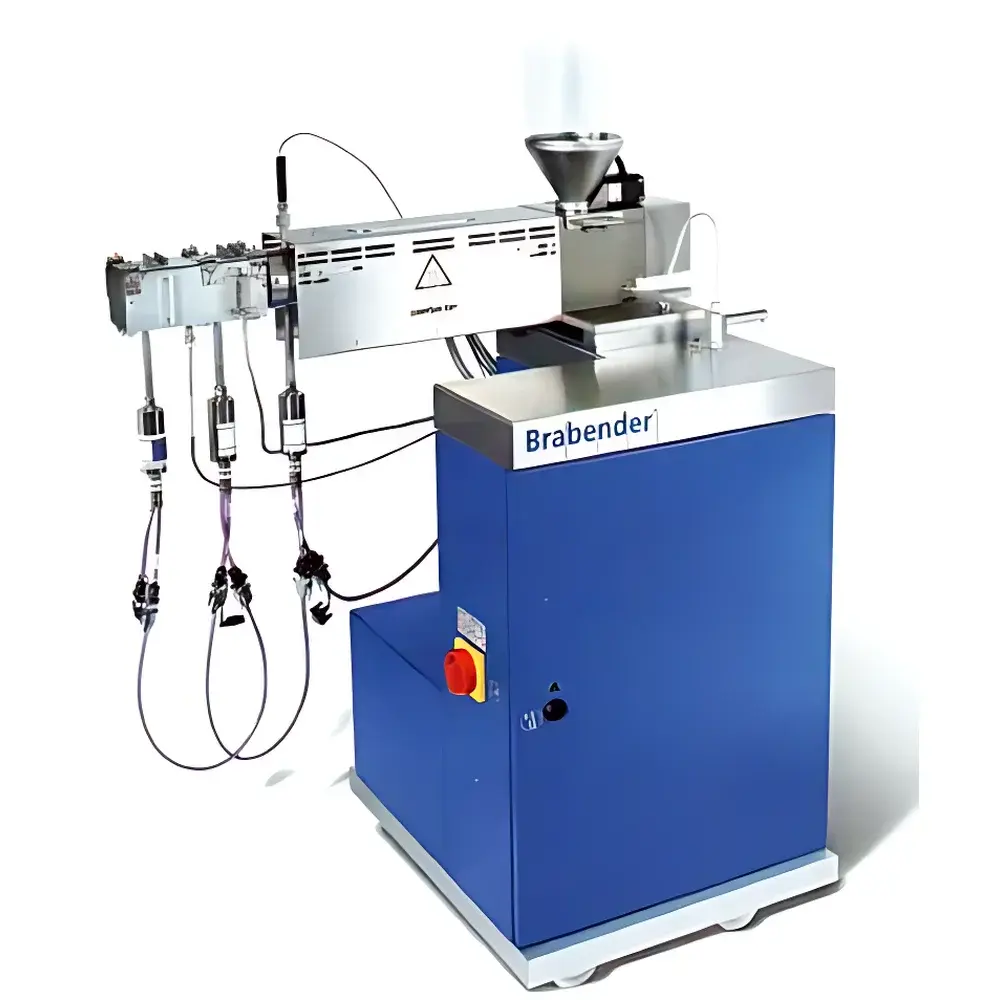
Brabender Extrusiograph 19/25 D Laboratory-Scale Measuring Extruder
| Origin | Germany |
|---|---|
| Manufacturer Type | Authorized Distributor |
| Origin Category | Imported |
| Model | Extrusiograph 19/25 D |
| Pricing | Upon Request |
Overview
The Brabender Extrusiograph 19/25 D is a precision-engineered, laboratory-scale measuring extruder designed to replicate industrial single-screw extrusion processes under controlled, reproducible conditions. Operating on the principle of torque-controlled melt extrusion, it enables real-time quantification of polymer rheological behavior—including melt viscosity, thermal stability, and flow consistency—during plastication and die extrusion. Integrated into the Brabender Plasti-Corder or Plastograph EC plus modular workstation, the Extrusiograph functions as a fully interchangeable measurement head, supporting method development, raw material qualification, formulation optimization, and QC/QA validation in rubber, thermoplastic, and advanced ceramic processing. Its 19 mm barrel diameter and 25D (475 mm) effective screw length provide sufficient residence time and shear history to emulate production-scale melt homogenization while maintaining scalability for small-batch R&D.
Key Features
- Modular integration with Brabender Plasti-Corder and Plastograph EC plus platforms for synchronized torque, temperature, pressure, and throughput data acquisition
- 6 standardized ½-20 UNF threaded ports along the barrel for flexible placement of thermocouples, pressure transducers, and melt temperature sensors
- Vibratory feed hopper with optional auger-fed configuration; feed zone geometry supports interchangeable conical or cylindrical designs for tailored solids conveying
- Electronically coupled torque transmission system protecting both drive motor and extruder head from overload-induced mechanical failure
- Stainless steel barrel with precision-machined flight geometry; compatible with interchangeable screw configurations (e.g., barrier, mixing, venting) and die assemblies (Garvey-type, capillary, slit)
- Real-time data logging at user-defined intervals (≥1 Hz), with simultaneous graphical display and tabular export in CSV or Excel-compatible formats
Sample Compatibility & Compliance
The Extrusiograph 19/25 D accommodates a broad spectrum of processable materials—including thermoplastics (PP, PE, PS, PC), elastomers (SBR, EPDM, TPE), filled compounds (CaCO₃, TiO₂, carbon black), and highly viscous pastes (ceramic slips, battery electrode slurries). Its design conforms to ASTM D2538 (Standard Test Method for Melt Flow Rates of Thermoplastics), ISO 1133 (Plastics — Determination of the Melt Mass-Flow Rate), and supports GLP-compliant workflows when used with Brabender’s validated software suite. All hardware components meet CE and RoHS directives; sensor interfaces comply with IEC 61000-4 electromagnetic compatibility standards.
Software & Data Management
Data acquisition and analysis are managed via Brabender’s WinPC software, which provides synchronized multi-channel visualization (torque vs. time, melt temperature vs. position, pressure gradient profiles), automatic peak detection, and statistical reporting (mean, standard deviation, CV%). The software supports audit trail functionality compliant with FDA 21 CFR Part 11 requirements when deployed on validated Windows environments. Exported datasets retain full metadata (operator ID, date/time stamp, instrument calibration status, environmental conditions), enabling traceability across R&D, pilot-scale trials, and regulatory submissions. Raw binary files (.brd) are archivable and convertible to open formats for third-party rheological modeling (e.g., POLYFLOW, MATLAB).
Applications
- Quantitative assessment of polymer melt homogeneity, gel content, and pigment dispersion efficiency using extrudate visual analysis (gloss, streaking, transparency) alongside instrumental metrics
- Evaluation of thermal degradation onset during extended residence time testing at elevated barrel temperatures
- Characterization of filler-matrix interaction via torque hysteresis analysis and die pressure fluctuations
- Optimization of screw design parameters (compression ratio, L/D, mixing element placement) through comparative extrusion trials
- Pre-validation of formulations prior to pilot-line trials—reducing scale-up risk and raw material waste
- Mechanical property correlation studies using post-extruded strands for tensile, impact, or rheological testing (e.g., dynamic mechanical analysis)
FAQ
What distinguishes the Extrusiograph 19/25 D from conventional capillary rheometers?
Unlike capillary systems that measure only steady-state flow resistance, the Extrusiograph captures transient plastication dynamics—including torque evolution, melt temperature gradients, and pressure build-up—across the entire extrusion cycle.
Can the Extrusiograph be used for elastomer processing?
Yes—when configured with the optional 19/10 DW configuration (shorter 10D length, feed roller, needle barrel), it delivers optimized shear control for low-viscosity, high-elasticity materials such as natural rubber and silicone compounds.
Is the system suitable for ceramic paste extrusion?
The 19/20DN variant—with its grooved barrel, pneumatic feeding, and liquid heating jacket—is specifically engineered for heat-sensitive, high-solid-content pastes common in structural ceramics and additive manufacturing feedstocks.
How is calibration maintained across multiple operators and test sessions?
Torque and temperature sensors are traceably calibrated per ISO/IEC 17025 protocols; software enforces user-specific login credentials and session-based calibration verification before each run.
Are replacement screws and dies available as spare parts?
Brabender supplies certified OEM screws (standard, barrier, mixing), die inserts (0.5–2.0 mm capillaries, slit dies), and barrel liners with documented dimensional tolerances and surface finish specifications (Ra ≤ 0.4 µm).




