
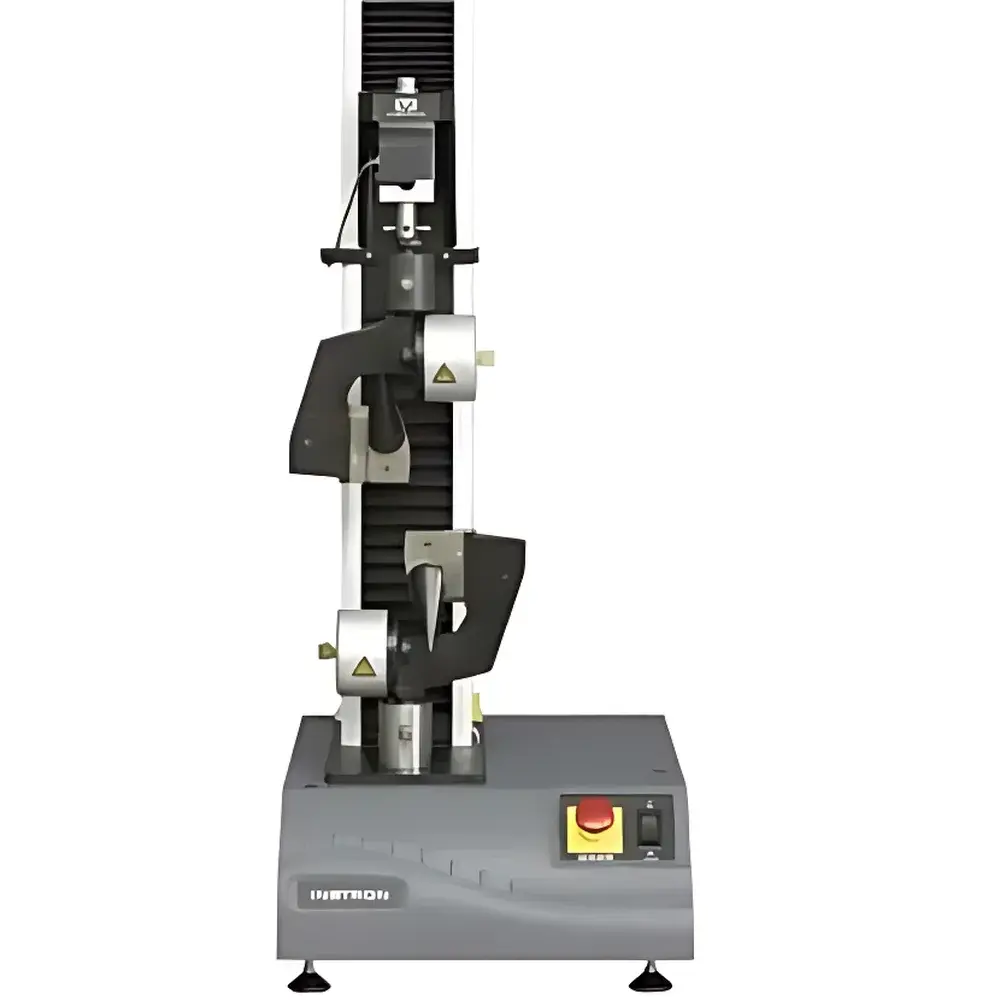
Instron 3340 Series Single-Column Electromechanical Tensile and Compression Testing System
| Brand | Instron |
|---|---|
| Origin | USA |
| Model | 3340 |
| Load Capacity Options | 0.5 kN, 1 kN, 2 kN, 5 kN |
| Vertical Test Space | 651–1383 mm |
| Force Accuracy | ±0.5% of indicated load |
| Force Resolution | 100:1 (down to 1.0% of sensor capacity without loss of accuracy) |
| Data Acquisition Rate | 500 Hz (with Bluehill 3 or Bluehill LE software) |
| Compliance | CE-marked |
| Sensor Recognition | Automatic |
| Software Control | Full PC-based control with optional cyclic testing capability |
Overview
The Instron 3340 Series is a precision-engineered single-column electromechanical testing system designed for routine tensile, compression, and flexural testing applications where force requirements remain below 5 kN (1,100 lbf). Built on Instron’s legacy of mechanical integrity and metrological traceability, the 3340 platform employs a high-rigidity aluminum column, brushless AC servo motor drive, and precision ball-screw actuation to deliver consistent crosshead motion, minimal deflection under load, and high positional repeatability. Its open-front architecture enables unobstructed sample access—critical for rapid specimen mounting, in-situ observation, and integration with auxiliary equipment such as extensometers, video gauging systems, or environmental chambers. The system operates under closed-loop displacement, load, or strain control, satisfying ASTM E4, ISO 7500-1, and ISO 5893 verification requirements for force measurement systems. As a Class 1 testing machine per ISO 7500-1, it supports both quality assurance workflows in manufacturing environments and standardized material characterization in academic and industrial laboratories.
Key Features
- 100:1 usable force range: Load cells maintain full accuracy down to 1.0% of rated capacity—eliminating the need for multiple sensors across varying test loads.
- ±0.5% force accuracy over the entire calibrated range, verified per ISO 7500-1 Annex B protocols.
- 500 Hz real-time data acquisition ensures high-fidelity capture of transient mechanical responses, including yield onset, necking behavior, and fracture events.
- Automatic load cell recognition via digital communication interface reduces setup time and eliminates manual calibration entry errors.
- Modular base design accommodates a broad portfolio of Instron-certified grips—including pneumatic, wedge, hydraulic, and custom fixtures—as well as accessories such as environmental chambers (−70 °C to +300 °C), video extensometers, and digital image correlation (DIC) mounts.
- CE-compliant construction with integrated safety interlocks, emergency stop circuitry, and mechanical overload protection aligned with EN ISO 12100 and EN 61000-6-2/6-3 electromagnetic compatibility standards.
Sample Compatibility & Compliance
The 3340 series supports specimens ranging from thin polymer films (<0.1 mm) to rigid composites and metallic coupons up to 1383 mm in height. Its low-profile base and vertical travel options (651 mm to 1383 mm) accommodate diverse geometries—such as ASTM D638 dogbones, ISO 527 strips, or ASTM C39 concrete cylinders—without requiring reconfiguration. All standard configurations comply with GLP and GMP documentation requirements when used with Bluehill software configured for 21 CFR Part 11 compliance (audit trail, electronic signatures, user access controls). The system meets essential requirements of ISO 17025 for accredited testing laboratories performing mechanical property determinations per ASTM D882, D3039, D695, ISO 527, ISO 604, and ISO 178.
Software & Data Management
Controlled exclusively through Instron’s Bluehill 3 or Bluehill LE software platforms, the 3340 integrates seamlessly into enterprise data ecosystems. Bluehill 3 provides full method scripting, multi-step test sequences, real-time pass/fail logic, and automated report generation compliant with ISO/IEC 17025 clause 7.8.2. Both versions support raw data export in CSV, XML, and universal .udf formats compatible with MATLAB, Python (NumPy/Pandas), and statistical analysis suites. Audit trails record all operator actions, parameter changes, and calibration events with timestamped, non-erasable entries—meeting FDA 21 CFR Part 11 and EU Annex 11 validation prerequisites. Optional IQ/OQ documentation packages are available for regulated industries including medical device, aerospace, and pharmaceutical packaging.
Applications
Typical use cases include tensile strength and elongation testing of thermoplastics, elastomers, adhesives, textiles, and biomedical films; compressive modulus evaluation of foams, gels, and soft tissues; peel and shear testing of laminates and coated substrates; and cyclic fatigue characterization of consumer product components. The 3340 is widely deployed in incoming inspection labs, R&D centers, and contract testing facilities where space constraints preclude floor-standing frames but metrological rigor cannot be compromised. Its scalability—from 0.5 kN micro-force testing to 5 kN structural component evaluation—enables unified methodology across material development, process validation, and release testing.
FAQ
What load capacities are available in the 3340 series?
The 3340 platform offers four standard models: 3342 (0.5 kN), 3343 (1 kN), 3344 (2 kN), and 3345 (5 kN), each with distinct vertical travel ranges optimized for specimen geometry and fixture stack height.
Is the system compatible with third-party environmental chambers?
Yes—Instron provides mechanical and electrical interfaces for integration with commercially available temperature chambers, humidity cabinets, and solvent exposure enclosures, subject to dimensional and thermal envelope constraints.
Can Bluehill software be validated for regulated environments?
Yes—Bluehill 3 includes built-in 21 CFR Part 11 compliance features, and Instron offers IQ/OQ documentation, installation qualification templates, and on-site validation support for GxP-regulated users.
Does the 3340 support strain-controlled testing?
Strain control requires an external contact or non-contact extensometer; the base system supports analog and digital inputs from Instron 2630-series clip-on extensometers or the AT-1000 video extensometer, enabling true strain feedback loops per ASTM E83 and ISO 9513.
What maintenance intervals are recommended?
Annual verification of force calibration and system alignment is recommended; preventive maintenance—including lubrication of the ball screw, inspection of drive belts, and functional checks of safety circuits—is advised every 12 months or after 2,000 test cycles, whichever occurs first.
Related Products



