
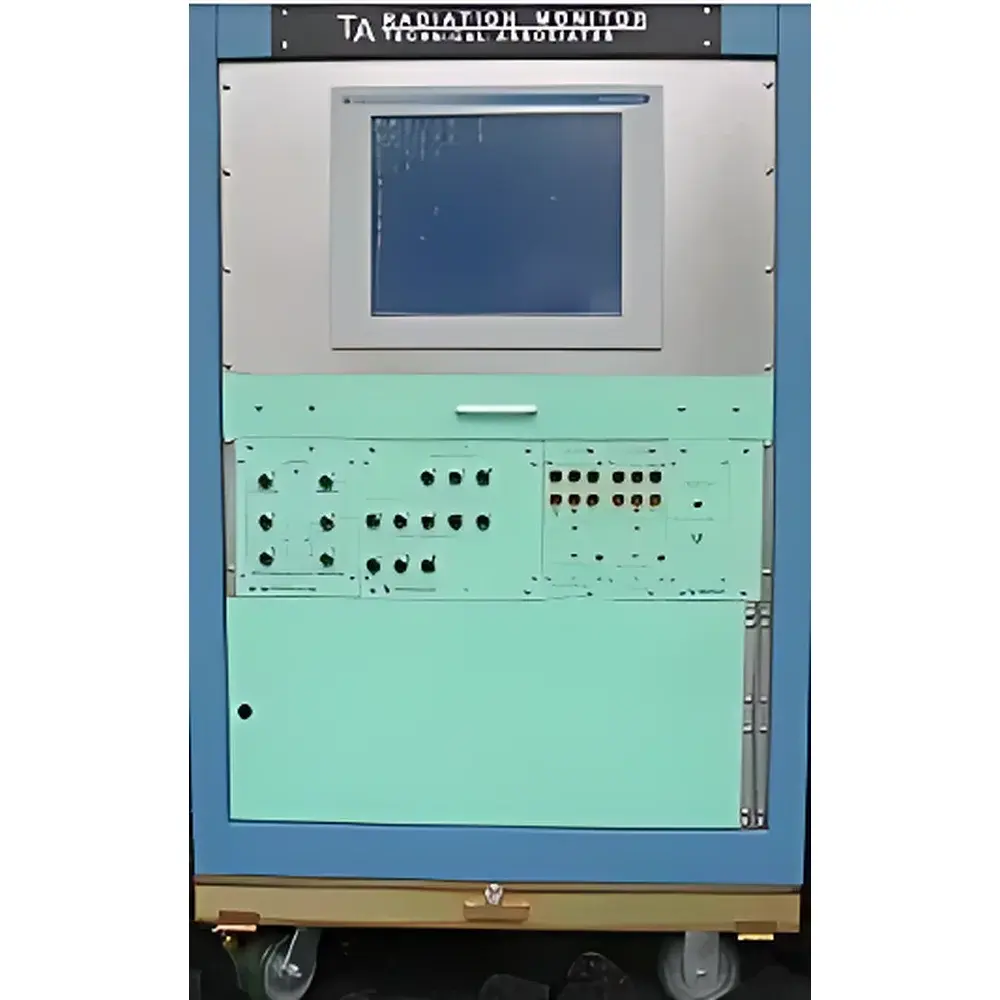
SSS-33-5FT-R Online Continuous Radioactivity Monitor for Drinking Water
| Origin | USA |
|---|---|
| Manufacturer Type | Authorized Distributor |
| Origin Category | Imported |
| Model | SSS-33-5FT-R |
| Pricing | Available Upon Request |
| Detection Capabilities | Simultaneous α, β, γ, Tritium (³H), and Radon (²²²Rn) |
| Detector Configuration | Dual scintillation detectors (α/β) + NaI(Tl) gamma detector |
| Shielding | Integrated lead shielding (≥5 cm equivalent) |
| Detector Accessibility | Modular, tool-free removal for decontamination |
| Flow Rate Range | 0.1–1.0 L/min |
| Minimum Detectable Activity (24-h integration) | α: 1.0 × 10⁴ pCi/L |
| β | 5.0 × 10⁴ pCi/L |
| γ | 500 pCi/L |
| ³H | 2.0 × 10⁴ pCi/L |
| ²²²Rn | 100 pCi/L |
Overview
The SSS-33-5FT-R Online Continuous Radioactivity Monitor for Drinking Water is an engineered solution for real-time, multi-nuclide radiological surveillance of potable water supplies. Designed in accordance with EPA Method 900 series guidance and aligned with IAEA Safety Standards Series No. RS-G-1.7 (Monitoring of Radioactivity in Drinking Water), the system employs a hybrid detection architecture to quantify alpha-emitting radionuclides (e.g., ²¹⁰Po, ²³⁸U), beta-emitters (e.g., ⁹⁰Sr/⁹⁰Y, ⁴⁰K), gamma-emitting isotopes (e.g., ¹³⁷Cs, ⁶⁰Co), tritium (³H), and dissolved radon-222 (²²²Rn) in a single, continuously flowing sample stream. Unlike batch-based laboratory assays, this instrument operates on the principle of flow-through liquid scintillation counting (for α/β) combined with gamma spectrometry (via NaI(Tl) crystal), enabling dynamic, near-real-time assessment without sample concentration or chemical separation. Its deployment supports regulatory compliance with U.S. EPA Radionuclides Rule (40 CFR Part 141, Subpart I), WHO Guidelines for Drinking-water Quality (4th ed., 2017), and EU Council Directive 2013/51/Euratom.
Key Features
- Triple-mode detection architecture: Independent, co-located α/β scintillation cells and a high-efficiency NaI(Tl) gamma detector—each housed in a mechanically isolated, lead-shielded compartment (≥5 cm Pb-equivalent) to minimize cross-talk and background interference.
- Modular detector design: All detectors feature quick-release mounting and sealed optical interfaces; no tools required for removal, cleaning, or replacement—critical for maintaining operational continuity during routine decontamination or after elevated activity events.
- Controlled laminar flow path: Precision-machined PTFE and quartz wetted components ensure chemical inertness, low memory effect, and stable hydraulic residence time (±2% over 0.1–1.0 L/min range).
- Integrated spectral stabilization: Onboard temperature-compensated photomultiplier tube (PMT) gain control and automatic energy calibration using internal reference sources (²²⁶Ra check source for gamma; ²⁴¹Am for alpha) ensure long-term spectral fidelity without manual intervention.
- Ruggedized industrial enclosure: IP65-rated NEMA 4X housing with redundant power input (100–240 VAC, 50/60 Hz), surge-protected Ethernet and RS-485 ports, and optional UPS interface for unattended 24/7 operation in pump stations, treatment plants, or remote wellheads.
Sample Compatibility & Compliance
The SSS-33-5FT-R accepts raw or filtered drinking water (turbidity ≤5 NTU, total suspended solids <10 mg/L) without pretreatment. It is validated for use with chlorinated, ozonated, and UV-treated water matrices and demonstrates no measurable quenching effect across pH 6.0–8.5 and conductivity up to 1,500 µS/cm. Regulatory alignment includes full traceability to NIST-traceable standards (SRM 4351B for alpha, SRM 4357 for beta/gamma), documented uncertainty budgets per ISO/IEC 17025:2017, and audit-ready data logs compliant with FDA 21 CFR Part 11 (electronic records/signatures) and EU Annex 11 (computerized systems). System validation reports include performance qualification (PQ) protocols covering linearity (R² ≥0.999), reproducibility (RSD ≤5% at MDA), and detection limit verification per ASTM D5430-21.
Software & Data Management
The embedded firmware (v4.2+) and companion PC application (RadiMonitor Suite v3.1) provide synchronized acquisition, spectral analysis, nuclide-specific quantification, and automated reporting. Data streams are timestamped, digitally signed, and stored locally (16 GB onboard flash) with configurable cloud backup (AWS S3 or on-premise NAS). Alarm logic supports dual-threshold alerts (warning/action), email/SMS notifications via SMTP/HTTP API, and seamless integration into SCADA or LIMS platforms via Modbus TCP or OPC UA. All raw spectra, calibration logs, and maintenance records are retained for ≥36 months with immutable audit trails—including user login history, parameter changes, and detector status transitions.
Applications
- Continuous monitoring at municipal intake points, groundwater wells, and surface water abstraction sites.
- Early-warning detection following radiological incidents (e.g., nuclear facility releases, transport accidents).
- Verification of treatment efficacy (e.g., ion exchange, reverse osmosis, activated alumina) for radionuclide removal.
- Long-term trend analysis for regulatory reporting under national drinking water surveillance programs.
- Research applications in hydrogeology and environmental radioecology requiring high-temporal-resolution aqueous radionuclide flux data.
FAQ
Does the system require radioactive standards for daily calibration?
No—automatic energy and gain stabilization uses built-in reference sources; full calibration verification is recommended quarterly using NIST-traceable standard solutions.
Can it distinguish between natural and anthropogenic radionuclides?
Yes—gamma spectral deconvolution identifies specific isotopes (e.g., ⁴⁰K vs. ¹³⁷Cs); alpha/beta ratios and decay-corrected time-series analysis further support source attribution.
Is tritium detection truly direct in liquid phase?
Yes—the α/β scintillation cell uses ultra-low-background, pulse-shape-discriminating cocktail optimized for ³H’s low-energy beta (Emax = 18.6 keV), eliminating need for electrolytic enrichment.
What maintenance intervals are recommended?
Detector PMTs and scintillation cocktails require replacement every 24 months; lead shielding integrity inspection annually; flow path cleaning every 3 months in high-turbidity environments.
Is remote firmware update supported?
Yes—secure OTA updates via TLS 1.2-encrypted HTTPS; rollback capability and pre-update diagnostic validation included.







