
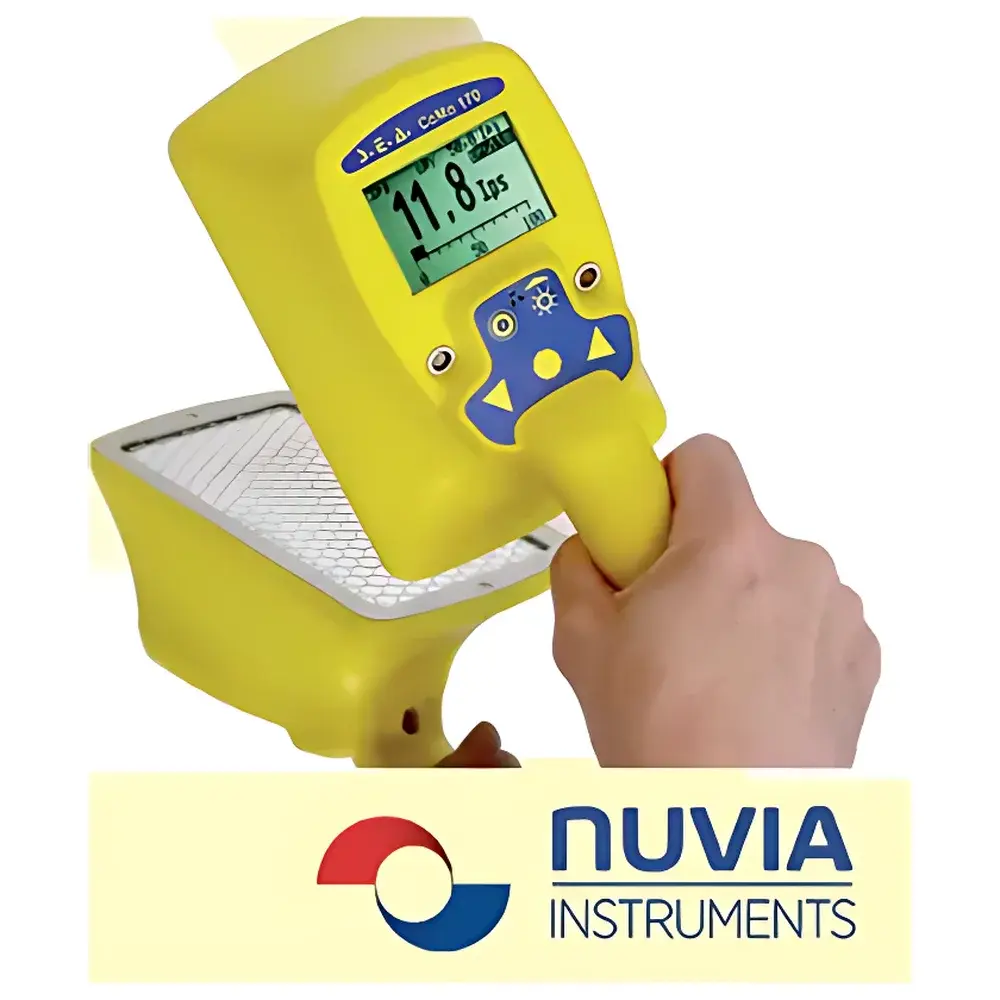
NUVIA COMO170 Surface Contamination Monitor
| Brand | NUVIA |
|---|---|
| Origin | Germany |
| Model | COMO170 |
| Instrument Type | Portable Radiation Contamination Monitor |
| Detector Type | ZnS(Ag)-coated Plastic Scintillator |
| Detection Area | 170 cm² |
| Display | 128×64 pixel backlit LCD |
| Measurement Units | cps, Bq, Bq/cm², nSv/h / µSv/h / mSv/h (with optional dose rate probe) |
| Radionuclide Library | 25 nuclides with user-defined calibration and auto-correction |
| Background Subtraction | Selectable (on/off), background measurement duration configurable |
| Measurement Modes | Fixed-time (1–9999 s) or statistical error-based termination |
| Operating Temperature | –10 °C to +40 °C (optional –20 °C variant) |
| Power Supply | 2 × AA 1.5 V alkaline or NiMH rechargeable batteries (25 h typical runtime) |
| Weight | 750 g (including batteries) |
| Dimensions | 280 × 125 × 135 mm |
| Intrinsic Alpha Efficiency (100 cm² reference) | ≥35% for ²⁴¹Am |
| Beta Efficiency (100 cm²) | ≥40% for ⁹⁰Sr/⁹⁰Y |
| Housing | Ergonomic, impact-resistant polymer casing |
| Optional Configurations | COMO170F (firefighter-optimized), COMO170D (dual-detector: scintillator + front-mounted GM tube) |
Overview
The NUVIA COMO170 is a high-sensitivity, hand-held surface contamination monitor engineered for rapid, quantitative assessment of alpha, beta, and gamma-emitting radionuclides on fixed surfaces, equipment, PPE, and swipe samples. Based on the proven principle of plastic scintillation coupled with ZnS(Ag) coating for enhanced alpha detection, the COMO170 delivers reliable, real-time activity quantification in units of counts per second (cps), becquerels (Bq), or surface-specific activity (Bq/cm²). Its 170 cm² large-area detector enables statistically robust measurements with low minimum detectable activities (MDA), critical for nuclear decommissioning, radiopharmaceutical handling, waste management, and emergency response. The instrument operates independently of external power sources and meets IEC 60846-1:2014 requirements for portable radiation monitoring devices, supporting field-deployable compliance with national radiation protection regulations.
Key Features
- Large-area (170 cm²) ZnS(Ag)-coated plastic scintillator detector optimized for simultaneous alpha/beta discrimination and high geometric efficiency
- Configurable measurement protocols: fixed-duration counting (1–9999 s) or precision-driven termination based on user-defined relative statistical uncertainty (e.g., ±5% or ±10%)
- Integrated radionuclide library with 25 preloaded isotopes—including ²³⁸U, ²³⁹Pu, ²⁴¹Am, ⁹⁰Sr/⁹⁰Y, ¹³⁷Cs, ⁶⁰Co—supporting nuclide-specific efficiency correction and automatic decay compensation
- Selectively enabled background subtraction with programmable background acquisition time (1–300 s), minimizing false positives during low-level surveys
- Real-time dual-unit display: primary readout in Bq/cm² (for smear tests) or Bq (for fixed-area surveys), with secondary dose rate indication (nSv/h, µSv/h, mSv/h) when paired with an external energy-compensated dose probe
- Rugged, ergonomic polymer housing rated IP54 for dust and splash resistance; operational range extended to –20 °C in optional cold-environment configuration
Sample Compatibility & Compliance
The COMO170 is validated for direct scanning of flat and moderately curved surfaces (e.g., stainless steel, concrete, painted metal, glass), as well as quantitative analysis of filter papers and smears (e.g., ISO 7503-1:2019 compliant wipe tests). Its detector geometry and energy response profile conform to ANSI N42.17A and IEC 62327:2017 for portable contamination monitors. All factory calibrations are traceable to national standards (PTB, NPL), and instrument performance is documented per ISO/IEC 17025 requirements. For regulated environments—including nuclear medicine departments, research reactors, and DOE-contracted facilities—the device supports GLP-compliant audit trails when used with optional PC interface software and timestamped data export.
Software & Data Management
Data acquisition, configuration, and reporting are managed via the NUVIA COMO-Link PC application (Windows 10/11 compatible). The software enables secure firmware updates, custom nuclide library editing, batch report generation (PDF/CSV), and full audit logging—including operator ID, location tag, measurement start/stop timestamps, and raw count history. Exported datasets include metadata required for regulatory submissions under 10 CFR Part 20, EURATOM Directive 2013/59, and IAEA Safety Standards Series No. GSR Part 3. Optional Bluetooth 5.0 module (COMO170-BT) permits wireless synchronization and remote configuration in hazardous or restricted-access zones.
Applications
- Nuclear facility routine contamination screening (reactor halls, hot cells, gloveboxes)
- Decommissioning site characterization and release surveys (e.g., ASTM D7282-18)
- Radiopharmaceutical production QC: vial, syringe, and fume hood surface verification
- First responder deployment for radiological incident assessment (RDD, IND scenarios)
- Regulatory compliance audits per ISO 20553:2021 (radiation protection in workplaces)
- Environmental remediation verification following uranium mining or NORM handling
FAQ
Does the COMO170 require annual recalibration?
Yes—NUVIA recommends traceable calibration every 12 months against certified reference sources (e.g., ²⁴¹Am, ⁹⁰Sr/⁹⁰Y), or after any physical damage or detector replacement, to maintain compliance with ISO/IEC 17025 and national metrology requirements.
Can it distinguish between alpha and beta emitters?
The COMO170 does not perform pulse-shape discrimination; however, its ZnS(Ag)/plastic scintillator combination provides inherent alpha sensitivity enhancement. Alpha/beta separation is achieved through selectable energy windowing and nuclide-specific calibration—validated per ISO 7503-2:2020.
Is the instrument suitable for use in explosive atmospheres?
Standard COMO170 units are not ATEX-certified. For Zone 1/2 environments, consult NUVIA’s intrinsically safe variant (COMO170-Ex, pending IEC 60079-0/11 certification).
How is measurement uncertainty reported?
Total uncertainty includes statistical counting error, detector efficiency uncertainty (±5.2% k=2), background subtraction variability, and geometry-related factors—automatically calculated and displayed alongside each result per ISO/IEC Guide 98-3 (GUM).
Related Products







