
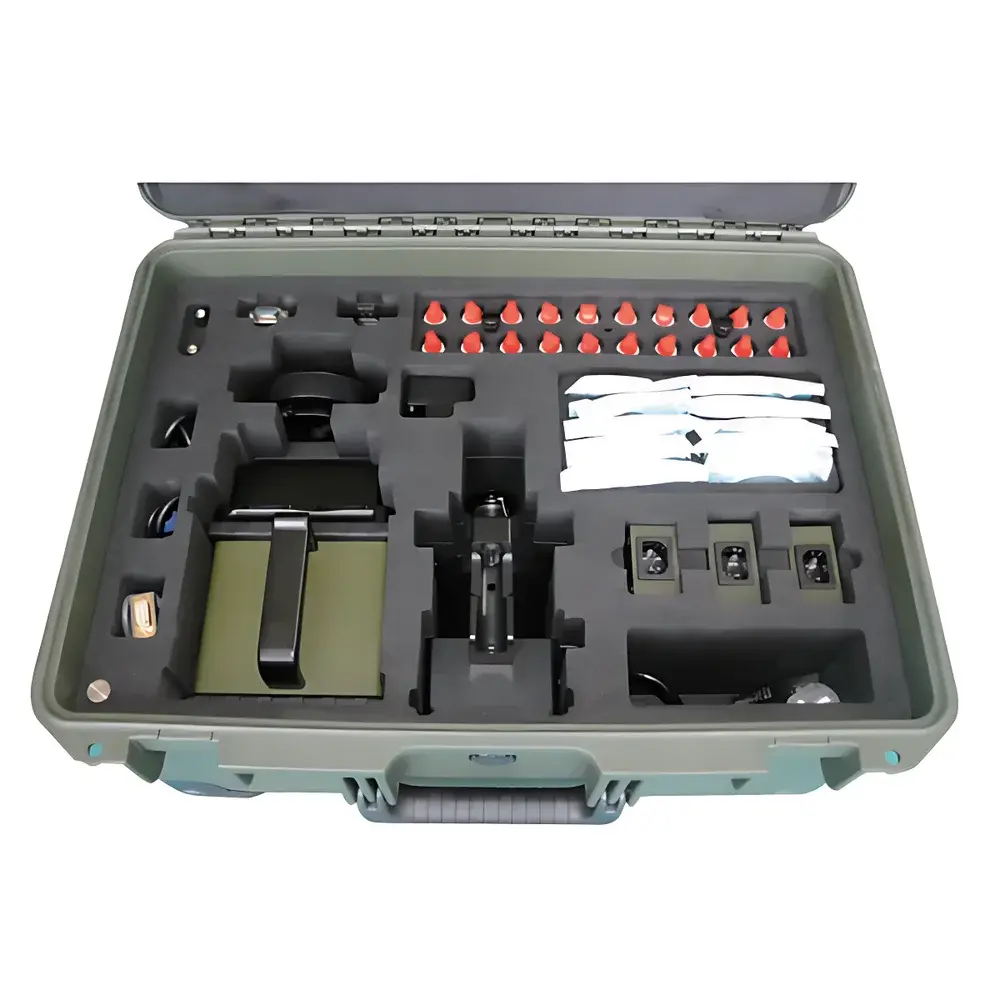
HuRongHe HRH-DSA350 High-Flow Biological Aerosol Sampler
| Brand | HuRongHe |
|---|---|
| Origin | Beijing, China |
| Model | HRH-DSA350 |
| Airflow Range | 50–400 L/min |
| Minimum Flow Rate | ≥400 L/min (at nominal operation) |
| Collection Efficiency | ≥90% for 0.5–1 μm particles |
| Sample Elution Efficiency | ≥75% (average) |
| Eluate Volume | ≤5 mL |
| Sample Generation Time | ≤1 min (liquid sample ready for downstream analysis) |
| Operating Temperature | −20 °C to +50 °C |
| Relative Humidity | ≤95% RH at 35 °C |
| Power Supply | AC 220 V / 50 Hz or DC 12 V / 24 V |
| Battery-Operated Runtime | >30 h continuous |
| Pump Lifetime | 60,000 h |
| Control Interface | Wired (RS485/Ethernet) and Wireless (Wi-Fi/Bluetooth) |
| Sampling Modes | Manual, Automatic, Hardware-Triggered, Software-Triggered |
| Collection Mechanism | Electret Filter-Based Electrostatic Capture |
Overview
The HuRongHe HRH-DSA350 High-Flow Biological Aerosol Sampler is an engineered field-deployable instrument designed for quantitative collection of airborne microorganisms—including bacteria, fungal spores, and viral particles—under real-world environmental and occupational settings. It operates on the principle of electret filter-based electrostatic capture: ambient air is drawn through a charged polypropylene electret membrane, where Coulombic and dielectrophoretic forces immobilize bioparticles across a broad aerodynamic diameter range (0.5–10 μm). Unlike impaction or impingement methods, this mechanism preserves biological viability and structural integrity, supporting both culture-based assays and molecular analyses (e.g., qPCR, metagenomic sequencing). The system integrates rapid post-sampling elution via a precision fluidic wash module, delivering a ≤5 mL liquid suspension within ≤60 seconds—enabling immediate transfer to biosafety level 2 (BSL-2) laboratories or on-site nucleic acid extraction platforms.
Key Features
- High-volume sampling capability with adjustable flow from 50 to 400 L/min, rated at ≥400 L/min under standard conditions (25 °C, 101.3 kPa), ensuring statistically robust detection limits for low-concentration bioaerosols.
- Dual-mode flow regulation: closed-loop feedback control using a brushless DC centrifugal blower, supported by integrated thermal mass flow sensor (±2% full-scale accuracy).
- Electret membrane cartridge with validated collection efficiency: ≥90% for 0.5–1 μm particles (critical for virus-laden droplet nuclei) and ≥95% for ≥2 μm particles (e.g., bacterial aggregates, mold spores), per ISO 21501-4 and ASTM D6602-22 test protocols.
- On-board elution module employing programmable peristaltic pump and optimized rinse cycle (three-stage buffer delivery), achieving ≥75% average recovery of viable and non-viable bioparticles without mechanical shear damage.
- Multi-modal triggering architecture: supports manual initiation, time-scheduled automatic cycles (with user-defined start/stop windows), hardware-level TTL pulse input (for integration with weather stations or radiation monitors), and remote software command via RESTful API.
- Robust environmental tolerance: operational across −20 °C to +50 °C and up to 95% RH at 35 °C; ingress protection rated IP54 for outdoor deployment in rain or dust-prone zones.
- Redundant power architecture: accepts AC 220 V / 50 Hz mains or field-deployable DC inputs (12 V / 24 V), enabling >30 hours of uninterrupted operation on external LiFePO₄ battery packs compliant with UN 38.3 transport standards.
Sample Compatibility & Compliance
The HRH-DSA350 is compatible with standard 15 mL and 50 mL conical centrifuge tubes, as well as custom-designed elution vials with screw-cap septa for automated liquid handling integration. Collected eluates maintain compatibility with common downstream workflows including colony-forming unit (CFU) enumeration on selective agars (e.g., TSA, SDA), immunoassay-based antigen detection, and RNA/DNA extraction kits (e.g., QIAamp UCP Pathogen, Zymo Quick-DNA/RNA Viral Kits). The device complies with ISO 14644-1 Class 5 cleanroom-compatible design principles for internal airflow path geometry and surface finish. Data logging meets GLP audit requirements with timestamped event records (sampling start/end, flow deviation alerts, power interruption flags), and firmware supports optional 21 CFR Part 11-compliant electronic signatures when paired with validated LIMS interfaces.
Software & Data Management
Device operation and monitoring are managed via the cross-platform HRH-AeroControl Suite (Windows/macOS/Linux), offering real-time telemetry visualization (flow rate, pressure drop, temperature, humidity, battery voltage), configurable sampling schedules, and export of CSV-formatted logs with UTC timestamps. Firmware v2.3+ includes MQTT client support for seamless integration into enterprise IoT infrastructure (e.g., AWS IoT Core, Azure IoT Hub). All configuration changes and sampling events are logged with immutable SHA-256 hashes for forensic traceability. Remote firmware updates are digitally signed and verified prior to installation, satisfying NIST SP 800-193 guidelines for resilient device integrity.
Applications
- Environmental surveillance of airborne pathogens near wastewater treatment plants, livestock facilities, and composting sites.
- Occupational health monitoring in pharmaceutical cleanrooms, hospital HVAC ducts, and biosafety laboratories.
- Field epidemiology during outbreak investigations involving inhalational agents (e.g., Legionella pneumophila, Aspergillus fumigatus, influenza A/H1N1).
- Validation of air disinfection technologies (UV-C, bipolar ionization, photocatalytic oxidation) per ISO 15714 and EN 17215 test frameworks.
- Long-term urban bioaerosol mapping in conjunction with meteorological data for exposure modeling (e.g., PM₂.₅–bioaerosol correlation studies).
FAQ
What biosafety level (BSL) precautions are required when operating the HRH-DSA350?
The sampler itself is classified as BSL-2 compatible equipment; however, post-sampling handling of eluates must follow institutional BSL-2 or higher protocols depending on target analyte risk group classification (e.g., WHO Risk Group 2/3 agents require BSL-3 containment during processing).
Can the electret filter be reused after elution?
No—electret membranes are single-use consumables. Reuse compromises charge stability and collection efficiency; validated replacement intervals are specified in the operator manual (typically one filter per 8-hour sampling shift under high-dust conditions).
Is calibration traceable to national standards?
Yes—mass flow sensors are factory-calibrated against NIST-traceable primary standards (NIST SRM 2999), with calibration certificates provided per unit. Annual recalibration is recommended per ISO/IEC 17025:2017 Clause 6.6.
Does the system support integration with third-party LIMS or SCADA platforms?
Yes—via Modbus TCP (RTU over Ethernet), OPC UA, or HTTP POST endpoints. Pre-built drivers are available for LabVantage, Thermo Fisher SampleManager, and Siemens Desigo CC.
What maintenance is required between sampling campaigns?
Routine inspection of inlet mesh pre-filter (cleanable stainless steel), verification of electret membrane seal integrity, and validation of elution volume accuracy using gravimetric check standards (±0.1 mL tolerance). No scheduled lubrication or pump servicing is required due to brushless motor architecture.
Related Products







