
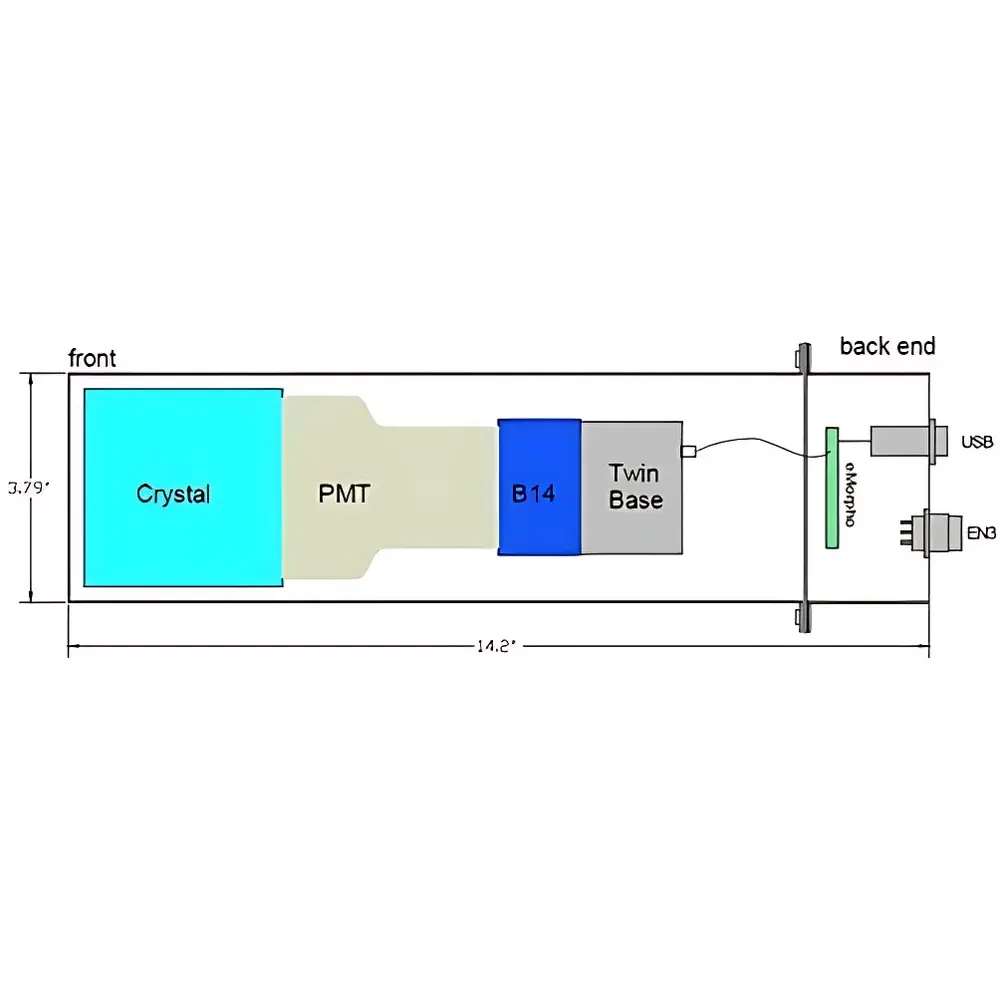
Radiation Spectrometer R2D-NaI(Tl)-3-AM
| Origin | USA |
|---|---|
| Manufacturer Type | Authorized Distributor |
| Origin Category | Imported |
| Model | R2D |
| Instrument Type | Dose Rate & Spectrometry Analyzer |
| Detector | 3" × 3" NaI(Tl) Scintillation Crystal |
| Energy Range | 40 keV – 2 MeV (adjustable) |
| Energy Resolution | ≤7.5% FWHM at 662 keV (¹³⁷Cs) |
| MCA Channels | 4096 |
| Maximum Throughput | 13 Mcps |
| Power Supply | USB-powered (140–300 mA) |
| Integral Nonlinearity | ≤±0.05% |
| Differential Nonlinearity | ≤1% |
| Shielding | LX705S Lead Castle — 125 mm electrolytic high-purity lead, 3 mm oxygen-free copper inner liner, lever-actuated hinged door |
Overview
The R2D-NaI(Tl)-3-AM is a high-sensitivity gamma-ray spectrometer engineered for rapid, automated radionuclide identification and quantitative activity measurement in environmental and food safety laboratories. It operates on the principle of scintillation spectroscopy: incident gamma photons interact with a thallium-doped sodium iodide [NaI(Tl)] crystal, generating light pulses proportional to photon energy. These pulses are converted to digital signals via a fully integrated, firmware-controlled multichannel analyzer (MCA), enabling real-time spectral acquisition and analysis without external hardware configuration. Designed for compliance with ISO 11929 (evaluation of measurement uncertainty in radioactivity), ASTM D3648 (standard test methods for radioactivity in water), and IAEA Safety Standards Series No. RS-G-1.7 (environmental monitoring), the system delivers trace-level detection capability across complex matrices—soil, sediment, liquid effluents, agricultural commodities, meat, seafood, and fresh produce—without sample pre-concentration under routine conditions.
Key Features
- High-efficiency 3″ × 3″ NaI(Tl) scintillation detector with optimized light collection geometry and thermally stabilized photomultiplier tube coupling
- Energy resolution ≤7.5% FWHM at 662 keV (¹³⁷Cs), meeting performance benchmarks for field-deployable gamma spectrometry per ANSI N42.14
- 4096-channel MCA architecture supporting high-throughput spectral accumulation (up to 13 million counts per second) with dead-time correction and pile-up rejection algorithms
- Fully software-defined operation: all acquisition parameters—including gain, offset, shaping time, and live-time gating—are configurable via PC interface without physical adjustments
- Time-stamped spectral acquisition mode enables dynamic monitoring applications such as airborne plume tracking or sequential batch analysis in regulatory screening workflows
- USB-powered design (140–300 mA draw) eliminates need for external power supplies; compatible with laptop-based mobile labs and battery-backed field stations
- LX705S shielding enclosure featuring 125 mm thick electrolytic high-purity lead (≥99.99% Pb) and 3 mm oxygen-free copper inner liner to suppress background continuum and characteristic X-ray escape peaks
Sample Compatibility & Compliance
The R2D-NaI(Tl)-3-AM accommodates standard geometries including 100 mL Marinelli beakers, 500 mL cylindrical containers, and planchet-mounted solid samples up to 15 cm diameter. Its low-background shielding and calibrated efficiency curves support quantitative analysis per ISO/IEC 17025-accredited methods. The system meets requirements for routine surveillance under EU Council Regulation (Euratom) No. 3954/87 and FDA’s Import Alert 99-05 (Radioactive Contamination in Food). All spectral processing routines adhere to NIST-traceable calibration protocols, and raw data files retain full metadata (acquisition time, HV setting, temperature logs) required for GLP audit trails.
Software & Data Management
Control and analysis are performed using GammaVision-compatible software compliant with FDA 21 CFR Part 11 (electronic records and signatures). The application provides automated peak search, nuclide library matching (IAEA NuDat 3.0–based), self-absorption correction for heterogeneous samples, and customizable reporting templates aligned with EPA Method 901.0 and ISO 11704. Spectral data are stored in standard .cnf and .spc formats; audit logs record user actions, parameter changes, and calibration events with timestamped digital signatures. Export options include CSV, PDF, and XML for integration into LIMS platforms.
Applications
- Post-incident environmental monitoring following nuclear facility incidents or orphan source discoveries
- Routine screening of imported foodstuffs for ¹³⁷Cs, ⁴⁰K, ²²⁶Ra, and natural series radionuclides
- Soil and sediment characterization in decommissioning projects (e.g., NRC License Termination Plans)
- Validation of decontamination efficacy in remediation sites
- Research-grade gamma spectroscopy in university nuclear engineering and health physics programs
- QA/QC for radiopharmaceutical production facilities requiring dose uniformity verification
FAQ
Is the R2D-NaI(Tl)-3-AM suitable for laboratory accreditation under ISO/IEC 17025?
Yes—the system includes factory-certified energy and efficiency calibrations traceable to NIST SRM 4353B and supports documented uncertainty budgets per ISO/IEC 17025 Clause 7.6.
Can it distinguish between ¹³⁷Cs and ⁶⁰Co in mixed spectra?
Yes—its 7.5% resolution at 662 keV and 4096-channel digitization enable clear separation of 662 keV (¹³⁷Cs) and the 1173/1332 keV doublet (⁶⁰Co) with validated peak deconvolution algorithms.
Does the LX705S shield meet ANSI N42.17B background requirements?
Yes—the measured background count rate in the 40–2000 keV window is ≤2.1 cps after 24-hour stabilization, satisfying ANSI N42.17B Class A specifications for portable spectrometers.
Is USB power sufficient for continuous 24/7 operation?
Yes—thermal management and low-noise circuit design ensure stable MCA performance over extended acquisitions; typical power consumption remains within USB 2.0 specification limits (500 mA @ 5 V).
What software validation documentation is provided?
A complete Software Validation Package (SVP) is supplied, including IQ/OQ protocols, traceability matrix to 21 CFR Part 11 Annex 11, and version-controlled release notes.







