
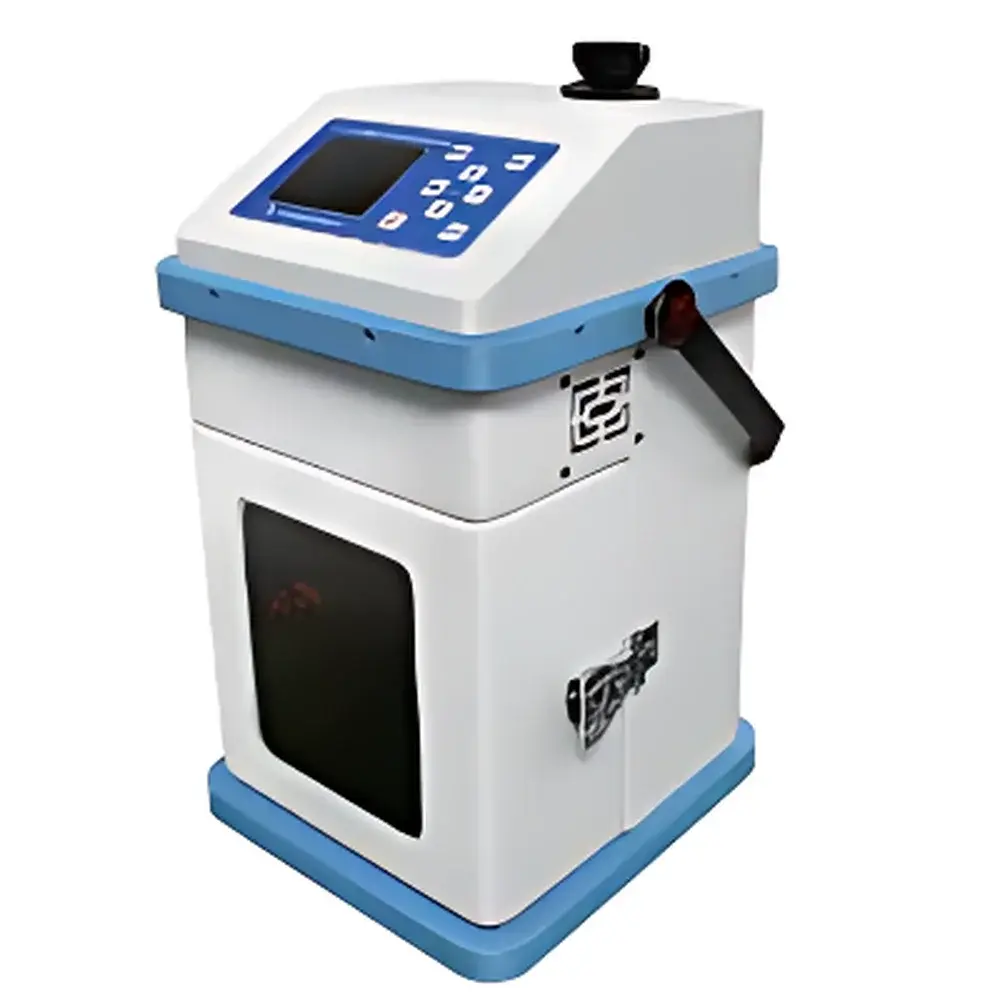
Huironhe HRH-BSA320 High-Flow Biological Aerosol Sampler
| Brand | Huironhe |
|---|---|
| Model | HRH-BSA320 |
| Sampling Principle | Wet-Wall Cyclonic Liquid-Film Collection |
| Max Flow Rate | ≥320 L/min |
| Sample Volume per Run | ≤5 mL |
| Sampling Duration | 1 min – 5 h (adjustable) |
| Liquid Reservoir Capacity | ≥500 mL |
| Wet-Wall Cyclone Chamber Liquid Film Thickness | 0.1–1 mm |
| Gas–Liquid Contact Area | ≥200 cm² |
| Cyclone Fan Speed | ≥10,000 rpm |
| Droplet Separation Rotor Speed | ≥100 rpm |
| Operating Temperature | 0–46 °C |
| Battery Runtime | ≥5 h |
| Unit Weight | ≤8 kg |
| Dimensions (L×W×H) | ≤250×240×420 mm |
| Cleaning & Maintenance | Automated inter-sample rinse and scheduled maintenance cycles |
| Sterilization Compatibility | Hydrogen Peroxide vapor (HPV), 5% Sodium Hypochlorite |
| Control Modes | Manual, Remote IR, Scheduled Auto-Run, Cloud-Connected Remote Management |
Overview
The Huironhe HRH-BSA320 is a high-flow, wet-wall cyclonic biological aerosol sampler engineered for quantitative collection of airborne microorganisms—including bacteria, fungi, viruses, and spores—into liquid suspension suitable for downstream molecular analysis (e.g., qPCR, RNA/DNA sequencing), culture-based isolation, and viability assessment. Unlike dry impaction or filtration methods, the HRH-BSA320 employs a precisely controlled wet-wall cyclonic liquid-film mechanism: aerosol-laden air is tangentially introduced into a rotating cylindrical chamber where centrifugal force drives particles toward a continuously replenished liquid film lining the inner wall. This ensures near-quantitative particle capture efficiency across a broad aerodynamic diameter range (0.5–10 µm), minimizes desiccation-induced viability loss, and delivers collected biomass directly into a stable aqueous matrix. The system’s design prioritizes biocontainment integrity, operational repeatability, and compatibility with standardized environmental monitoring workflows in biosafety laboratories, pharmaceutical cleanrooms, field epidemiology, and biodefense surveillance.
Key Features
- High-throughput sampling at ≥320 L/min—enabling statistically robust detection of low-concentration bioaerosols within clinically or environmentally relevant timeframes.
- Dynamic wet-wall cyclone with programmable liquid film thickness (0.1–1 mm) and ≥200 cm² effective gas–liquid interfacial area, optimizing particle inertial impaction and diffusion-driven deposition.
- Integrated liquid reservoir (≥500 mL) with closed-loop auto-replenishment to compensate for evaporation during extended runs (up to 5 h), maintaining consistent collection efficiency.
- Dual-stage fluidic management: (1)旁路 liquid recirculation loop for targeted enrichment of low-abundance analytes; (2) high-speed droplet separation rotor (≥100 rpm) minimizing carryover of entrained liquid into exhaust airflow.
- Intelligent automation suite: fully programmable sampling schedules, delayed start, customizable rinse cycles between samples, and self-initiated maintenance routines after predefined operational hours.
- Ruggedized portable architecture: total mass ≤8 kg; compact footprint (≤250×240×420 mm); wide operating temperature range (0–46 °C); and ≥5-hour battery autonomy for unattended field deployment.
- Multi-mode control interface supporting local keypad operation, infrared remote, timed autonomous execution, and secure cloud-based remote configuration via encrypted TLS-enabled API.
Sample Compatibility & Compliance
The HRH-BSA320 is validated for collection of viable and non-viable biological particulates from ambient, indoor, and controlled-environment air streams. Collected eluates are compatible with ISO 14698-1:2003 (Biocontamination control), ISO 21501-4 (Particle size distribution calibration), and USP sterility testing sample preparation protocols. Its materials-of-construction (316L stainless steel wet-wall chamber, medical-grade silicone tubing, PTFE-coated internals) resist degradation under repeated exposure to 5% sodium hypochlorite and hydrogen peroxide vapor (HPV)—both recognized decontamination agents under CDC/NIH BSL-2+ and EU GMP Annex 1 requirements. The device supports audit-ready data integrity through time-stamped event logs, user-access controls, and optional 21 CFR Part 11-compliant electronic signatures when integrated with validated LIMS platforms.
Software & Data Management
Embedded firmware provides real-time monitoring of flow rate stability, liquid level, motor RPMs, battery status, and thermal conditions. All operational parameters—including start/stop timestamps, duration, volume consumed, and maintenance alerts—are logged locally with microSD backup and synchronizable to centralized servers via Wi-Fi or Ethernet. Optional software modules enable automated report generation (PDF/CSV), trend analysis of historical sampling campaigns, and integration with laboratory information management systems (LIMS) using HL7 or ASTM E1384-compliant messaging. Firmware updates are delivered over-the-air (OTA) with cryptographic signature verification to ensure traceability and regulatory compliance.
Applications
- Environmental monitoring in aseptic manufacturing suites (ISO Class 5–8) per EU GMP Annex 1 and FDA Aseptic Processing Guidance.
- Field-based biothreat agent surveillance in public infrastructure, transportation hubs, and military forward operating bases.
- Longitudinal studies of airborne microbiome dynamics in hospitals, schools, and urban environments.
- Validation of HVAC filtration efficacy and cleanroom recovery testing.
- Supporting WHO-recommended airborne pathogen surveillance frameworks for influenza, SARS-CoV-2, and emerging respiratory viruses.
- Research applications requiring high-yield, low-stress bioaerosol collection for metagenomic, transcriptomic, or culturomic analysis.
FAQ
What is the minimum detectable concentration of viable bacteria achievable with the HRH-BSA320?
Detection limits depend on downstream assay sensitivity and ambient particle load; however, sampling at 320 L/min for 30 minutes yields sufficient biomass for reliable qPCR detection of Bacillus subtilis spores at concentrations ≥0.1 CFU/m³ in controlled challenge studies.
Does the instrument comply with ISO 21501-4 for particle sizing calibration?
While the HRH-BSA320 is not a particle sizer, its wet-wall cyclone geometry and flow profile have been characterized per ISO 21501-4 Annex D to establish equivalent cut-off diameters and collection efficiency curves for bioaerosol-relevant particle sizes.
Can the collected liquid be directly injected into an autosampler for LC-MS analysis?
Yes—eluates are compatible with standard autosampler vials and require no pre-filtration if particulate load is low; for high-dust environments, optional inline 0.45 µm syringe filtration is recommended prior to injection.
Is remote firmware update capability validated for GxP environments?
Firmware updates include SHA-256 hash verification and rollback protection; full validation documentation (IQ/OQ/PQ templates, change control records) is available upon request for regulated deployments.
How frequently must the wet-wall chamber be cleaned during continuous operation?
Automated cleaning initiates after each sample cycle; for multi-day unattended use, the system executes a deep-clean protocol every 8 operational hours, including ultrasonic-assisted chamber flush and rotor purge.







