
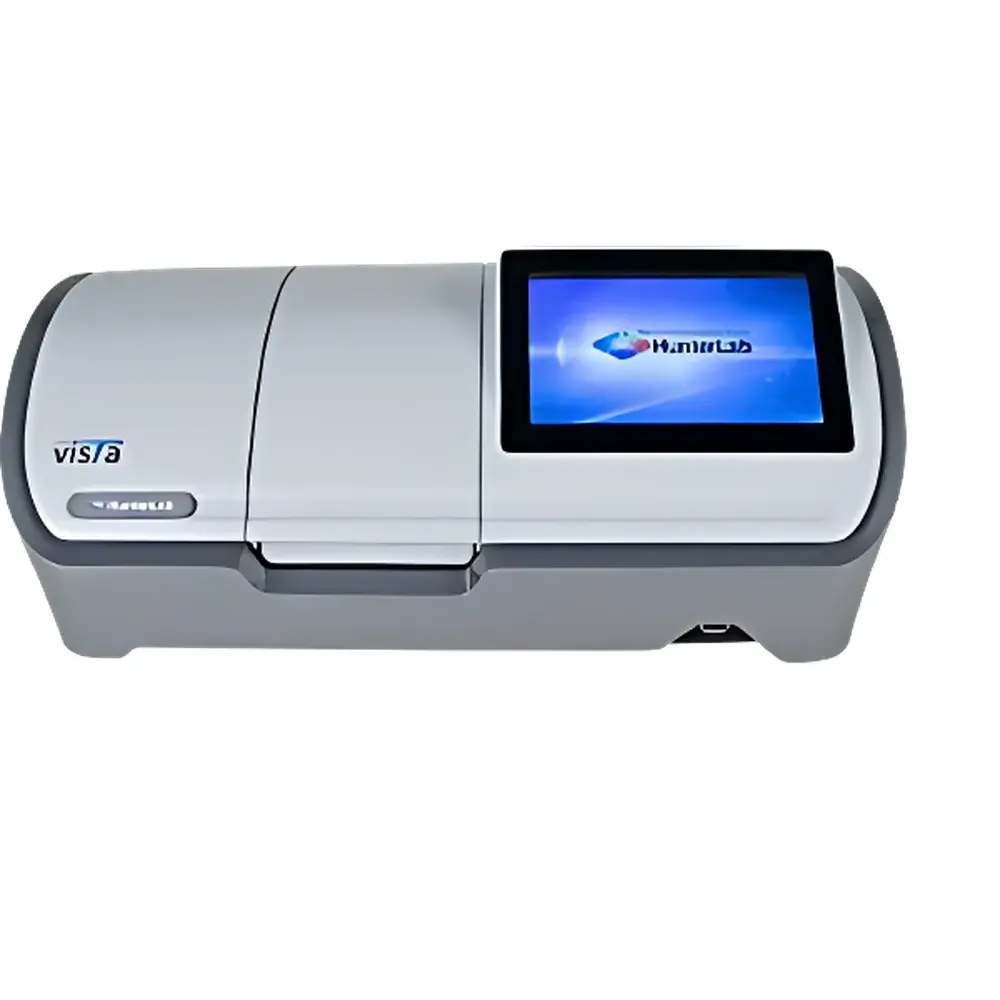
HunterLab Vista Spectrophotometer for Transmission Color and Haze Measurement of Transparent and Translucent Materials
| Brand | HunterLab |
|---|---|
| Origin | USA |
| Model | HunterLab Vista |
| Product Category | Color Difference Meter |
| Instrument Type | Benchtop (Not Online) |
| Optical Geometry | 0/45° Integrating Sphere |
| Wavelength Range | 400–700 nm |
| Repeatability | ≤0.08 ΔE*ab (Typical, Standard Illuminant D65/10°) |
| Compliance | ASTM D1003, ISO 14782, ISO 6236, USP <631>, EP 2.2.17, JP 2.07, ChP 0901 |
| Software | EasyMatch Essentials v5.x with 21 CFR Part 11 Audit Trail Option |
| Display | 7-inch capacitive touchscreen |
| Sample Chamber | Anti-spill design with integrated sample positioning guide |
| Calibration | Electronic self-calibration with NIST-traceable standards |
Overview
The HunterLab Vista Spectrophotometer is a benchtop instrument engineered for simultaneous, high-fidelity measurement of transmission color and haze in transparent and translucent materials—including clear liquids, pharmaceutical solutions, polymer films, glass, and packaging substrates. Operating on the principle of spectrophotometric analysis at 0/45° geometry with an integrating sphere detector, the Vista captures full spectral reflectance and transmittance data across the visible spectrum (400–700 nm) to compute CIE-compliant colorimetric values (L*a*b*, L*C*h*, YI, WI, etc.) and quantitative haze (%Haze) per ASTM D1003 and ISO 14782. Unlike conventional colorimeters limited to tristimulus output, the Vista acquires full 10-nm interval spectral data—enabling traceable spectral reconstruction, metamerism assessment, and compliance verification against pharmacopeial appearance specifications.
Key Features
- Single-measurement dual-output capability: Simultaneous acquisition of transmission color (CIE L*a*b*, Yellowness Index, Whiteness Index, Pt-Co/Hazen/APHA, Gardner) and haze (%Haze, Turbidity, Clarity) without reconfiguration or software switching.
- 0/45° optical geometry with large-area integrating sphere (150 mm diameter) optimized for low-scatter and high-diffuse transmittance sampling—ensuring robustness against minor sample misalignment and edge effects.
- 7-inch high-resolution capacitive touchscreen interface with customizable workspaces, drag-and-drop layout editor, and context-aware soft keys—designed for glove-compatible operation in cleanroom and QC lab environments.
- Electronic self-calibration system with internal reference tiles traceable to NIST SRM 2035 and SRM 2036; eliminates manual calibration drift and reduces daily setup time by >70% compared to mechanical standardization routines.
- Compact footprint (290 × 330 × 240 mm) and anti-spill sample chamber with precision-guided cuvette and film holder—supports 10-mm, 20-mm, 50-mm pathlength cells and flat-sheet specimens up to 100 × 100 mm.
- Built-in pharmacopeial compliance engine: Direct calculation and pass/fail reporting against USP (Clarity and Degree of Opalescence), EP 2.2.17 (Transmittance and Haze), JP 2.07 (Turbidity), and ChP 0901 (Solution Appearance).
Sample Compatibility & Compliance
The Vista accommodates a broad range of sample formats: aqueous and organic liquid solutions (e.g., APIs, excipients, solvents), rigid and flexible polymer films (PET, PP, PC), coated glass, optical lenses, and medical device packaging. Its optical architecture meets the geometric and spectral requirements of ASTM D1003 (Standard Test Method for Haze and Luminous Transmittance of Transparent Plastics), ISO 14782 (Plastics — Determination of Haze), and ISO 6236 (Optics and optical instruments — Visual quality of optical elements). For regulated industries, the instrument supports GLP/GMP workflows via optional 21 CFR Part 11-compliant firmware (electronic signatures, audit trail, user access control, and data integrity logging), and its spectral output satisfies ICH Q5E comparability criteria for visual attributes in biopharmaceutical manufacturing.
Software & Data Management
EasyMatch Essentials v5.x serves as the native software platform—deployable on Windows 10/11 systems or embedded directly on the Vista’s onboard OS. It provides real-time spectral visualization, multi-sample trending (SPC charts for YI, %Haze, ΔE*ab), batch report generation (PDF/CSV/XLSX), and automated export to LIMS via ODBC or HL7 interfaces. All spectral and color data are stored with metadata (operator ID, timestamp, instrument serial, calibration history, sample ID), and raw .spc files adhere to ASTM E2591-22 format for long-term archival and third-party reprocessing. Optional cloud synchronization enables secure cross-site method sharing and centralized instrument fleet monitoring.
Applications
- Pharmaceutical QC: Verification of solution clarity, opalescence grading, and color consistency of injectables, ophthalmic solutions, and oral suspensions per USP/EP/JP monographs.
- Chemical & Polymer Manufacturing: Monitoring yellowing index (YI) of polycarbonate sheets, haze stability of PET bottles, and spectral shift during thermal aging studies.
- Food & Beverage R&D: Objective quantification of juice browning, syrup transparency, and dairy product whey separation using turbidity-correlated indices.
- Coatings & Adhesives: Assessment of film clarity, solvent residue impact on haze, and batch-to-batch color uniformity in optically clear adhesives.
- Academic & Materials Research: Correlation of haze with crystallinity (via XRD), surface roughness (AFM), or nanoparticle dispersion homogeneity in nanocomposites.
FAQ
Does the Vista support both transmission and reflectance measurements?
No—the Vista is dedicated to transmission-mode analysis only. Its optical path and sphere configuration are optimized exclusively for transmittance, haze, and transmission color. Reflectance applications require a separate instrument such as the HunterLab UltraScan VIS.
Can the Vista measure samples with very low transmittance (e.g., <10%)?
Yes, but with defined limitations: for samples exhibiting <10% total luminous transmittance (Y < 10), haze accuracy degrades due to signal-to-noise constraints; users should validate method suitability per ASTM D1003 Annex A3 for low-transmittance materials.
Is method transfer possible between Vista units?
Yes—spectral data exchange is fully interoperable across Vista instruments when using identical firmware and EasyMatch Essentials versions; inter-instrument agreement (IIA) testing per ASTM E308-22 confirms ΔE*ab < 0.15 for standardized liquid and solid references.
What validation documentation is provided?
Each unit ships with a Factory Certificate of Conformance, NIST-traceable calibration report, IQ/OQ protocol templates (GAMP 5 aligned), and installation qualification checklists compliant with ISO/IEC 17025 laboratory accreditation requirements.




