
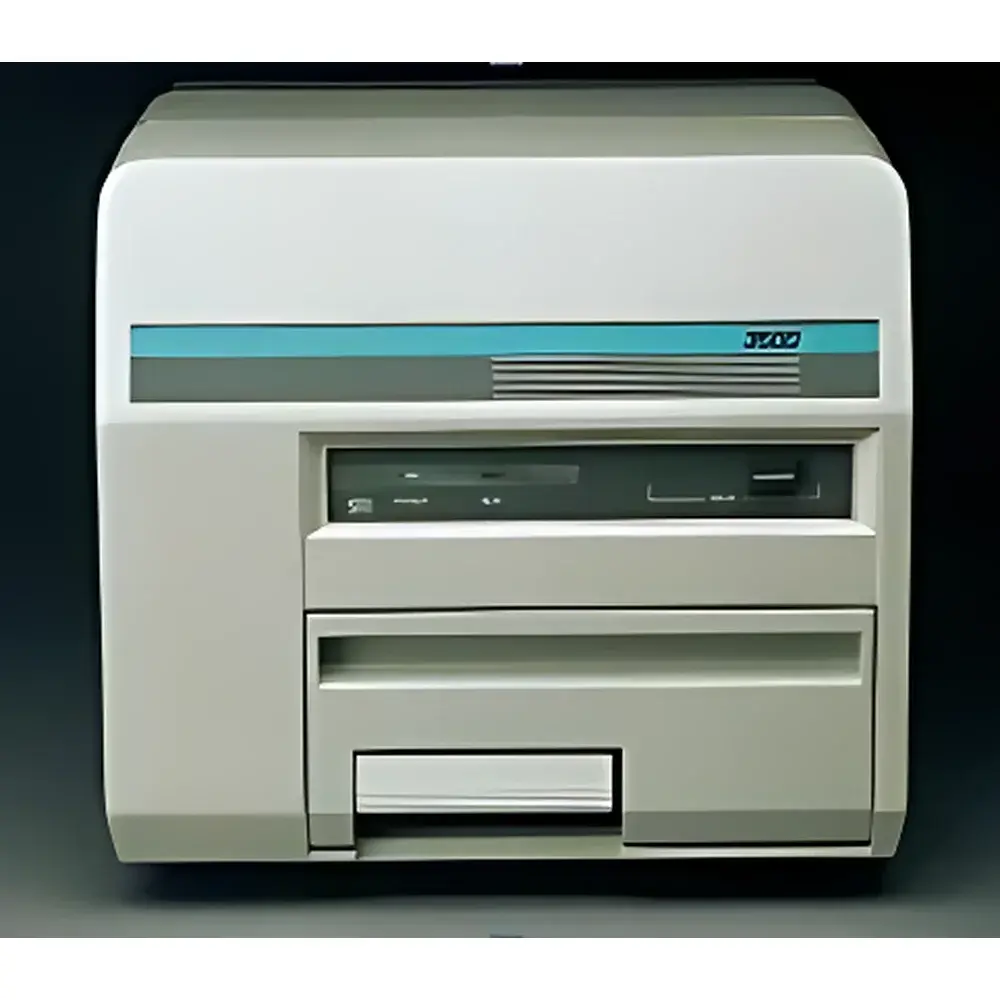
Thermo Fisher Harshaw 3500 Thermoluminescence Dosimetry (TLD) Reader
| Brand | Thermo Fisher |
|---|---|
| Origin | USA |
| Manufacturer Type | Authorized Distributor |
| Origin Category | Imported |
| Model | Harshaw 3500 |
| Pricing | Upon Request |
Overview
The Thermo Fisher Harshaw 3500 is a precision thermoluminescence dosimetry (TLD) reader engineered for quantitative measurement of ionizing radiation dose absorbed by crystalline phosphor materials. It operates on the fundamental principle of thermoluminescence: when previously irradiated TLD materials (e.g., LiF:Mg,Ti, CaSO₄:Dy, or Al₂O₃:C) are heated under controlled conditions, trapped electrons recombine with lattice defects, emitting visible photons proportional to the absorbed dose. The Harshaw 3500 employs resistive heating via a calibrated thermocouple-controlled metal planchet, enabling reproducible thermal stimulation profiles critical for accurate glow curve deconvolution and dose reconstruction. Designed for laboratory environments requiring regulatory compliance and metrological traceability, it serves as a core instrument in radiation protection programs, clinical dosimetry QA/QC, environmental monitoring, archaeological and geological dating, and food irradiation validation.
Key Features
- Thermocouple-regulated planchet heating system with programmable temperature ramping (0–400 °C standard; optional 600 °C configuration with high-temperature thermocouple)
- Nitrogen-purged readout chamber (99.995% purity, 130 L/h flow rate) to suppress spurious luminescence and ensure thermal uniformity across sample geometry
- Modular sample holder design accommodating diverse TLD geometries: rods (1 mm Ø × ≤6 mm), discs (4.5 mm Ø × 0.25–0.89 mm thick), squares (3.2 mm × 3.2 mm × 0.25–0.89 mm), cubes (1 mm³), and powders
- Integrated neutral density filter option for extended dynamic dose range without signal saturation
- Single-button operation interface with three status LEDs—optimized for routine use while maintaining full parameter accessibility via software
- High-stability photomultiplier tube detection system with dark current <50 μGy (referenced to Cs-137) and HV stability of ±0.005%/hour
- Thermal profile repeatability of ±1 °C and linearity deviation <1% across calibrated dose range
Sample Compatibility & Compliance
The Harshaw 3500 supports tissue-equivalent and non-tissue-equivalent TLD materials with demonstrated batch uniformity (±30% prior to ECC correction) and repeatability (<2% RSD for 1 mGy Cs-137 exposures). Its mechanical and thermal architecture complies with international electromagnetic compatibility and safety standards including EN 61000-6-3, IEC 61066, and ANSI N42.22. Dose algorithms embedded in WinREMS software meet requirements for DOELAP (Department of Energy Laboratory Accreditation Program) and NVLAP (National Voluntary Laboratory Accreditation Program) accreditation, supporting audit-ready documentation for GLP and GMP environments. All operational parameters—including preheat, readout, and annealing temperatures/times—are fully configurable and logged with timestamped metadata.
Software & Data Management
WinREMS (Windows Radiation Evaluation and Measurement System) provides comprehensive control, analysis, and archival functionality. It enables real-time visualization of glow curves, multi-peak deconvolution using standardized kinetic models (e.g., general-order or mixed-order), automatic baseline correction, and TLD-specific calibration curve generation. All acquisition settings, raw photon counts, thermal profiles, and post-processing steps are stored in a structured binary format with cryptographic integrity checks. Audit trails comply with FDA 21 CFR Part 11 requirements, including electronic signatures, user access controls, and immutable change logs. Reports can be exported in PDF, CSV, or XML formats, supporting integration into LIMS and enterprise QA databases.
Applications
- Radiation protection monitoring for personnel and environmental dosimetry programs
- Clinical radiotherapy QA—verification of beam output, wedge factors, and IMRT/VMAT delivery accuracy
- Food irradiation process validation per ISO/ASTM 51204 and FDA 21 CFR Part 179
- Archaeological and geological thermoluminescent dating (e.g., ceramics, sediments, volcanic quartz)
- Research in radiation physics, defect kinetics, and phosphor material development
- Calibration laboratory reference measurements traceable to NIST SRMs
FAQ
What types of TLD materials are compatible with the Harshaw 3500?
The system reads standard phosphors including LiF:Mg,Ti (TLD-100), LiF:Mg,Cu,P (TLD-100H), CaSO₄:Dy, CaF₂:Dy, and Al₂O₃:C—provided they conform to supported physical dimensions and thermal response characteristics.
Is nitrogen purge mandatory for operation?
Yes. Continuous high-purity nitrogen flow (≥99.995%) is required to minimize background luminescence, prevent oxidation of sensitive phosphors, and ensure thermal homogeneity during readout.
Can the Harshaw 3500 be integrated into a networked QA/QC workflow?
Yes. RS232 serial communication enables bidirectional data exchange with laboratory information management systems (LIMS) and custom middleware; WinREMS also supports scheduled automated backups and encrypted remote diagnostics.
What is the typical warm-up time before first measurement?
A 30-minute stabilization period is recommended to achieve thermal equilibrium in the heater block and PMT housing, ensuring optimal signal-to-noise ratio and long-term measurement consistency.
Does the system support multi-sample batch processing?
No. The Harshaw 3500 processes one TLD element per readout cycle (20 seconds standard TTP protocol), prioritizing measurement fidelity over throughput—a design choice aligned with reference-grade dosimetry requirements.
Related Products







