
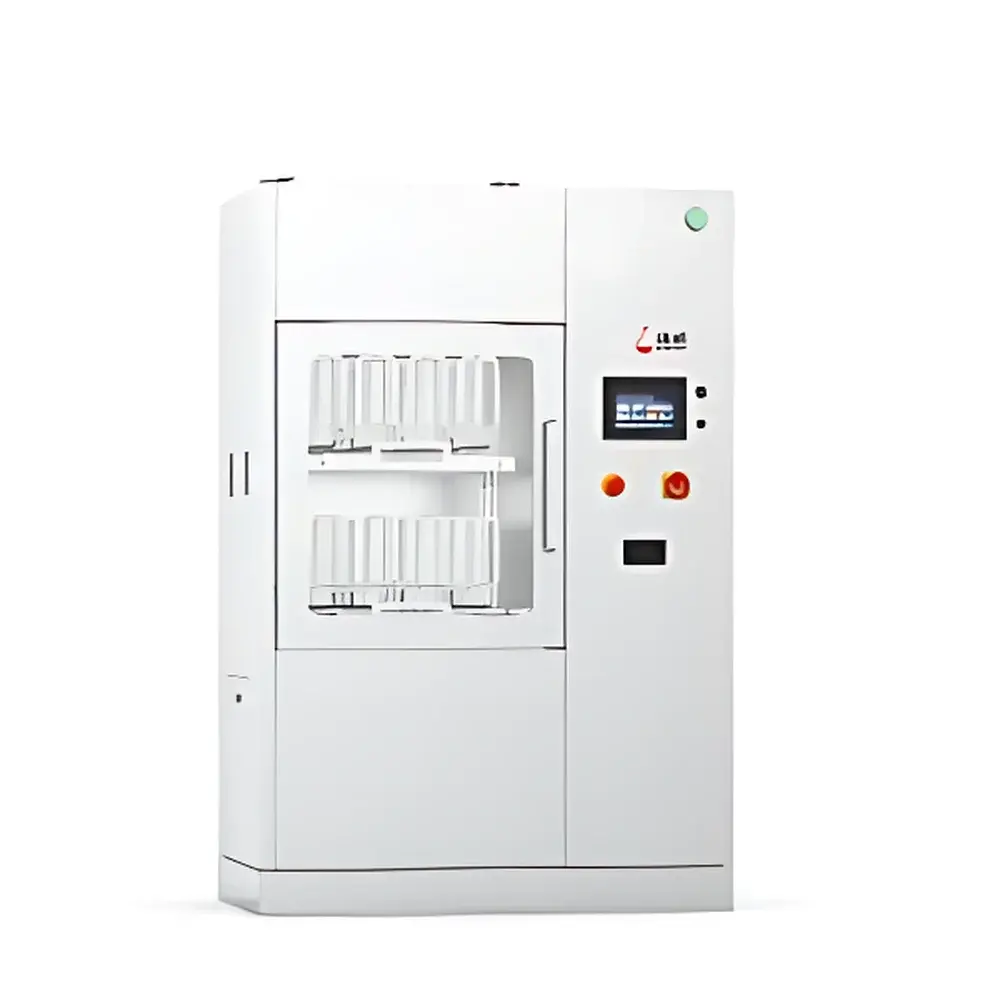
EURPING Poseidon 300 GMP-Compliant Laboratory Bottle Washer
| Brand | EURPING |
|---|---|
| Origin | Tianjin, China |
| Manufacturer Type | Original Equipment Manufacturer (OEM) |
| Model | Poseidon 300 |
| Chamber Volume | 480 L |
| Heating Power | 3 kW |
| Temperature Range | Ambient to 93 °C |
| Compatible Cleaning Agents | Acidic & Alkaline Detergents |
| External Dimensions (L×W×H) | 1170 × 767 × 1811 mm |
| Internal Chamber Dimensions (L×W×H) | 680 × 680 × 1000 mm |
| Construction | 304 Stainless Steel Exterior / 316L Stainless Steel Interior |
| Door | Side-opening Tempered Glass with Silicone Sealing |
| PLC Control System | Siemens S7-1200 + 7" Color HMI |
| Programmable Cycles | 20 Total (10 User-Defined + 10 Predefined) |
| Data Compliance | FDA 21 CFR Part 11, EU Annex 11, cGMP Audit Trail |
| Circulation Flow Rate | 800 L/min per Pump |
| Spray Arm Monitoring | Real-time Rotation Sensor |
| HEPA Filtration | H14 Class, Differential Pressure Monitoring |
| Drying Airflow | 145 m³/h per Fan, 700 W |
| LIMS Integration | Yes (RS-232/RS-485, Modbus TCP) |
Overview
The EURPING Poseidon 300 is a fully programmable, GMP-compliant laboratory bottle washer engineered for high-integrity cleaning of glassware, volumetric flasks, pipettes, bioreactor components, and other critical labware in regulated pharmaceutical, biotechnology, and clinical research environments. It operates on a validated closed-loop washing principle combining precision temperature-controlled aqueous cleaning, multi-stage rinsing, and HEPA-filtered hot-air drying. Unlike generic lab washers, the Poseidon 300 integrates process-critical hardware and software controls designed to meet stringent regulatory expectations—including ISO 13485, ASTM E2855-22 (Standard Guide for Validation of Automated Washing Systems), and ICH Q5C stability testing support requirements. Its architecture eliminates fluid stagnation points through GTAW-welded 316L stainless steel piping with ≥2% slope, Ra ≤0.4 µm internal surface finish, and zero-dead-leg design—ensuring consistent removal of residues, endotoxins, and bioburden without manual intervention.
Key Features
- Double-walled 316L stainless steel chamber with argon-shielded orbital welding and electropolished interior (Ra ≤0.6 µm), minimizing microbial adhesion and facilitating visual inspection.
- Side-mounted tempered glass door with dual silicone gasket sealing system, enabling real-time observation while maintaining full water-tight and vapor-tight integrity during cycles.
- Siemens S7-1200 PLC control platform with 7-inch color touchscreen HMI, supporting up to 20 fully customizable wash cycles—including configurable phase durations, temperature ramps, detergent dosing sequences, and rinse conductivity thresholds.
- Dual high-capacity circulation pumps (800 L/min each), soft-start controlled to prevent mechanical shock to delicate glassware during pump activation.
- Integrated conductivity monitoring system that dynamically adjusts final rinse count based on measured rinse water resistivity—ensuring consistent residue-free output per USP and EP 2.6.27 criteria.
- H14-class HEPA filtration in the drying circuit, continuously monitored via differential pressure sensors; automatic alarm triggers when filter efficiency degrades beyond ISO 16890:2016 thresholds.
- Comprehensive safety architecture: overtemperature cutoffs for heating elements, thermal protection for blowers and pumps, leak detection sensors, low/high liquid level interlocks, and emergency stop with mechanical latch.
Sample Compatibility & Compliance
The Poseidon 300 accommodates standard and custom-configured basket racks—designed for volumetric flasks (up to 2 L), serum bottles, scintillation vials, culture tubes, and reusable bioprocess containers. All wetted surfaces contact only 316L stainless steel, pharmaceutical-grade silicone, or PTFE—materials certified to USP Class VI and ISO 10993-5 cytotoxicity standards. The system conforms to cGMP Annex 15 (Qualification & Validation), EU GMP Annex 11 (Computerized Systems), and FDA 21 CFR Part 11 for electronic records and signatures. Audit trail functionality logs all user actions, parameter changes, alarms, and cycle execution metadata with immutable timestamps, supporting GLP/GMP audits and regulatory inspections.
Software & Data Management
The embedded control firmware supports three-tier access control (Operator, Supervisor, Administrator) with role-based permissions. Cycle logs—including start/stop timestamps, temperature profiles, detergent volumes dispensed, rinse conductivity values, and alarm history—are automatically generated as PDF reports and stored locally for ≥12 months. Optional LIMS integration enables bidirectional data exchange via Modbus TCP or serial handshake protocols, transmitting cycle IDs, pass/fail status, and operator credentials. All electronic records include cryptographic hashing and are backed up daily to external USB media or network drives compliant with 21 CFR Part 11 §11.10(a)(2).
Applications
- Pre-validation cleaning of analytical glassware prior to HPLC, GC-MS, and ICP-MS analysis.
- Routine decontamination of cell culture vessels and fermentation equipment in QC microbiology labs.
- Residue removal from high-potency API manufacturing tools per ICH Q7 A.12.3 guidance.
- Endotoxin reduction validation studies aligned with LAL test requirements (USP ).
- Supporting cleaning validation protocols (IQ/OQ/PQ) under ASTM E2855-22 and ISPE Baseline Guide Vol. 4.
FAQ
Does the Poseidon 300 support IQ/OQ/PQ documentation packages?
Yes—EURPING provides standardized qualification templates, test protocols, and raw data logs compatible with common validation management systems.
Can final rinse conductivity thresholds be adjusted per product-specific cleaning validation?
Yes—the system allows user-defined setpoints (e.g., ≤0.5 µS/cm) with automatic iteration until target is achieved.
Is remote monitoring supported via Ethernet or cloud interface?
Local Ethernet connectivity is standard; secure cloud telemetry requires optional gateway hardware and TLS 1.2-compliant configuration.
What is the expected service life of the H14 HEPA filter under typical lab usage?
Filter replacement interval is determined by differential pressure delta; average lifespan exceeds 18 months at 8 h/day operation.
Are spare parts and technical support available outside China?
EURPING maintains authorized service partners in Germany, USA, and Singapore, with 48-hour response SLA for critical failures.



