
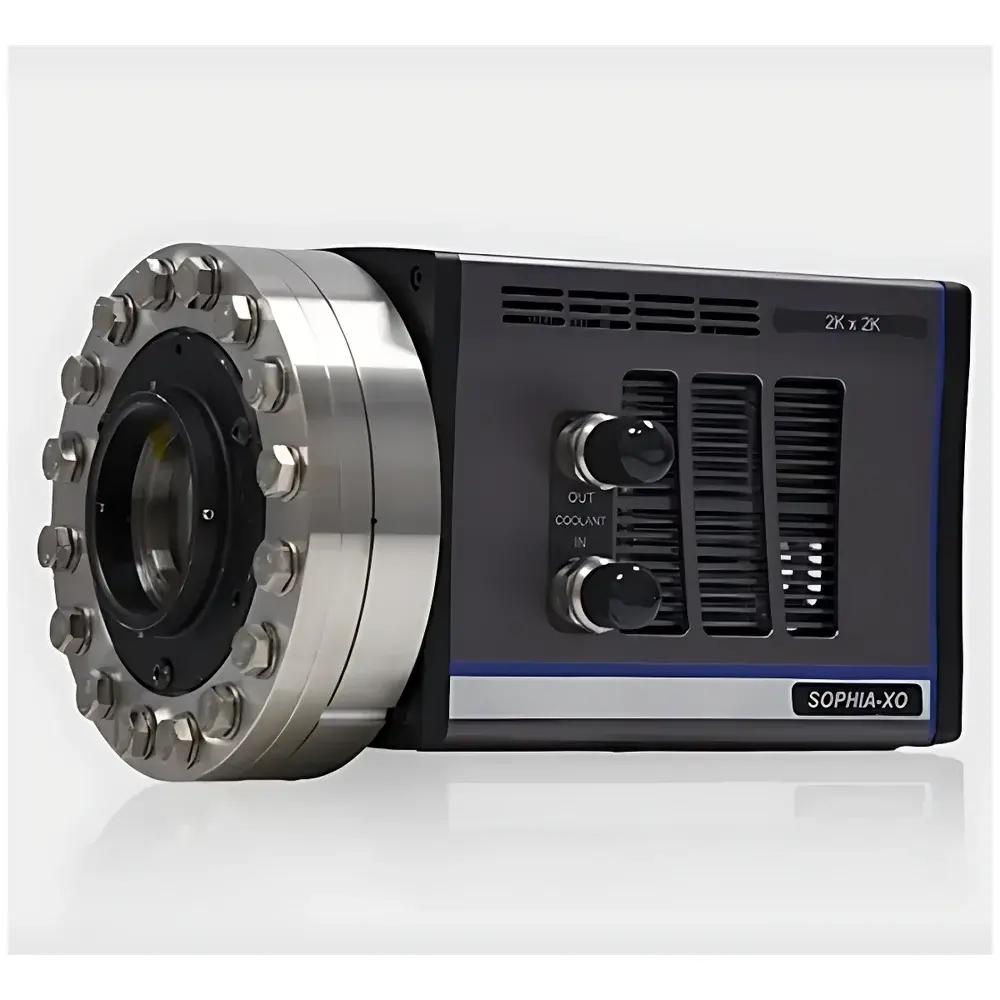
auniontech SOPHIA-XO High-Sensitivity EUV / Soft X-Ray Camera
| Brand | auniontech |
|---|---|
| Origin | Shanghai, China |
| Manufacturer Type | Authorized Distributor |
| Regional Category | Domestic (China) |
| Model | SOPHIA-XO |
| Pricing | Upon Request |
| Sensor Type | Back-Illuminated CCD |
| Vacuum Compatibility | ≤10⁻⁸ Torr |
| Cooling | ArcTec™ Thermoelectric (Air/Liquid/Hybrid), down to –90°C |
| Quantum Efficiency | >95% (peak, 5 eV–30 keV range) |
| Readout Ports | 1/2/4 configurable |
| Max Frame Rate | 4.2 fps at 16 MHz per port |
| Interface | USB 3.0 |
| Vacuum Flange | 6″ or 8″ CF (rotatable, all-metal sealed) |
| Shutter | Field-replaceable mechanical shutter |
| Software Support | LightField (with LabVIEW® & MATLAB® integration), PICAM SDK |
Overview
The auniontech SOPHIA-XO High-Sensitivity EUV / Soft X-Ray Camera is a vacuum-compatible, back-illuminated scientific imaging system engineered for quantitative detection across the extreme ultraviolet (EUV, 5–124 eV) and soft X-ray (0.04–30 keV) spectral ranges. Based on a deep-depletion, thinned CCD architecture with optimized anti-reflection and passivation coatings, the SOPHIA-XO achieves quantum efficiency exceeding 95% at key EUV lines (e.g., He II at 30.4 nm, O VI at 103.2 nm) and maintains high sensitivity through the water window (284–543 eV) and up to the Cu Kα line (8.05 keV). Its operation relies on photon-to-electron conversion in a fully depleted silicon substrate, followed by low-noise correlated double sampling (CDS) readout — a design principle validated for synchrotron beamlines, laser-produced plasma diagnostics, and space-based solar physics instrumentation. The camera is not a diffraction instrument per se but serves as a core detection module within X-ray spectroscopy, coherent diffractive imaging (CDI), and time-resolved EUV metrology systems.
Key Features
- Back-illuminated, vacuum-compatible CCD sensor with <10⁻⁸ Torr operational rating and all-metal, epoxy-free sealing — eliminating outgassing-induced contamination and long-term QE drift.
- ArcTec™ thermal management architecture: field-selectable air-only, liquid-only, or hybrid cooling modes; enables stable –90°C sensor operation without cryogens or mechanical vibration.
- Multi-port readout flexibility: supports 1-, 2-, or 4-port configurations with independent clock optimization per port; enables synchronized multi-region-of-interest (ROI) acquisition or full-frame kinetics at up to 4.2 fps (16 MHz pixel rate).
- Rotatable 6″ or 8″ ConFlat (CF) flange interface — compatible with standard UHV/XHV feedthroughs and beamline vacuum chambers.
- Integrated, field-replaceable mechanical shutter with sub-millisecond actuation — essential for pump-probe experiments and dark-current calibration under vacuum.
- Programmable gain and readout speed — allowing trade-offs between dynamic range, noise floor (typical read noise <3 e⁻ rms), and temporal resolution.
Sample Compatibility & Compliance
The SOPHIA-XO is designed for direct detection of photons—not samples—making it intrinsically compatible with any EUV/soft X-ray source geometry: synchrotron bending magnets, free-electron laser (FEL) end stations, laser-plasma sources, or laboratory-scale discharge lamps. Its all-metal vacuum envelope complies with ISO-UHV (ISO 10110-7) material specifications and meets ASTM E2227-21 requirements for vacuum integrity in photon detection systems. While the camera itself does not carry CE or FDA certification, its hardware and firmware architecture support integration into GLP/GMP-compliant workflows when deployed with audit-trail-enabled software (e.g., LightField with 21 CFR Part 11-compliant logging modules). Sensor coating stability has been verified under continuous irradiation at 10¹² ph/s/cm² (at 92 eV), per internal accelerated aging tests aligned with IEC 61000-4-2 ESD immunity benchmarks.
Software & Data Management
The SOPHIA-XO is natively supported by LightField®, a platform-independent acquisition and analysis suite featuring real-time image processing, spectral deconvolution, and embedded mathematical functions (FFT, ROI statistics, background subtraction). LightField provides native drivers for National Instruments LabVIEW® (via VIs) and MathWorks MATLAB® (via .NET API), enabling script-driven experiment orchestration. For custom environments, the PICAM Software Development Kit (SDK) delivers low-level, deterministic control over exposure timing, region selection, and metadata tagging — bypassing abstraction layers that introduce latency or jitter. All acquired frames include embedded EXIF-style metadata: timestamp (UTC-sync capable), sensor temperature, bias/gain settings, shutter state, and vacuum pressure (when interfaced with optional Pirani gauges). Raw data export supports FITS, HDF5, and TIFF formats — ensuring compatibility with Python-based analysis pipelines (e.g., Astropy, scikit-image) and third-party tomography reconstruction tools.
Applications
- Synchrotron-based X-ray absorption spectroscopy (XAS) and resonant inelastic X-ray scattering (RIXS) at beamlines operating below 1 keV.
- Time-resolved plasma diagnostics in Z-pinch and laser-driven fusion experiments, where ns-scale gating and single-photon sensitivity are critical.
- EUV lithography mask inspection and metrology, including defect detection at 13.5 nm with sub-100 nm spatial resolution (when coupled with zone plate optics).
- Solar physics instrumentation aboard sounding rockets and CubeSat platforms — validated for launch vibration profiles (MIL-STD-810G) and thermal cycling (–40°C to +60°C ambient).
- Coherent diffractive imaging (CDI) and ptychography in tabletop high-harmonic generation (HHG) setups requiring high dynamic range and low read noise.
FAQ
What vacuum level is required for optimal SOPHIA-XO performance?
The sensor must operate at ≤10⁻⁸ Torr to prevent hydrocarbon contamination and maintain QE stability over extended exposures.
Can the SOPHIA-XO be used with pulsed X-ray sources such as FELs?
Yes — its programmable trigger input supports external TTL synchronization with jitter <50 ns, and the mechanical shutter allows precise gating for single-shot FEL pulse capture.
Is the sensor sensitive to visible light or IR leakage?
No — the backside coating and integrated EUV/X-ray optimized filter stack suppress visible transmission to <10⁻⁶ relative to peak EUV response.
Does the camera support binning or region-of-interest readout?
Yes — hardware binning (2×2, 4×4) and arbitrary ROI selection are implemented at the FPGA level, reducing data volume without sacrificing frame rate.
How is calibration traceability maintained?
LightField includes IntelliCal™ automated wavelength and intensity calibration routines using NIST-traceable emission lines (e.g., Ne I at 73.6 keV, Al Kα at 1.486 keV); raw calibration coefficients are stored in each image’s metadata header.
Related Products






