
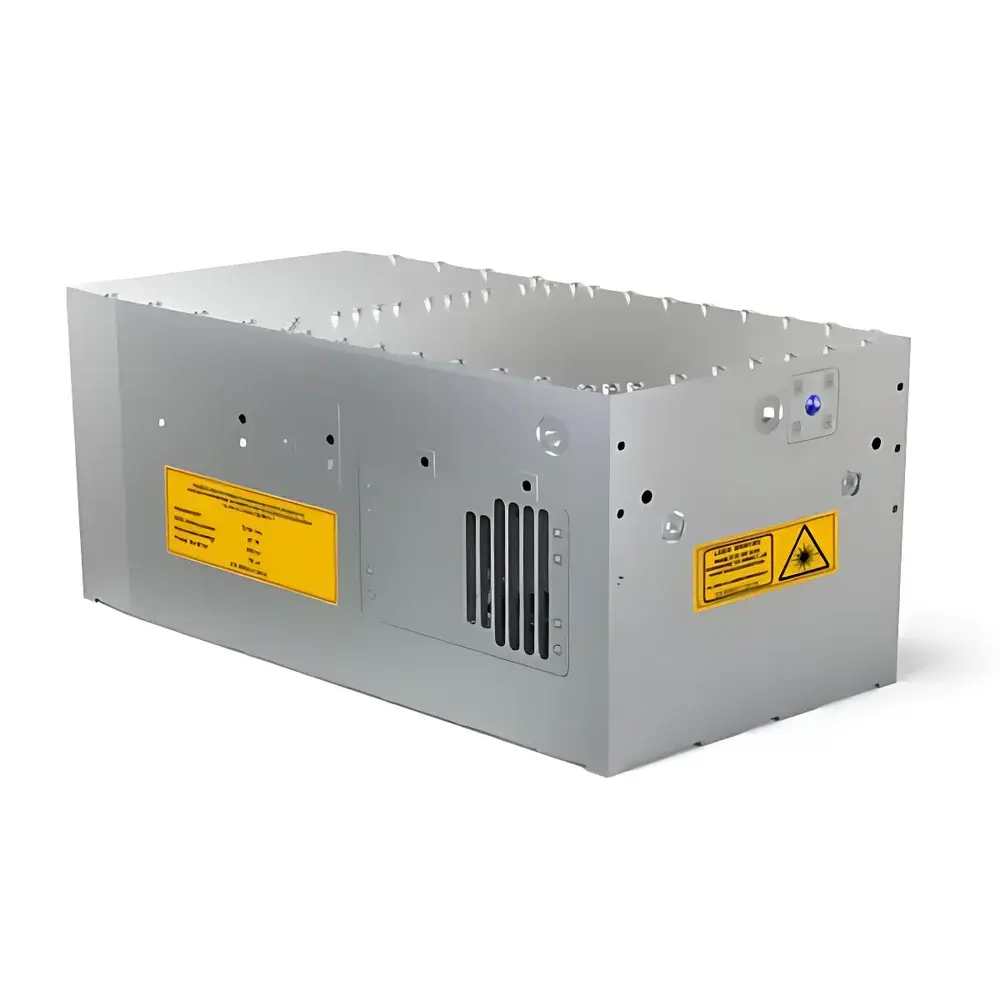
Bright Solutions Lampo Compact DPSS Picosecond Laser
| Brand | Bright Solutions |
|---|---|
| Country of Origin | Italy |
| Model | Lampo Series |
| Pulse Width | < 70 ps |
| Repetition Rate | 50 kHz – 40 MHz |
| Peak Power | up to 4.5 MW |
| Wavelength Options | 1064 nm (fundamental), 532 nm, 355 nm, 266 nm (harmonic generation) |
| Spectral Linewidth | < 0.4 nm |
| Cooling | Integrated air-cooling unit |
| Architecture | Monolithic, OEM-ready design |
| Compliance | CE, RoHS, IEC 60825-1:2014 (Class 4 Laser Product) |
Overview
The Bright Solutions Lampo Compact DPSS Picosecond Laser is a solid-state, diode-pumped, passively Q-switched laser system engineered for high-repetition-rate ultrafast pulse generation with exceptional temporal and spatial stability. Based on robust Nd:YAG or Nd:YVO4 gain media and optimized intra-cavity harmonic generation, the Lampo series delivers transform-limited picosecond pulses (< 70 ps FWHM) across multiple harmonics — from infrared (1064 nm) through visible (532 nm) and deep ultraviolet (266 nm). Its core architecture leverages decades of Bright Solutions’ expertise in DPSS laser design, integrating oscillator, harmonic generator, thermal management, and driver electronics into a single mechanically stable, vibration-insensitive platform. Unlike conventional amplified femtosecond systems, the Lampo operates without external amplification or complex cavity alignment, making it inherently suitable for integration into industrial OEM equipment, laboratory-grade spectroscopic setups, and field-deployable remote sensing instruments.
Key Features
- Ultrafast Pulse Generation: Sub-70 ps pulse width with high temporal fidelity, verified via autocorrelation and second-harmonic generation (SHG) techniques.
- Wide Repetition Rate Tunability: Electronically adjustable repetition frequency from 50 kHz to 40 MHz — enabling synchronization with external triggers, lock-in detection schemes, or time-resolved acquisition hardware.
- High Peak Power Output: Up to 4.5 MW peak power at 1064 nm (depending on average power and pulse duration), supporting nonlinear frequency conversion and ablation threshold studies.
- Multiband Wavelength Flexibility: Standard output at 1064 nm, with optional intracavity or external harmonic modules delivering 532 nm, 355 nm, and 266 nm — all maintaining narrow spectral linewidth (< 0.4 nm).
- Compact & Industrial-Grade Packaging: Fully integrated monolithic housing includes air-cooled thermal management, low-noise power supply, and TTL/RS-232 control interface — designed for 24/7 operation in cleanroom or factory-floor environments.
- OEM-Ready Architecture: Modular signal electronics separate from optical head; standardized mechanical footprint and electrical interfaces (e.g., SMA sync outputs, analog modulation inputs) facilitate rapid integration into larger laser systems or custom instrumentation.
Sample Compatibility & Compliance
The Lampo laser is compatible with a broad range of optically transparent and absorbing materials — including metals, semiconductors (Si, GaAs, InP), polymers (PI, PET, PMMA), fused silica, sapphire, and biological tissues — due to its controllable pulse energy density (fluence) and wavelength-selective photon absorption characteristics. Its Class 4 laser classification per IEC 60825-1:2014 requires appropriate interlocks, beam enclosures, and operator training in accordance with local occupational safety regulations. The system complies with CE marking requirements for electromagnetic compatibility (EMC Directive 2014/30/EU) and RoHS 2011/65/EU restrictions on hazardous substances. For GMP/GLP-regulated applications (e.g., medical device manufacturing or pharmaceutical R&D), optional firmware logging and audit-trail-enabled control software are available upon request to support FDA 21 CFR Part 11 compliance.
Software & Data Management
Bright Solutions provides the Lampo Control Suite, a cross-platform application (Windows/Linux/macOS) supporting real-time monitoring of laser status (pulse energy, temperature, repetition rate), remote parameter adjustment, and automated sequence programming. All operational parameters are timestamped and exportable in CSV or HDF5 format for traceable data analysis. The suite supports LabVIEW, Python (via PyVISA), and MATLAB instrument drivers for seamless integration into automated test benches. Optional SDKs enable custom GUI development and synchronization with oscilloscopes, streak cameras, or time-correlated single-photon counting (TCSPC) systems. Firmware updates are delivered via secure HTTPS channels with SHA-256 signature verification to ensure integrity and version control in regulated environments.
Applications
- Semiconductor Micromachining: High-precision drilling, scribing, and surface texturing of wafers and thin-film devices without thermal damage zones.
- Nonlinear Optical Studies: Pump-probe spectroscopy, optical parametric amplification (OPA), and coherent anti-Stokes Raman scattering (CARS) microscopy.
- Raman & Time-Resolved Spectroscopy: Enhanced signal-to-noise ratio via gated detection synchronized to picosecond pulses.
- LIDAR & Remote Sensing: High-resolution atmospheric profiling and target identification enabled by short pulse duration, narrow bandwidth, and MHz-rate burst modes.
- Biophotonics & Ophthalmology: Low-damage photodisruption in corneal surgery and multiphoton excitation imaging of live tissue.
- Holography & Interferometry: Coherent illumination source for dynamic holographic recording and phase-shifting interferometric metrology.
- UV Lithography Research: Maskless direct-write patterning of photoresists using 266 nm output with sub-micron resolution potential.
FAQ
What is the typical pulse-to-pulse energy stability over 8 hours?
Energy stability is ≤ ±1.5% RMS under constant ambient temperature (±0.5 °C) and line voltage variation < ±2%, measured with calibrated photodiode and digital integrator.
Can the Lampo be synchronized to an external clock or trigger signal?
Yes — it supports TTL-compatible external triggering with jitter < 100 ps RMS and programmable delay (0–10 ms) relative to input edge.
Is water cooling required?
No — the integrated air-cooling system maintains thermal equilibrium across the full operating range; no external chiller or plumbing is needed.
Are harmonic modules field-replaceable?
Harmonic generation units are pre-aligned and factory-qualified; replacement requires recalibration and must be performed by authorized Bright Solutions service centers.
Does the laser meet ISO 13694 for laser-induced damage threshold (LIDT) testing?
Yes — all optical coatings and crystals are qualified per ISO 13694:2019 using 1-on-1 and S-on-1 test protocols at relevant wavelengths and pulse durations.





