
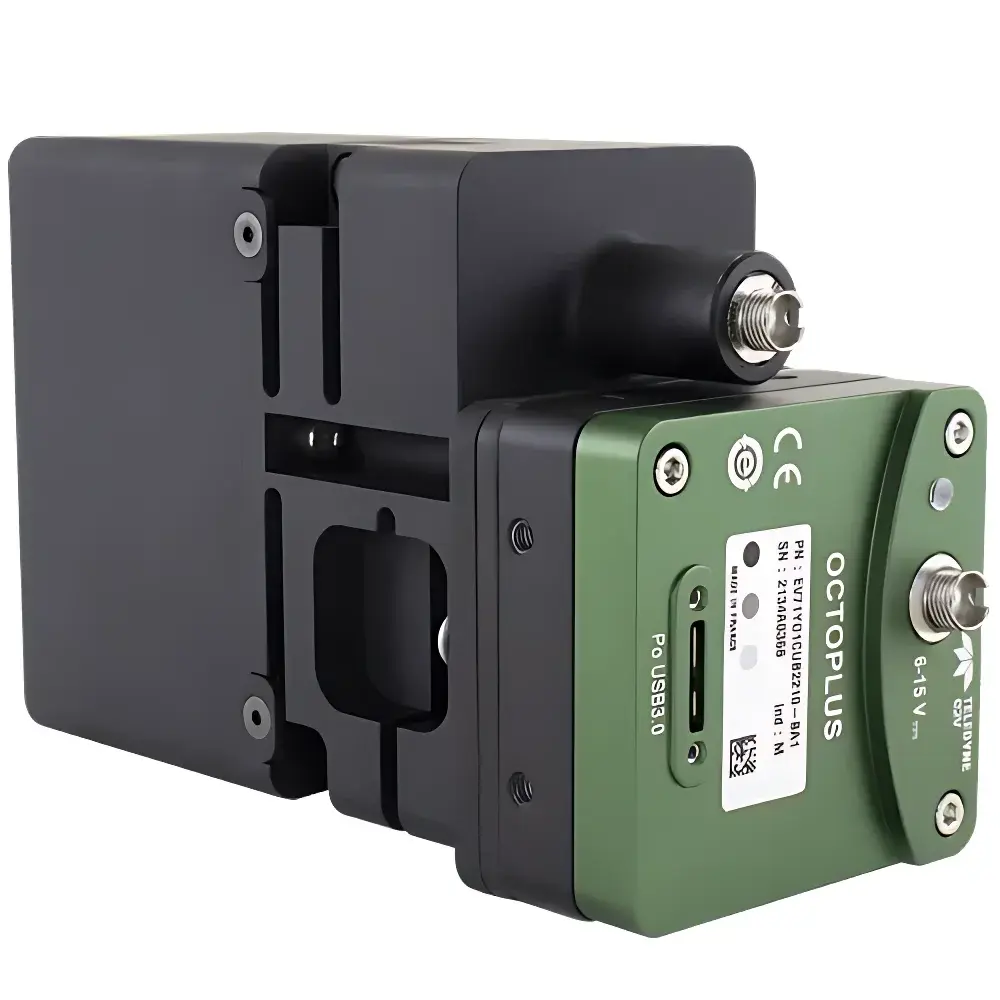
Wasatch Photonics Cobra OEM OCT Spectrometer (Industrial Integration Customized Version)
| Brand | Wasatch Photonics |
|---|---|
| Origin | USA |
| Manufacturer Type | Authorized Distributor |
| Product Category | Imported Instrument |
| Model | CO800S Series |
| Instrument Type | Laboratory & Industrial OEM Module |
| Application Field | General-purpose (Universities, Research Labs, Industrial QA/QC) |
| Operating Principle | Spectral-Domain Optical Coherence Tomography (SD-OCT) |
| Imaging Depth (in air) | 2.0–4.0 mm |
| Wavelength Range | 750–930 nm |
| Bandwidth Options | 90–180 nm |
| Central Wavelength Options | 840 nm, 850 nm |
| Spectral Resolution | 0.05–0.09 nm |
| Line Rate | 20–250 kHz |
| Pixel Count | 2048 |
| Interface | USB 3.0 (up to 130 kHz) or Camera Link (up to 250 kHz) |
| Dimensions | 130 × 86 × 60 mm |
| Weight | 0.7 kg |
| Optical Architecture | VPH grating-based, diffraction-limited imaging optics |
| Thermal & Mechanical Stability | Validated for industrial integration |
Overview
The Wasatch Photonics Cobra OEM OCT Spectrometer is a compact, high-performance spectral-domain optical coherence tomography (SD-OCT) detection module engineered specifically for original equipment manufacturer (OEM) integration into industrial and clinical systems. Unlike conventional benchtop spectrometers, the Cobra OEM platform is designed from the ground up for embedded deployment—delivering laboratory-grade spectral fidelity within a ruggedized, thermally stable mechanical housing measuring only 130 × 86 × 60 mm and weighing under 0.7 kg. Its core optical architecture employs a volume phase holographic (VPH) grating paired with diffraction-limited collimation and focusing optics, enabling sub-pixel spectral sampling and minimal inter-pixel crosstalk. The instrument operates in the near-infrared (NIR) window—centered at 840 nm or 850 nm—with configurable bandwidths ranging from 90 nm to 180 nm, supporting trade-offs between axial resolution (down to ~5 µm in tissue-equivalent media) and imaging depth (2.0–4.0 mm in air). As an SD-OCT engine, it captures full spectral interferograms at line rates up to 250 kHz via Camera Link or up to 130 kHz via USB 3.0, making it suitable for real-time volumetric imaging in manufacturing process monitoring, precision ophthalmic guidance, and non-destructive evaluation (NDE) applications.
Key Features
- Compact OEM-optimized form factor: < 700 cm³ volume, < 0.7 kg mass—designed for space-constrained system integration
- Thermally and mechanically validated stability: Meets industrial environmental specifications for continuous operation across ambient temperature fluctuations (±0.5 °C drift tolerance over 8-hour duty cycles)
- VPH grating technology: Delivers >90% diffraction efficiency across the full NIR band, minimizing thermal load and maximizing signal-to-noise ratio (SNR)
- High-fidelity optical design: Diffraction-limited imaging optics and low-crosstalk 2048-pixel linear CMOS sensor ensure spectral resolution of 0.05–0.09 nm (FWHM), depending on configuration
- Flexible interface options: USB 3.0 for cost-sensitive integration (≤130 kHz) or Camera Link for high-speed, deterministic timing (≤250 kHz)
- Scalable performance variants: Four standard configurations (CO800S-840/90, -840/120, -850/140, -840/180) support application-specific optimization of axial resolution vs. imaging depth
- Designed for manufacturability: Standardized mounting features, IPC-compliant PCB layout, and RoHS-compliant materials facilitate high-volume assembly and regulatory compliance
Sample Compatibility & Compliance
The Cobra OEM spectrometer is compatible with standard superluminescent diode (SLD) sources operating in the 750–930 nm range and integrates seamlessly with common fiber-optic OCT interferometers (e.g., 50/50 or 80/20 couplers, single-mode SMF-28 or HI1060 delivery fibers). It supports both free-space and fiber-coupled input configurations, with alignment-tolerant optical interfaces optimized for automated assembly. From a regulatory perspective, the module complies with IEC 61326-1 (electromagnetic compatibility for laboratory and industrial use) and IEC 61000-6-2/6-3 emission standards. While not a standalone medical device, its optical performance aligns with key requirements for Class IIa medical OCT systems under ISO 13485 quality management systems and supports audit-ready documentation packages for FDA 510(k) submissions when integrated into final devices. It also meets GLP-relevant traceability standards for calibration data logging and firmware version control.
Software & Data Management
The Cobra OEM module ships with a vendor-supported SDK (C++ and Python APIs) providing low-level register access, real-time line acquisition control, dark-frame subtraction, and hardware-triggered synchronization. Data output is delivered as 16-bit unsigned integer arrays representing raw spectral interferograms, enabling full flexibility for custom dispersion compensation, Fourier-domain resampling, and complex conjugate suppression algorithms. The SDK includes reference implementations compliant with OCT industry conventions—including k-space linearization using calibrated wavelength vectors and support for GPU-accelerated B-scan reconstruction pipelines. All firmware updates are digitally signed and version-locked to prevent unauthorized modification, satisfying integrity requirements under FDA 21 CFR Part 11 for electronic records and signatures when deployed in regulated environments. Configuration metadata (e.g., grating calibration coefficients, pixel-to-wavelength mapping, thermal drift compensation tables) is stored in non-volatile memory and accessible programmatically for audit trail generation.
Applications
- Industrial process monitoring: Real-time layer-thickness measurement during coating, lamination, or additive manufacturing; defect detection in polymer films, composites, and semiconductor wafers
- Ophthalmic surgical guidance: Intraoperative cross-sectional imaging for vitreoretinal procedures, corneal flap assessment in LASIK, and anterior segment biometry
- Non-destructive evaluation (NDE): Subsurface crack detection in aerospace composites, delamination analysis in bonded structures, and moisture ingress mapping in insulation materials
- Biomedical research: Dynamic microvascular imaging in rodent models, 3D histology correlation, and label-free tissue differentiation in ex vivo specimens
- Academic instrumentation development: Core spectral engine for custom-built OCT platforms, teaching labs focused on photonics and biomedical optics, and metrology testbeds for algorithm validation
FAQ
What central wavelengths and bandwidths are available?
Standard configurations include 840 nm ±45 nm (90 nm BW), 840 nm ±60 nm (120 nm BW), 850 nm ±70 nm (140 nm BW), and 840 nm ±90 nm (180 nm BW). Custom center wavelengths (e.g., 930 nm, 1060 nm) and bandwidths can be engineered upon request.
Is the Cobra OEM compatible with existing OCT interferometers?
Yes—it accepts collimated free-space input or fiber-pigtailed input (FC/PC or FC/APC) and is optimized for use with standard SLD sources and Michelson or Mach-Zehnder interferometer topologies.
How is thermal drift managed in long-duration acquisitions?
The module incorporates passive thermal stabilization via low-CTE aluminum housing and internal thermal mass balancing; active recalibration is supported through periodic dark-frame acquisition and built-in temperature sensor feedback (±0.1 °C resolution).
Can the spectrometer be used in FDA-regulated medical devices?
As an OEM component, it is intended for integration into finished devices subject to applicable regulatory pathways (e.g., 510(k), De Novo); Wasatch provides design history file (DHF) excerpts and risk management documentation per ISO 14971 to support submission efforts.
What level of technical support is provided for system integrators?
Wasatch offers engineering collaboration including optical interface specification review, mechanical mounting guidance, SDK integration workshops, and pre-compliance EMC testing support—all documented under NDA and covered by standard OEM support agreements.





