
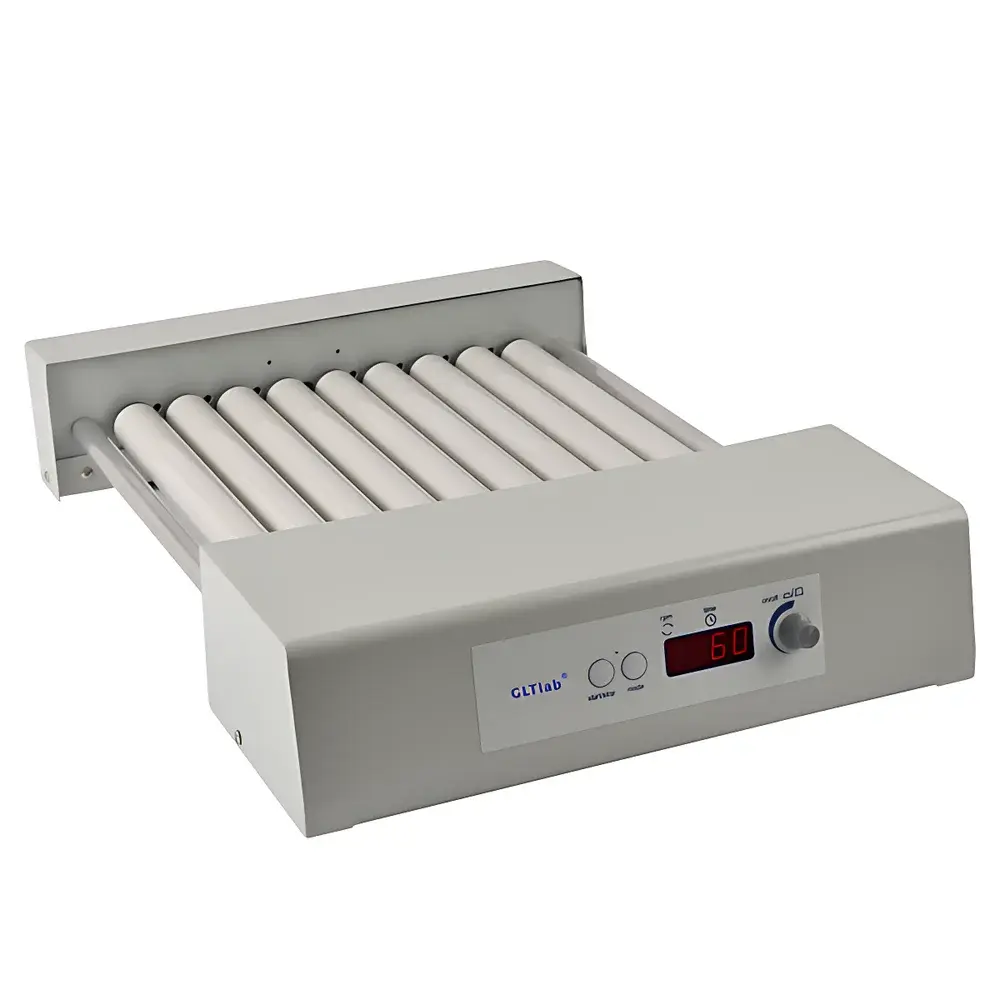
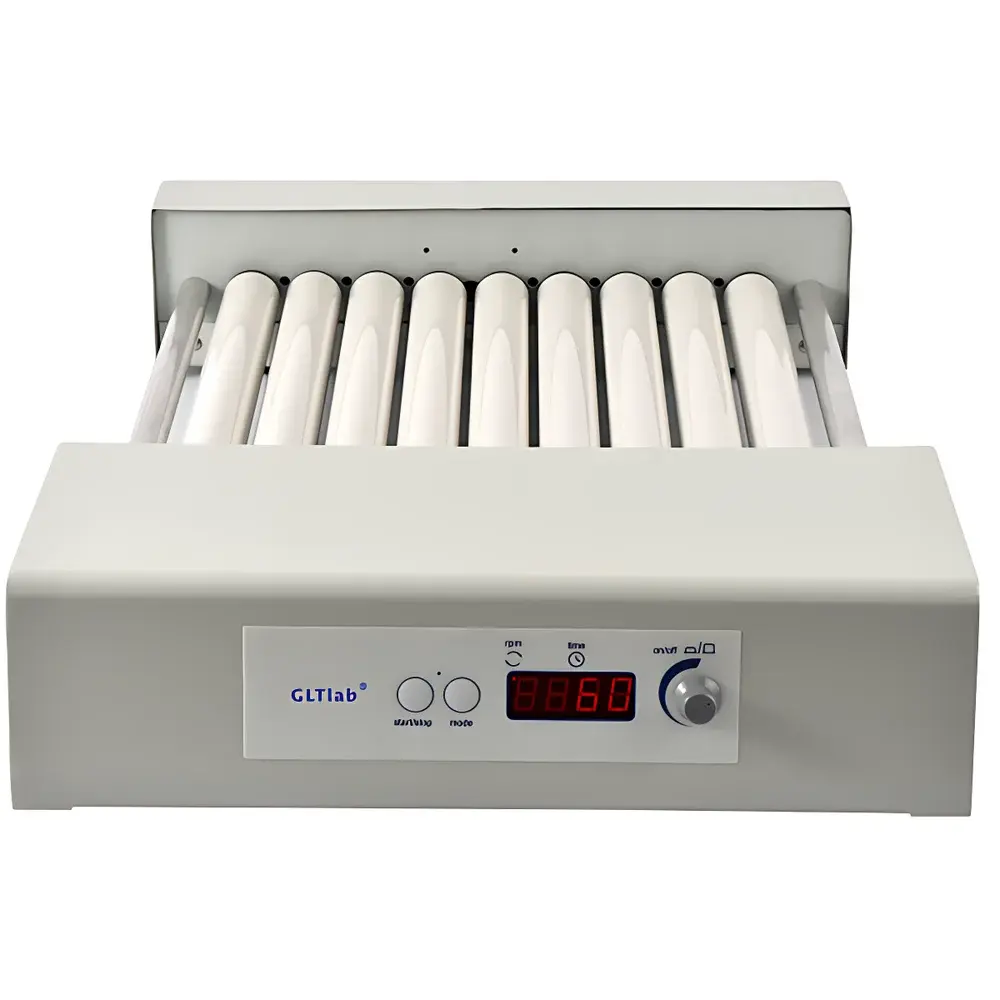
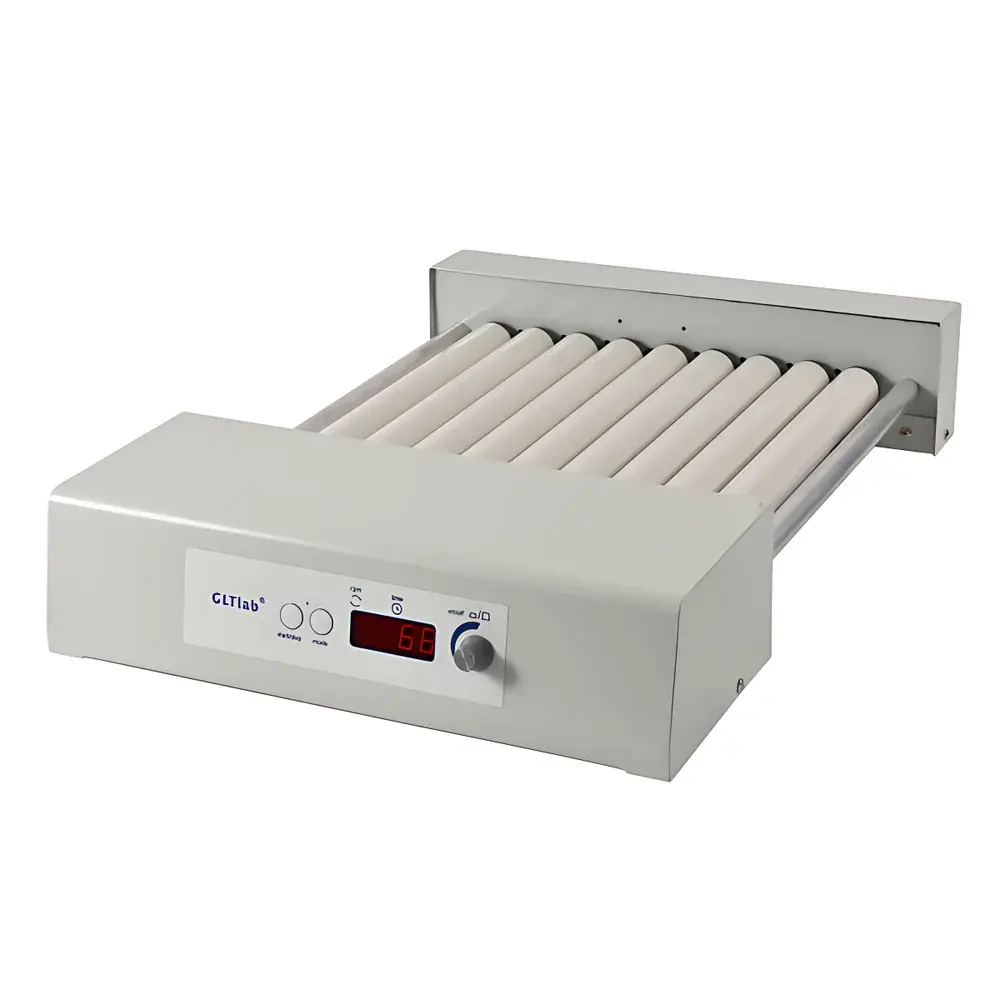
GLTlab LTR-1D 9-Roller Orbital & Rocking Mixer
| Brand | GLTlab |
|---|---|
| Origin | Guangdong, China |
| Manufacturer Type | Direct Manufacturer |
| Country of Origin | China |
| Model | LTR-1D |
| Dimensions (W×D×H) | 556 × 392 × 98 mm |
| Maximum Load Capacity | 10 kg |
| Roller Count | 9 |
| Operating Modes | Orbital Rolling & Tilting Rocking |
| Speed Range | 5–300 rpm (digital control) |
| Direction Control | Bidirectional (CW/CCW) |
| Timing Function | 1–540 min total runtime or 5–120 min per direction cycle |
| Roller Dimensions | Ø30 × 340 mm (L×D) |
| Power Supply | DC 12 V, 5 A |
| Net Weight | 9 kg |
| Sample Vessel Compatibility | Tubes, bottles, flasks, vials (0.5–500 mL standard |
Overview
The GLTlab LTR-1D is a precision-engineered 9-roller laboratory mixer designed for reproducible, low-shear homogenization and suspension maintenance across diverse sample types. It operates on two distinct mechanical principles: orbital rolling—where rollers rotate coaxially to induce continuous axial tumbling—and tilting rocking—where the roller axis is angled relative to the drive shaft, generating gentle vertical oscillation during rotation. This dual-mode architecture enables method-specific optimization: orbital mode delivers uniform, laminar motion ideal for powder blending and granular dispersion, while rocking mode enhances mixing efficiency in high-viscosity fluids, blood-derived samples, cryopreserved suspensions, and heterogeneous solid–liquid systems requiring minimal shear-induced aggregation or phase separation. The device is constructed with a rigid aluminum alloy chassis and sealed DC motor drive, ensuring long-term operational stability under routine QC, biobanking, and R&D workflows.
Key Features
- 9 independently aligned rollers with adjustable inter-roller spacing—tubes or bottles can be physically removed from the roller set to widen the gap, accommodating vessels up to 1 L in volume.
- Dual-mode operation: selectable orbital (zero-tilt) or rocking (angled-axis) motion via mechanical configuration—no software switching required.
- Digital speed control (5–300 rpm) with ±2 rpm repeatability, calibrated against NIST-traceable tachometric reference.
- Bidirectional rotation capability: programmable clockwise/counterclockwise alternation with user-defined interval timing (5–120 minutes per direction).
- Extended timer functionality: total run time up to 540 minutes (9 hours), with automatic shutdown and memory retention of last-used parameters.
- Low-voltage DC power architecture (12 V, 5 A) minimizes electromagnetic interference and eliminates grounding hazards—suitable for use inside biosafety cabinets and cold rooms.
- Compact footprint (556 × 392 × 98 mm) and lightweight design (9 kg net) facilitate benchtop integration without structural reinforcement.
Sample Compatibility & Compliance
The LTR-1D accommodates standard laboratory containers—including polypropylene and glass tubes (1.5–50 mL), centrifuge bottles (15–50 mL), serum vials (2–20 mL), and wide-mouth flasks (up to 1 L when rollers are repositioned). Its low-shear profile meets ASTM D4097 (Standard Practice for Mixing Suspensions for Particle Size Analysis) and ISO 8502-9 (Preparation of steel substrates before application of paints and related products) requirements for gentle agitation prior to analytical sampling. While not certified for GMP manufacturing environments, its repeatable motion profiles support GLP-compliant documentation when paired with external audit-log-capable timers or connected to validated lab information management systems (LIMS). No consumables or proprietary adapters are required—reducing cross-contamination risk and validation burden.
Software & Data Management
The LTR-1D is a stand-alone electromechanical instrument with no embedded firmware or network interface. All operational parameters—including speed, direction sequence, and timing—are configured via front-panel push-button controls with LED status indicators. For traceability in regulated environments, users may integrate external digital timers with timestamped logging or connect the unit to programmable logic controllers (PLCs) via its isolated 12 V trigger output (optional accessory). The absence of onboard software ensures immunity to cybersecurity vulnerabilities and eliminates FDA 21 CFR Part 11 electronic record compliance overhead—making it suitable for labs prioritizing simplicity, reliability, and audit-ready manual SOP execution.
Applications
- Blood banking: gentle resuspension of thawed red blood cell units and platelet concentrates without hemolysis.
- Cell culture: maintenance of adherent cell aggregates in suspension bioreactors and stem cell differentiation media.
- Materials science: homogenization of ceramic slurries, polymer dispersions, and battery slurry formulations prior to rheological or particle size analysis.
- Clinical diagnostics: preparation of whole-blood lysates and immunoassay calibration standards requiring consistent matrix homogeneity.
- Cryobiology: controlled-rate rewarming of frozen tissue samples and organoids to minimize ice recrystallization damage.
- Pharmaceutical QA: blending of placebo powders and excipient mixtures for content uniformity testing per USP .
FAQ
Can the LTR-1D accommodate 50-mL conical tubes?
Yes—standard 50-mL Falcon-style tubes fit securely between adjacent rollers in orbital mode; rocking mode requires slight tube repositioning to prevent lateral slippage.
Is the speed range linearly controllable across the full 5–300 rpm span?
Yes—digital potentiometer-based regulation ensures monotonic, stepless adjustment with ≤±2 rpm deviation across ambient temperature (15–30°C) and load conditions (0–10 kg).
Does the unit include overheat or stall protection?
Yes—the integrated thermal cutoff switch deactivates the motor at ≥75°C internal temperature and auto-resets after cooling to <45°C.
What is the expected service life under continuous operation?
Rated for >20,000 hours of cumulative runtime based on bearing and brush-life specifications under nominal load (≤7 kg) and ambient conditions.
Can the LTR-1D be operated inside a refrigerated incubator?
Yes—its DC-powered design and absence of heat-generating AC components allow safe operation at temperatures from 4°C to 35°C and humidity ≤80% RH non-condensing.



