
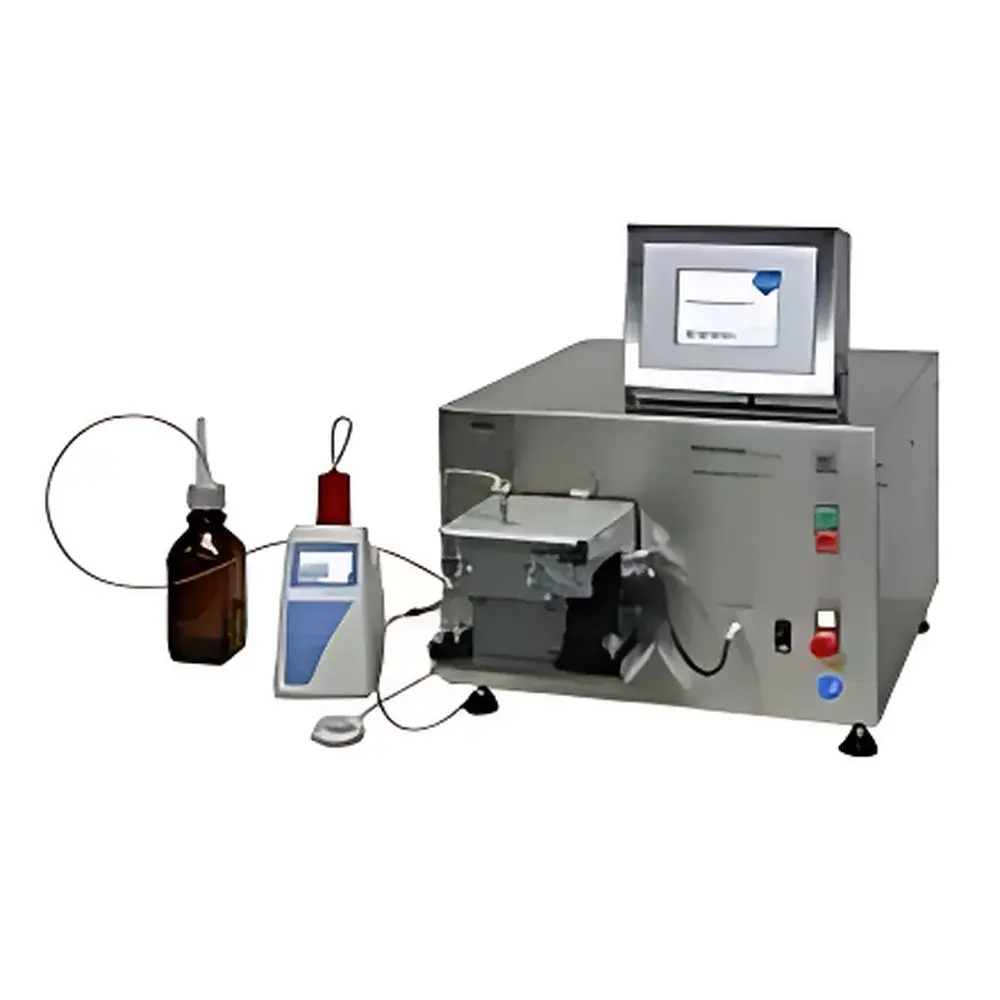
Brabender Absorptometer C-Type Carbon Black Oil Absorption Tester
| Brand | Brabender |
|---|---|
| Origin | Germany |
| Model | Absorptometer C-Type |
| Compliance | ASTM D2414, ASTM D3493 (Methods A, B, C) |
| Drive | AC frequency-controlled motor (0.75 kW) |
| Speed Range | 5–150 rpm (default 125 rpm per ASTM) |
| Torque Measurement | 0–10 N·m, electronic quartz-based feedback |
| Dropping Rate | 4 mL/min default (adjustable via software/control panel) |
| Mixing Chamber Volume | 100 mL |
| Dropper Accuracy | ±0.05 mL |
| Power Supply | 230 V AC, 50/60 Hz, 4 A |
| Dimensions (L×W×H) | 530 × 560 × 700 mm (excl. burette) |
| Weight | ~75 kg |
| Software | Windows-compatible (Win98/ME/XP/2000), 32-bit, full ASTM parameter mapping, polynomial curve-fitting for torque inflection points, automated data logging, multi-mixer support |
Overview
The Brabender Absorptometer C-Type is a precision-engineered instrument designed exclusively for the quantitative determination of oil absorption number (OAN) in carbon black—recognized globally as the definitive reference method for this critical quality parameter. Operating on the principle of controlled oil addition to dry carbon black under defined shear conditions, the system monitors real-time torque response during mixing to identify phase transitions: free-flowing (liquid-dominant), agglomerated (solid-like), and final re-fluidization (oil-saturated). The OAN is derived from the inflection point corresponding to 70% of maximum torque—per ASTM D3493 Method C—or alternatively from the peak torque (Method A) or fixed-time endpoint (Method B). This physico-mechanical measurement directly correlates with carbon black’s structure, surface area, and dispersion behavior in rubber compounding, thereby serving as a predictive indicator for compound processability, filler network formation, and vulcanizate mechanical performance.
Key Features
- True ASTM-compliant architecture: Fully implements D2414 and D3493 across Methods A, B, and C without manual calibration—software enforces standard-defined parameters by default.
- High-fidelity torque sensing: Quartz-stabilized electronic transducer with 0–10 N·m range and digital closed-loop feedback ensures sub-millitorque resolution and long-term drift stability.
- Programmable variable-speed drive: 5–150 rpm AC inverter motor enables precise replication of shear history; factory-set at 125 rpm per ASTM but fully adjustable for method validation or R&D studies.
- Automated titration control: Motor-driven burette delivers oil at user-defined rates (default 4 mL/min); integrated calibration routine verifies volumetric accuracy (±0.05 mL).
- Dual-mode mixer compatibility: Supports rapid interchange of standardized 100 mL mixing bowls—enabling parallel testing or dedicated use for high-abrasion or low-structure grades.
- Thermal management option: Optional jacketed mixing chamber allows temperature-controlled experiments (e.g., 25°C ±0.5°C) to assess thermal effects on wetting kinetics and aggregate breakdown.
Sample Compatibility & Compliance
The Absorptometer C-Type accommodates all commercial carbon black grades—including N110 through N990 series—as well as specialty conductive and reinforcing blacks used in tire treads, sidewalls, and industrial rubber goods. Sample mass is standardized at 5.0 g per test, consistent with ASTM protocols. Instrument design and firmware are validated against ISO/IEC 17025 requirements for testing laboratories, and raw torque/time data files include embedded metadata (operator ID, timestamp, method version, environmental conditions) to support GLP/GMP audit trails. All software operations comply with FDA 21 CFR Part 11 when configured with electronic signature modules and audit-log activation.
Software & Data Management
The 32-bit Windows-native application provides full instrument orchestration: synchronized control of motor speed, dropper actuation, and data acquisition at 10 Hz sampling rate. It applies third-order polynomial fitting to torque curves to precisely locate the 70% torque inflection—minimizing operator subjectivity and enhancing inter-laboratory reproducibility. Default parameter sets mirror ASTM D2414/D3493 tables, yet permit deviation logging for internal method optimization. Each test generates a structured XML report containing raw torque vs. time, derivative plots, OAN result, statistical confidence interval (based on triplicate run variance), and compliance flagging (e.g., “Method C pass/fail”). Data exports to CSV, PDF, or LIMS-ready formats; local storage supports ≥10,000 test records with automatic timestamped backup.
Applications
This instrument serves as the primary metrology tool in carbon black manufacturing QC labs, rubber formulation centers, and third-party certification bodies. Its output informs critical decisions in: (1) batch release verification against contractual OAN specifications; (2) correlation modeling between OAN and Mooney viscosity or Payne effect in compounded elastomers; (3) evaluation of surface oxidation or silanization treatments affecting oil affinity; (4) troubleshooting dispersion issues in masterbatch production; and (5) supporting regulatory submissions where ASTM traceability is mandatory (e.g., FDA-listed medical device components or EPA-regulated tire wear particulates).
FAQ
Does the Absorptometer C-Type require external calibration standards?
No—its torque sensor is factory-calibrated using NIST-traceable deadweight systems, and software auto-validates zero-point and span before each test sequence.
Can the instrument be integrated into an existing LIMS environment?
Yes—via configurable ODBC drivers and ASCII-formatted export templates compatible with major LIMS platforms including LabVantage, Thermo Fisher SampleManager, and Siemens Opcenter.
What maintenance intervals are recommended for long-term torque accuracy?
Annual verification of torque transducer linearity and dropper volumetric accuracy is advised; Brabender-certified service technicians perform on-site recalibration using certified reference oils and inertial load simulators.
Is the software compliant with 21 CFR Part 11 for regulated environments?
Yes—when deployed with password-protected user roles, electronic signatures, and enabled audit trail logging, it meets ALCOA+ data integrity principles required for pharmaceutical and medical-grade elastomer development.
How does the C-Type differ from older Brabender models (e.g., A- or B-Type)?
Unlike legacy versions relying on analog potentiometers or fixed-speed drives, the C-Type employs digital torque feedback, programmable kinetics, and ASTM-method-specific algorithms—eliminating manual curve interpretation and reducing inter-operator variability by >40% (per Brabender interlab study #BAC-2022-08).






