
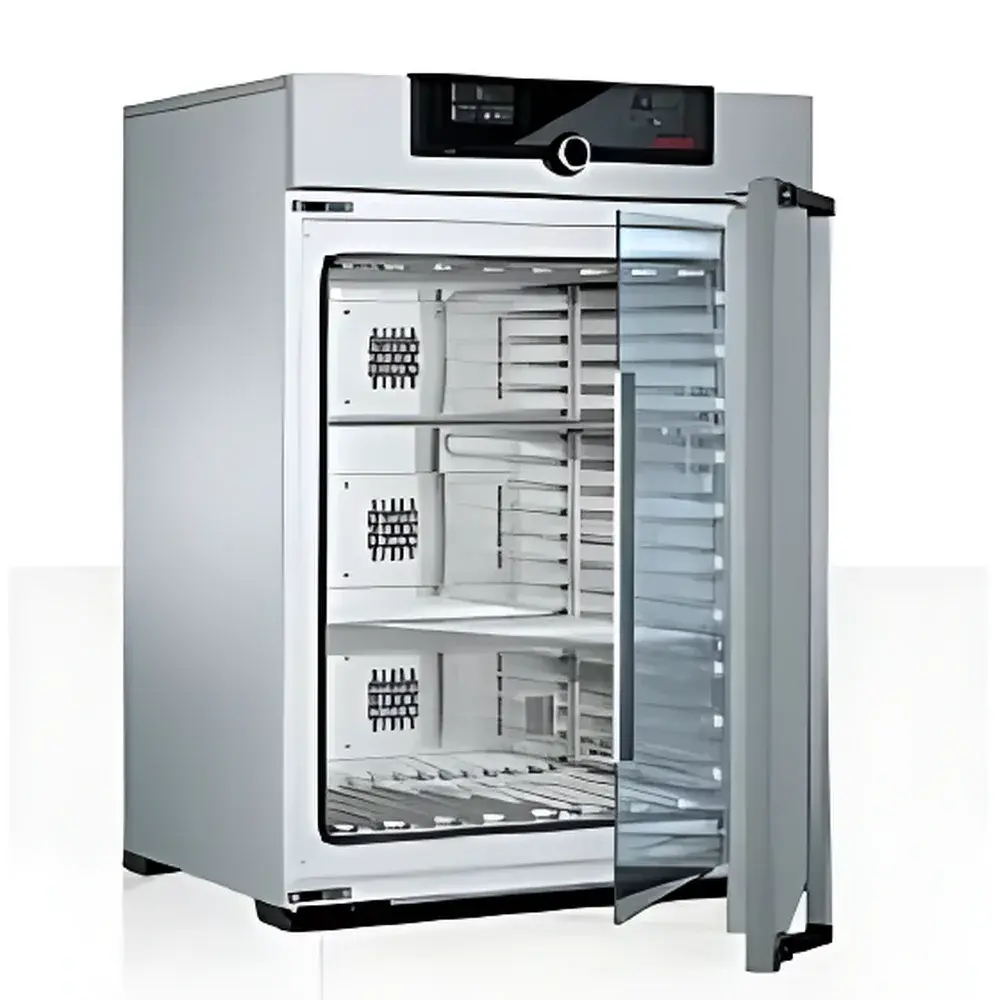
Memmert HPP110 / HPP260 / HPP750 Temperature and Humidity Controlled Stability Chambers
| Brand | Memmert |
|---|---|
| Origin | Germany |
| Model | HPP110 / HPP260 / HPP750 |
| Temperature Range (no lighting) | 0 °C to +70 °C |
| Temperature Range (with LED lighting) | +10 °C to +40 °C |
| Humidity Range (no lighting) | 10–90 % RH |
| Humidity Range (with LED lighting) | 10–85 % RH |
| Temperature Setting Resolution | 0.1 K |
| Humidity Setting Resolution | 1 % RH |
| Internal Volume | 108 L / 256 L / 749 L |
| Power Consumption (230 V, 50 Hz) | 350 W / 525 W / 1050 W |
| LED Lighting Options | 5500 K (cool white) or 2700 K (warm white), 10% intensity steps |
Overview
The Memmert HPP Series — comprising the HPP110, HPP260, and HPP750 — are precision-engineered temperature and humidity controlled stability chambers designed for long-term pharmaceutical, biotechnological, and material science applications requiring strict environmental compliance. Unlike conventional compressor-based chambers, the HPP series employs solid-state Peltier (thermoelectric) technology for both heating and cooling, enabling exceptional thermal stability, ultra-low vibration, and near-silent operation. This architecture eliminates the need for refrigerants, mechanical compressors, or routine lubrication maintenance — resulting in a robust, low-downtime platform ideal for ICH Q1A(Q)-compliant stability studies, accelerated aging protocols, and controlled sample storage under GLP/GMP conditions. The chambers maintain precise setpoints across their full operating range (0 °C to +70 °C; 10–90 % RH), with enhanced uniformity achieved via optimized air distribution, dual-sensor feedback loops, and microprocessor-controlled modulation of thermoelectric elements.
Key Features
- Solid-state Peltier climate control system delivering up to 90% lower energy consumption vs. compressor-driven alternatives — verified per DIN EN 60068-3-5 and ISO 16750-4 test cycles
- Three validated chamber volumes: 108 L (HPP110), 256 L (HPP260), and 749 L (HPP750), all featuring electropolished stainless steel interior (AISI 316L-grade), corrosion-resistant construction, and seamless welds
- AtmoCONTROL software suite with TwinDISPLAY interface supporting real-time monitoring, multi-point logging (up to 3 independent IQ/OQ/PQ validation points), and configurable alarm thresholds
- Optional integrated LED illumination modules (5500 K cool white or 2700 K warm white) with 10% stepwise intensity control — fully compliant with ICH Q5C photostability requirements when configured per Annex 2
- Temperature resolution of 0.1 K and humidity resolution of 1 % RH, traceable to national metrology institutes (e.g., PTB, NIST) via optional calibration certificates
- Passive airflow design with axial fans and optimized duct geometry ensures ±0.5 °C temperature uniformity and ±3 % RH homogeneity (at 25 °C / 60 % RH, load-free condition per VDI/VDE 3511-4.4)
Sample Compatibility & Compliance
The HPP chambers accommodate standard pharmaceutical packaging formats — including blister packs, vials, syringes, and secondary cartons — on adjustable stainless steel grid shelves (2 standard, up to 5/9/14 maximum). Each shelf supports 30 kg uniformly distributed load; total chamber capacity reaches 175 kg (HPP110), 300 kg (HPP260), or 300 kg (HPP750). All models comply with essential regulatory frameworks: ICH Q1A(R3), Q5C, and Q6A for stability testing; ISO 14644-1 Class 8 cleanroom-compatible operation; and EU Directive 2014/30/EU (EMC) and 2014/35/EU (LVD). Optional 21 CFR Part 11-compliant software packages provide electronic signatures, audit trails, and role-based access control for FDA-submission-ready data integrity.
Software & Data Management
AtmoCONTROL firmware enables full-cycle environmental management — from protocol definition (e.g., ICH Zone IVb: 30 °C/75 % RH) to automated deviation reporting. Data is logged at user-defined intervals (1 s to 24 h) and stored internally (≥1 million records) with timestamp, sensor ID, and status flags. Export options include CSV, PDF reports, and direct integration with LIMS via OPC UA or Modbus TCP. Validation support includes preconfigured IQ/OQ templates aligned with ASTM E2500-13 and GAMP 5 guidance, plus built-in tools for sensor mapping, ramp/soak verification, and uncertainty budgeting per ISO/IEC 17025:2017 Annex A.2.
Applications
- ICH-compliant long-term and accelerated stability studies (Q1A–Q1E) for APIs, finished dosage forms, and biologics
- Photostability testing per Q5C Annex 2 using calibrated LED irradiance profiles (300–800 nm spectral range)
- Accelerated aging of medical device packaging per ISO 11607-1 and ASTM F1980
- Controlled storage of reference standards, cell cultures, and hygroscopic materials under documented environmental conditions
- Material degradation analysis (e.g., polymer hydrolysis, coating delamination) under defined T/RH stress profiles
- Environmental qualification of analytical instruments requiring thermal/hygrometric preconditioning
FAQ
Does the HPP series require refrigerant handling or periodic compressor servicing?
No — the solid-state Peltier system contains no refrigerants, oils, or moving mechanical parts beyond low-vibration axial fans. Maintenance is limited to periodic filter cleaning and annual sensor verification.
Can the HPP chambers be validated for GMP environments?
Yes — all models support full IQ/OQ/PQ execution with factory-provided documentation kits, optional third-party certification (e.g., by TÜV SÜD or NSF), and 21 CFR Part 11-compliant software add-ons.
What is the typical temperature recovery time after door opening?
Under standard conditions (25 °C/60 % RH), recovery to ±0.5 °C and ±3 % RH is achieved within ≤12 minutes for HPP110, ≤15 minutes for HPP260, and ≤18 minutes for HPP750 (per VDI/VDE 3511-4.4, 30-second door open, 50% load).
Is external humidity supply required for operation?
No — integrated ultrasonic humidification and desiccant-based dehumidification systems operate autonomously; only standard tap water (≤100 ppm hardness) is needed for the humidifier reservoir.
Are the LED lighting modules spectrally characterized and photometrically traceable?
Yes — each module undergoes spectral power distribution (SPD) measurement per CIE S 026/E:2019 and is supplied with a calibration certificate referencing NIST-traceable irradiance standards at 320–400 nm (UV-A) and 400–800 nm (visible) bands.
Related Products



