
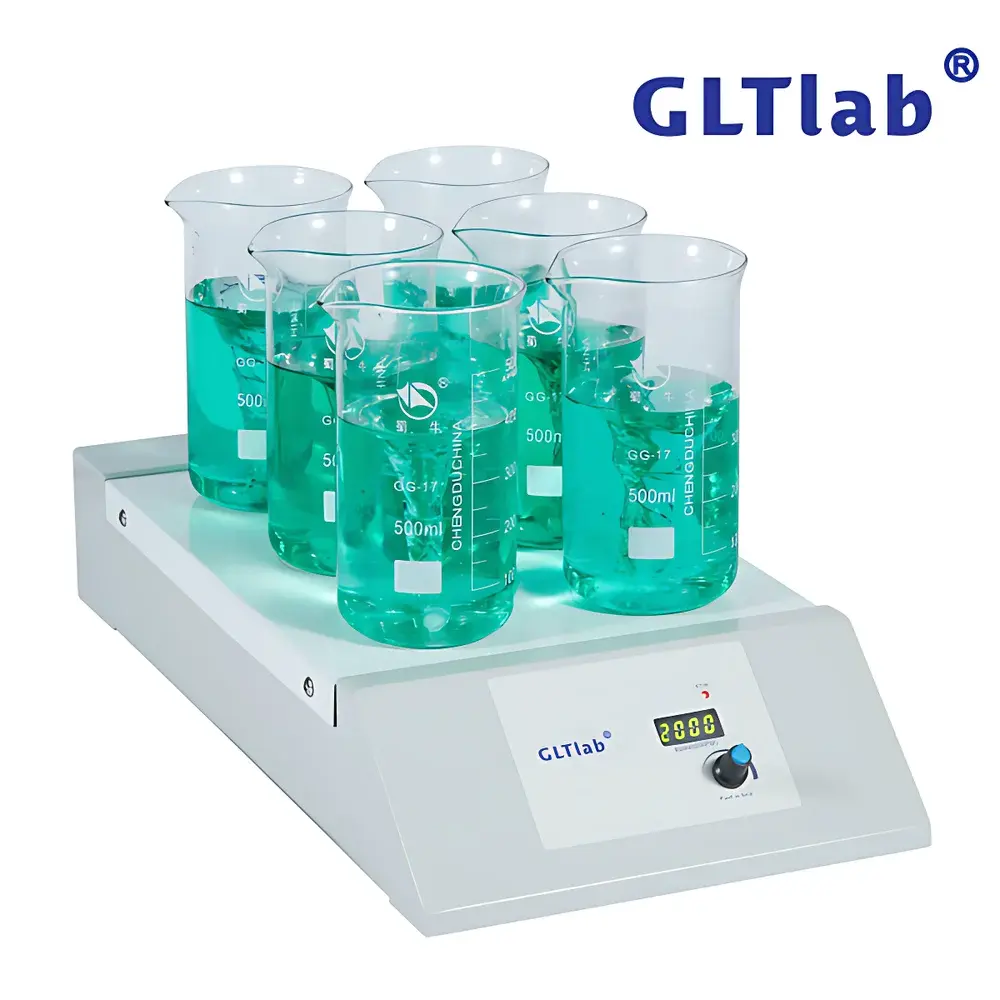
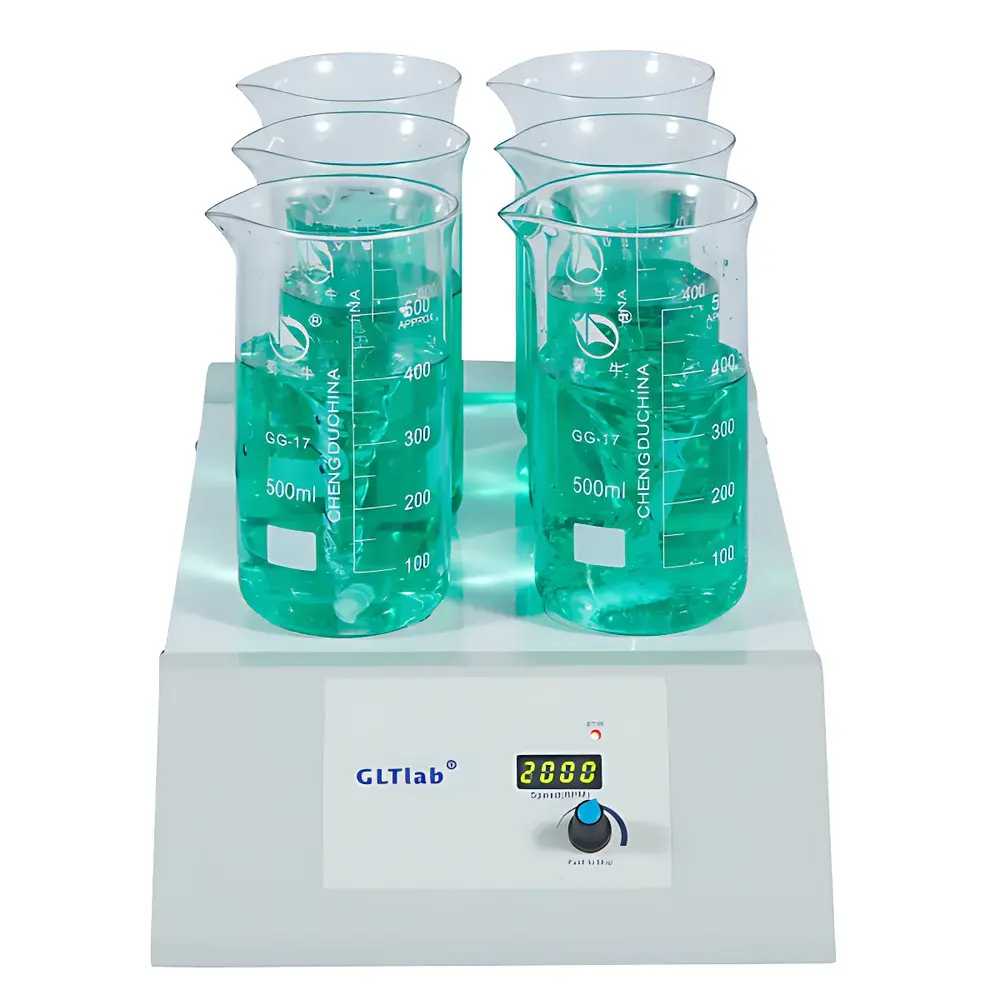
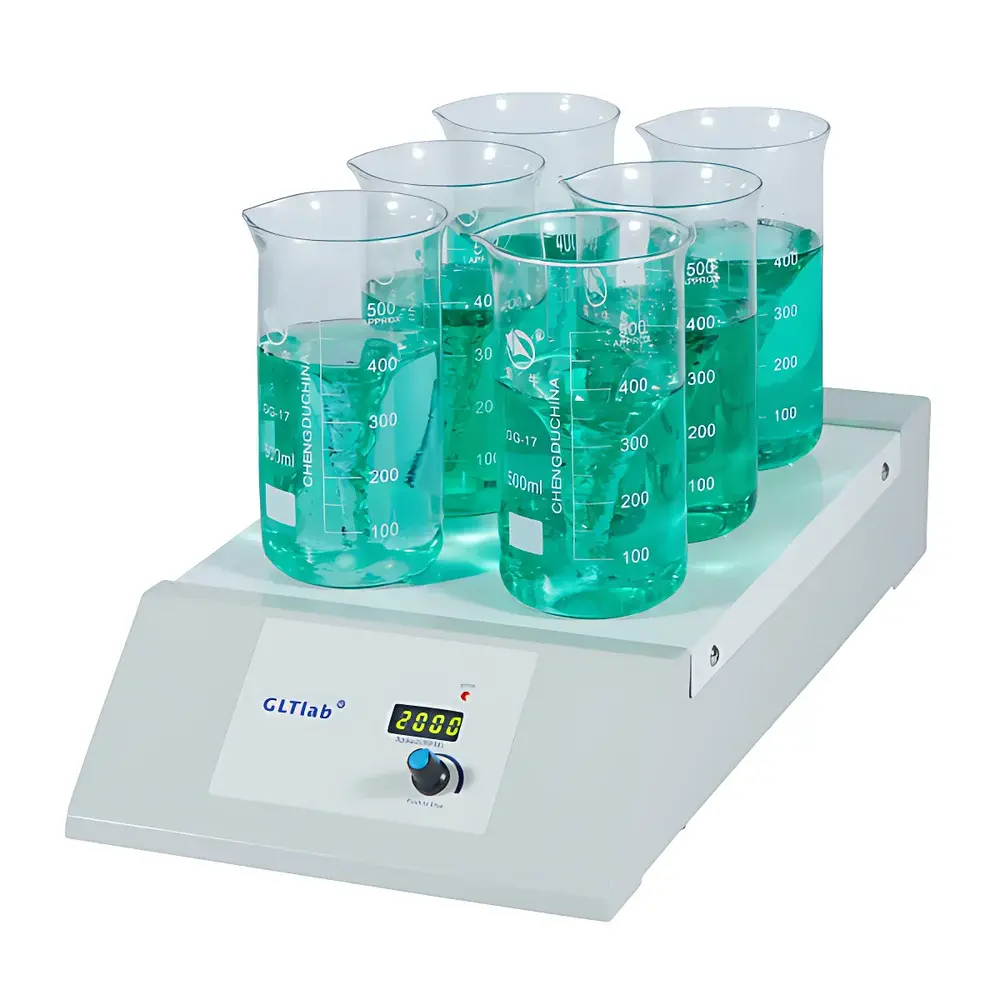
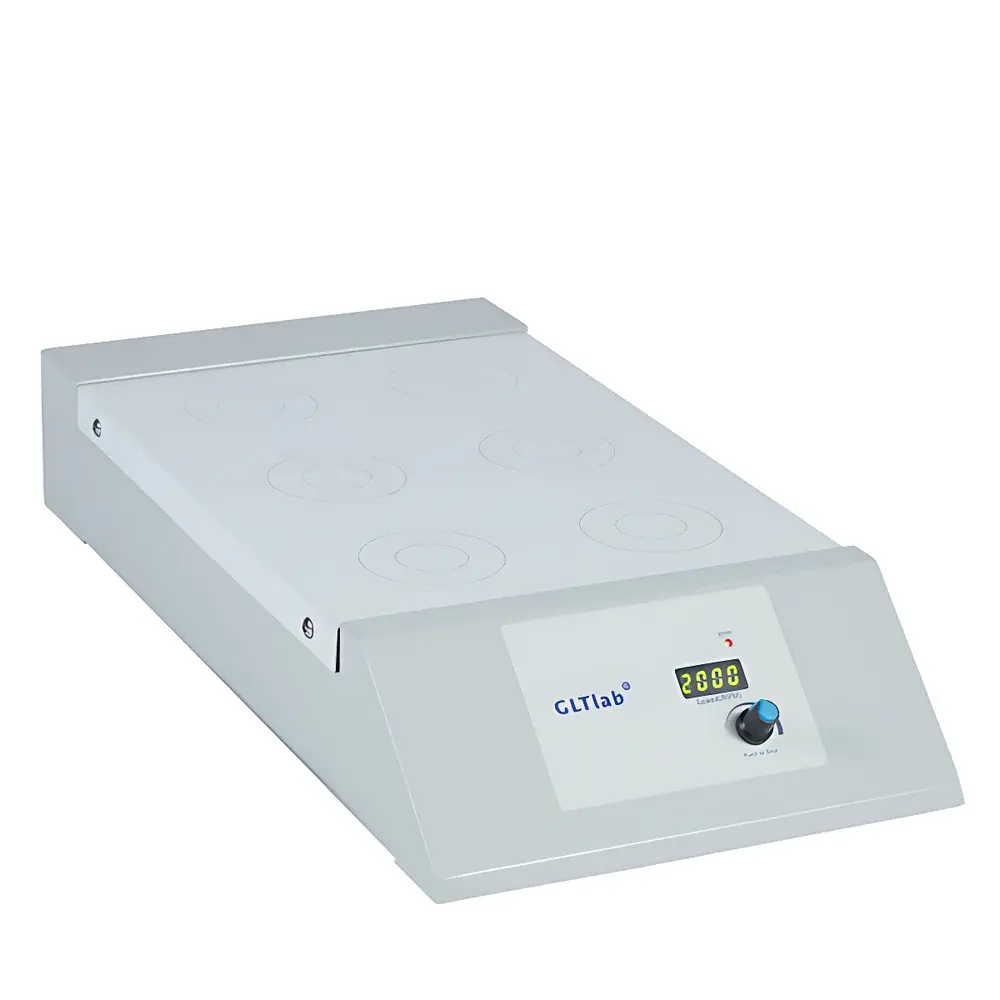
GLTLab SS-6N Six-Position Digital Magnetic Stirrer
| Brand | GLTLab |
|---|---|
| Origin | Guangdong, China |
| Manufacturer Type | Direct Manufacturer |
| Product Category | Domestic |
| Model | SS-6N |
| Instrument Type | Magnetic Stirrer |
| Max. Stirring Volume | 6 L (1 L × 6 positions) |
| Speed Range | 150–2000 rpm |
| Temperature Control Range | Ambient to 120 °C |
| Plate Surface | Ceramic-coated stainless steel |
| Dimensions (W×L×H) | 230 × 340 × 84 mm |
| Plate Size | 230 × 300 mm |
| Weight | 3 kg |
Overview
The GLTLab SS-6N is a six-position digital magnetic stirrer engineered for high-throughput laboratory workflows requiring simultaneous, independent control of multiple samples under consistent thermal and mechanical conditions. It operates on the principle of rotating magnetic fields generated beneath a non-magnetic, ceramic-coated stainless steel heating plate—inducing synchronous rotation of PTFE- or glass-coated magnetic stir bars placed within vessels. Designed for reproducible mixing in analytical sample preparation, reagent synthesis, dissolution testing, and buffer equilibration, the SS-6N integrates precise speed regulation with programmable temperature control across all six stations. Its compact footprint and modular architecture make it suitable for benchtop deployment in QC labs, pharmaceutical development suites, and academic research facilities where spatial efficiency and multi-sample parallelism are critical.
Key Features
- Six independent stirring positions, each supporting up to 1 L volume (total 6 L capacity), enabling concurrent processing without cross-contamination or positional bias.
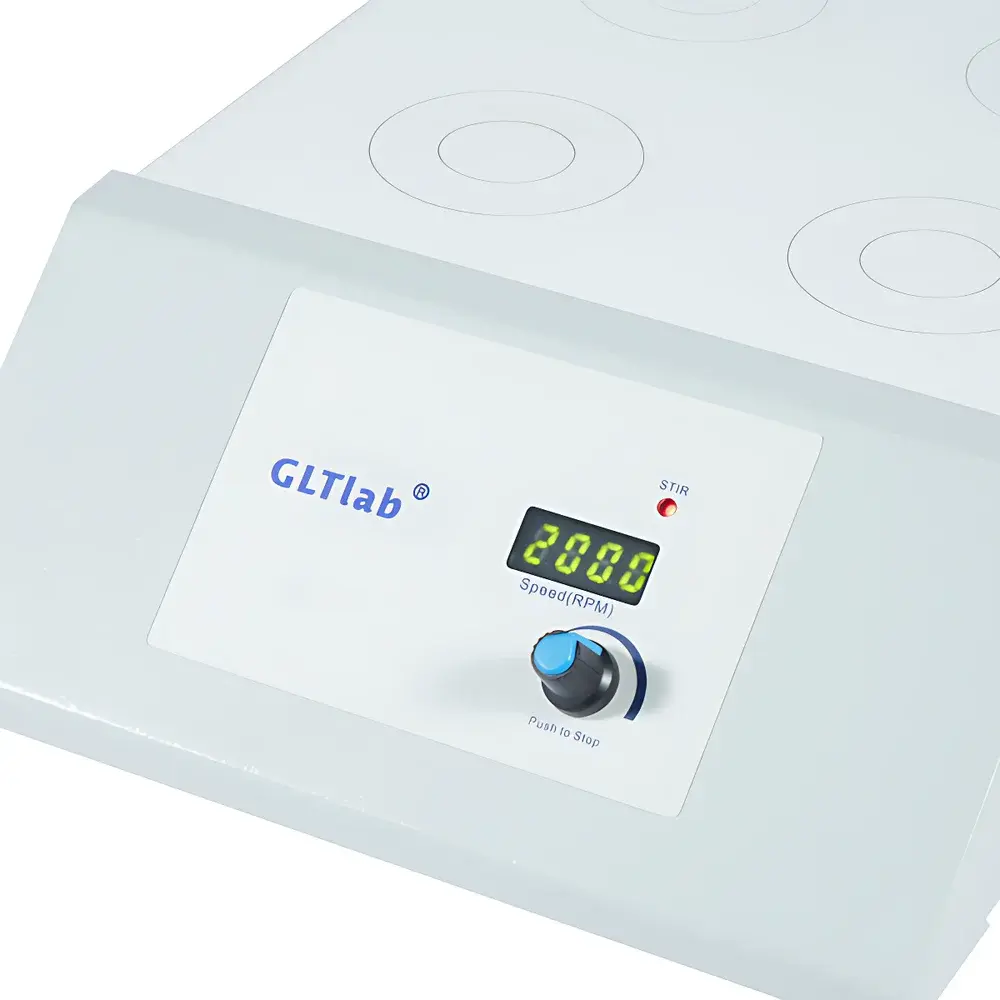
- Digital speed control with resolution of ±10 rpm across the full 150–2000 rpm range, ensuring stable torque delivery even at low speeds for viscous or sensitive solutions.
- Integrated heating plate with ceramic coating over 304 stainless steel substrate—resistant to chemical corrosion, thermal shock, and mechanical abrasion; uniform surface temperature distribution verified per ASTM E2209.
- Temperature control from ambient to 120 °C with ±2 °C accuracy at setpoint (measured at plate surface using calibrated PT100 sensor), supporting applications such as accelerated stability studies and enzymatic reaction kinetics.
- Front-panel LED interface with dedicated digital displays for speed and temperature per channel; optional timer function supports single-cycle or multi-stage protocols (e.g., ramp-hold-cool sequences).
- Robust mechanical design: aluminum alloy housing with reinforced base, IP20-rated enclosure, and thermal cutoff protection at 130 °C to prevent overheating during unattended operation.
Sample Compatibility & Compliance
The SS-6N accommodates standard laboratory glassware including beakers (50–1000 mL), Erlenmeyer flasks, and cylindrical reaction vessels with flat bottoms. Compatibility extends to borosilicate glass, polypropylene, and PTFE-lined containers—provided stir bar geometry and vessel diameter allow efficient coupling with the magnetic field. The device complies with IEC 61010-1:2010 for electrical safety in laboratory equipment and meets CE marking requirements for electromagnetic compatibility (EMC Directive 2014/30/EU). While not certified for GMP environments out-of-the-box, its programmable parameters, audit-ready operation logs (when paired with optional RS-232/USB data export), and traceable calibration support alignment with GLP documentation practices and internal SOPs governing method validation.
Software & Data Management
The SS-6N operates via embedded firmware with no external software dependency; however, optional communication modules enable serial (RS-232) or USB connectivity for integration into centralized lab management systems. When configured with data logging capability, it records timestamped speed, temperature, and runtime values per station at user-defined intervals (1–60 s), exporting CSV-formatted files compatible with LIMS platforms and statistical process control (SPC) tools. All parameter changes—including manual overrides—are logged with operator ID and timestamp, satisfying basic FDA 21 CFR Part 11 requirements for electronic records when deployed with appropriate access controls and audit trail configuration.
Applications
- Pharmaceutical QC: Simultaneous dissolution testing of six tablet batches per USP , buffer pH adjustment, and standard solution homogenization prior to HPLC analysis.
- Materials science: Dispersion of nanoparticles in solvent matrices, polymer solution viscosity conditioning, and precursor mixing for sol-gel synthesis.
- Environmental testing: Extraction and homogenization of soil/water samples prior to ICP-MS or GC-MS analysis.
- Biotechnology: Cell culture media equilibration, antibody conjugation reactions, and enzyme assay buffer preparation under controlled thermal profiles.
- Academic teaching labs: Multi-group experiments in general chemistry, physical chemistry, and biochemistry curricula requiring standardized agitation protocols.
FAQ
Is the SS-6N suitable for use with corrosive solvents such as concentrated acids or halogenated organics?
Yes—the ceramic-coated stainless steel plate provides enhanced resistance to mild to moderate chemical exposure; however, prolonged contact with hydrofluoric acid or molten alkalis is not recommended.
Can individual stations be operated at different speeds and temperatures simultaneously?
Yes—each of the six positions features independent digital control for both speed and temperature, allowing heterogeneous experimental conditions across the same platform.
Does the unit include calibration certificates or support NIST-traceable verification?
Factory calibration is performed per internal QA protocol; users may perform field verification using ISO/IEC 17025-accredited third-party services—no pre-installed certificate is included but documentation templates are available upon request.
What stir bar sizes are recommended for optimal performance at maximum speed (2000 rpm)?
For 1 L vessels, elliptical or cross-shaped stir bars measuring 30–40 mm in length with 8–10 mm width provide optimal vortex formation and stability above 1500 rpm.
Is remote monitoring or network integration supported natively?
No native Ethernet or Wi-Fi capability exists; however, RS-232/USB interfaces permit integration with SCADA systems or custom Python-based monitoring scripts via serial command protocol (available in technical manual).



