
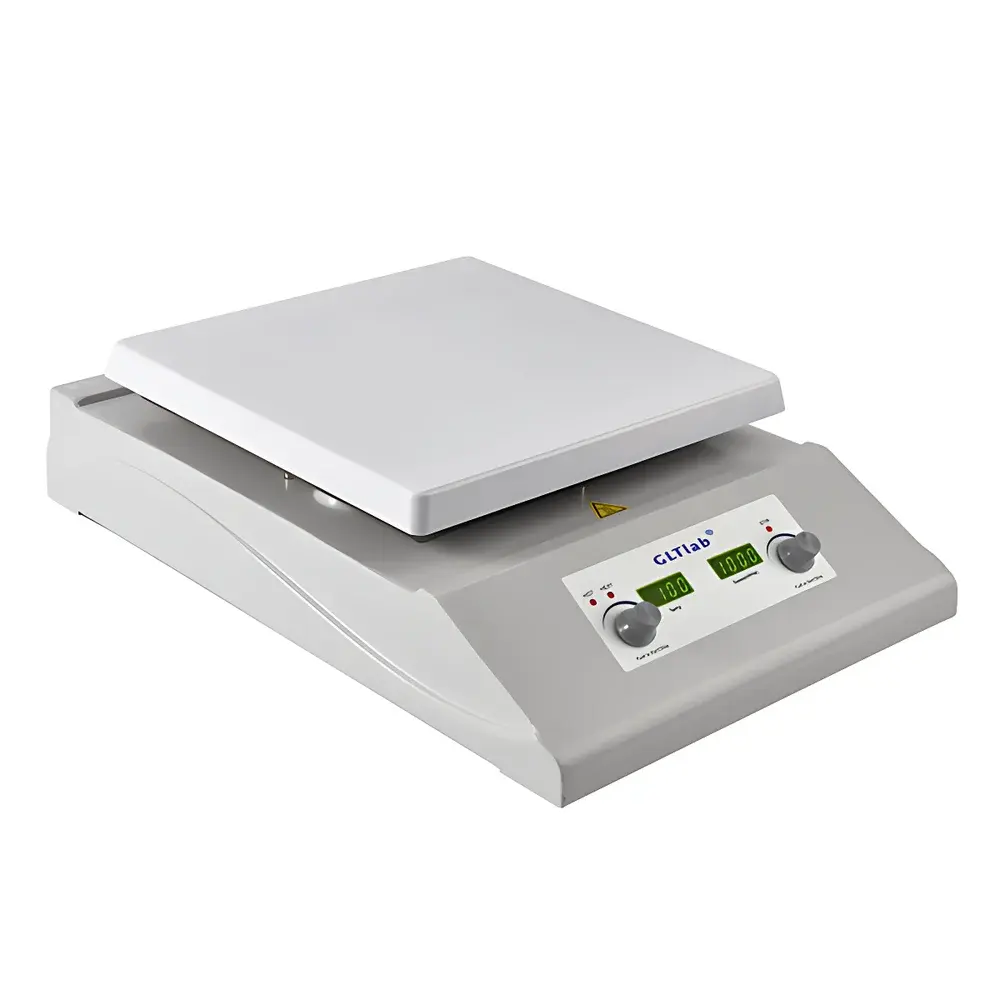
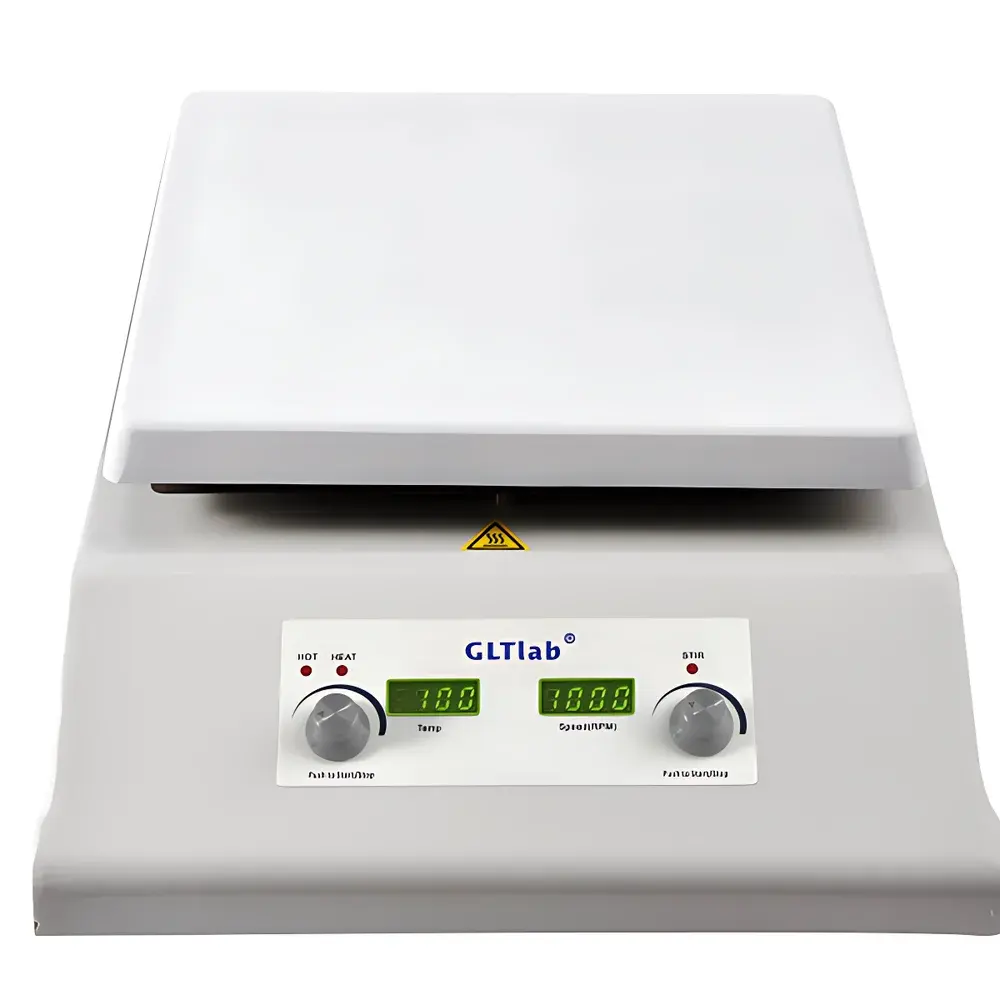
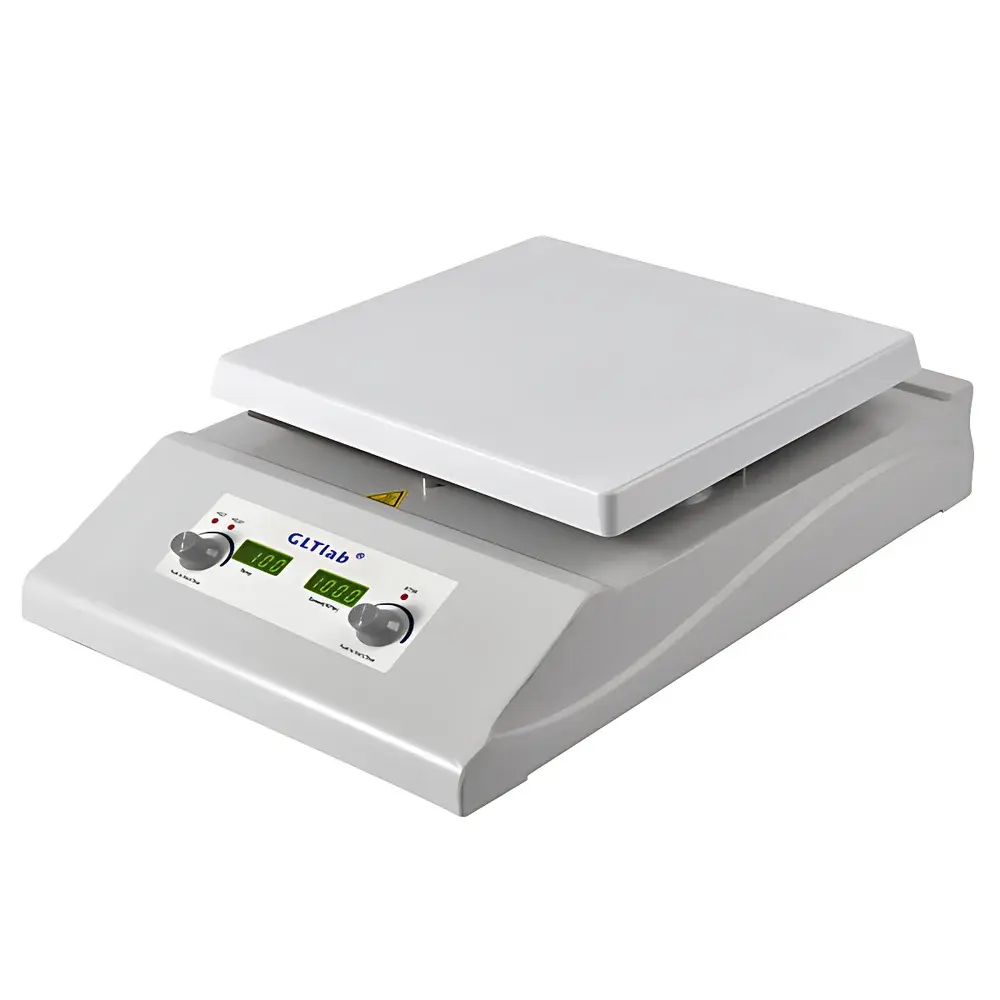
GLTlab SHA-2D 10-Inch High-Temperature Ceramic-Coated Magnetic Stirrer with Integrated Heating Plate
| Brand | GLTlab |
|---|---|
| Model | SHA-2D |
| Type | Magnetic Stirrer with Heated Ceramic Plate |
| Max Stirring Volume | 20 L (H₂O) |
| Speed Range | 150–1500 rpm |
| Plate Temperature Range | 35–400 °C |
| Solution Temperature Range | 35–200 °C |
| Temperature Setting Resolution (Plate) | 1 °C |
| Temperature Setting Resolution (Solution, with PT1000 probe) | 0.1 °C |
| Temperature Stability | ±1 °C |
| PT1000 Control Accuracy | ±0.5 °C |
| External Probe Calibration Function | Yes |
| Stirring Position | Single |
| Panel Material | Alumina-ceramic coated aluminum |
| Panel Diameter | 250 mm (10 in) |
| Power Rating | 1600 W |
| Input Voltage | 100–130 V / 200–240 V AC, 50/60 Hz |
| Dimensions (W×D×H) | 190 × 290 × 100 mm |
| Weight | 3.5 kg |
| Operating Ambient | 5–40 °C, ≤80% RH |
| IP Rating | IP21 |
Overview
The GLTlab SHA-2D is a single-position, high-temperature magnetic stirrer engineered for demanding laboratory applications requiring simultaneous precise stirring and robust thermal control. Unlike conventional stirrers limited to ≤250 °C plate temperatures, the SHA-2D integrates a 10-inch (250 mm) alumina-ceramic coated aluminum heating plate capable of sustained operation up to 400 °C — enabling direct heating of high-boiling-point solvents (e.g., ethylene glycol, silicone oils), molten salts, or viscous polymer precursors without thermal degradation of the surface. Its core principle relies on electromagnetic coupling between the internal drive magnet and PTFE- or glass-coated stir bars, delivering consistent torque across the full 150–1500 rpm speed range. The system supports both open-loop plate temperature control and closed-loop solution temperature regulation via an integrated PT1000 external probe, ensuring traceable thermal performance aligned with ISO/IEC 17025 calibration practices.
Key Features
- 10-inch (250 mm) ceramic-coated aluminum heating plate rated for continuous operation at up to 400 °C — optimized for thermal uniformity and resistance to chemical etching and mechanical abrasion
- Dual-mode temperature control: independent selection of plate-setpoint mode (35–400 °C, 1 °C resolution) or solution-feedback mode (35–200 °C, 0.1 °C resolution) using supplied PT1000 probe
- High-accuracy thermal regulation: ±0.5 °C control precision with PT1000 sensor; ±1 °C stability under steady-state conditions per ASTM E2465
- LED digital display with intuitive parameter navigation, real-time RPM and temperature readouts, and visual overheat warning indicator
- Robust 1600 W power architecture supporting rapid thermal ramping and stable maintenance across large-volume loads (up to 20 L aqueous solutions)
- Calibration-ready design: built-in external probe offset adjustment function compliant with GLP documentation requirements
- Universal dual-voltage input (100–130 V / 200–240 V AC, 50/60 Hz) and IP21-rated enclosure for safe operation in standard laboratory environments
Sample Compatibility & Compliance
The SHA-2D accommodates standard laboratory glassware including beakers (50 mL–5000 mL), round-bottom flasks, and crystallization dishes. Stir bar compatibility spans lengths from 25 mm to 60 mm, with recommended maximum diameters of 8 mm for optimal vortex formation in volumes >5 L. The ceramic coating resists attack from common organic solvents (acetone, THF, DMF), dilute acids (≤1 M HCl, HNO₃), and alkaline media (≤1 M NaOH), extending service life beyond conventional enamel or stainless-steel plates. Device firmware and hardware design conform to IEC 61010-1:2010 safety standards for electrical equipment for measurement, control, and laboratory use. While not inherently 21 CFR Part 11-compliant, audit trails for temperature setpoints and runtime can be manually logged to support FDA-regulated process validation when used within documented SOPs.
Software & Data Management
The SHA-2D operates as a standalone instrument with no proprietary software dependency. All operational parameters — speed, plate/solution setpoint, actual temperature, and elapsed time — are displayed locally on the LED interface. For integration into automated workflows, the unit features a 0–5 V analog output port (optional adapter required) that mirrors real-time plate temperature, enabling connection to external data loggers (e.g., Omega OM-DAQ, National Instruments USB-TC01) or SCADA systems. User-accessible calibration offsets for the PT1000 probe facilitate periodic verification against NIST-traceable reference thermometers — a requirement under ISO/IEC 17025 Clause 6.6 for accredited testing laboratories.
Applications
- Synthesis of high-melting-point metal-organic frameworks (MOFs) requiring extended reflux at >300 °C in high-boiling solvents
- Preparation of concentrated polymer solutions (e.g., PVDF in NMP) where solvent volatility necessitates inert-atmosphere heating above 250 °C
- Standardized dissolution testing per USP , particularly for poorly soluble APIs requiring elevated bath temperatures
- Accelerated aging studies of battery electrolytes and solid-state ion conductors under controlled thermal stress
- Homogenization of nanoparticle dispersions in high-viscosity silicone matrices prior to rheological characterization
- Teaching laboratories conducting Arrhenius kinetic experiments across wide temperature ranges with reproducible stirring conditions
FAQ
What is the maximum recommended vessel diameter for optimal stirring efficiency?
For consistent vortex formation and thermal homogeneity, vessels with diameters ≤180 mm are recommended when operating above 1000 rpm or at plate temperatures >300 °C.
Can the SHA-2D be used under inert gas or vacuum conditions?
Yes — the unit itself contains no sealed electronics or moving parts requiring atmospheric pressure; however, the heating plate surface must remain unobstructed, and glassware must be rated for the intended pressure/temperature profile.
Is the PT1000 probe included with the instrument?
Yes, one calibrated PT1000 external temperature probe is supplied as standard equipment.
Does the device support programmable ramp-soak temperature profiles?
No — the SHA-2D provides manual setpoint control only; multi-step thermal protocols require external programmable controllers or data acquisition systems.
How often should the PT1000 probe be recalibrated?
Per ISO/IEC 17025 guidance, annual calibration against a certified reference thermometer is recommended; more frequent verification is advised after mechanical shock or exposure to thermal cycling beyond 350 °C.



