
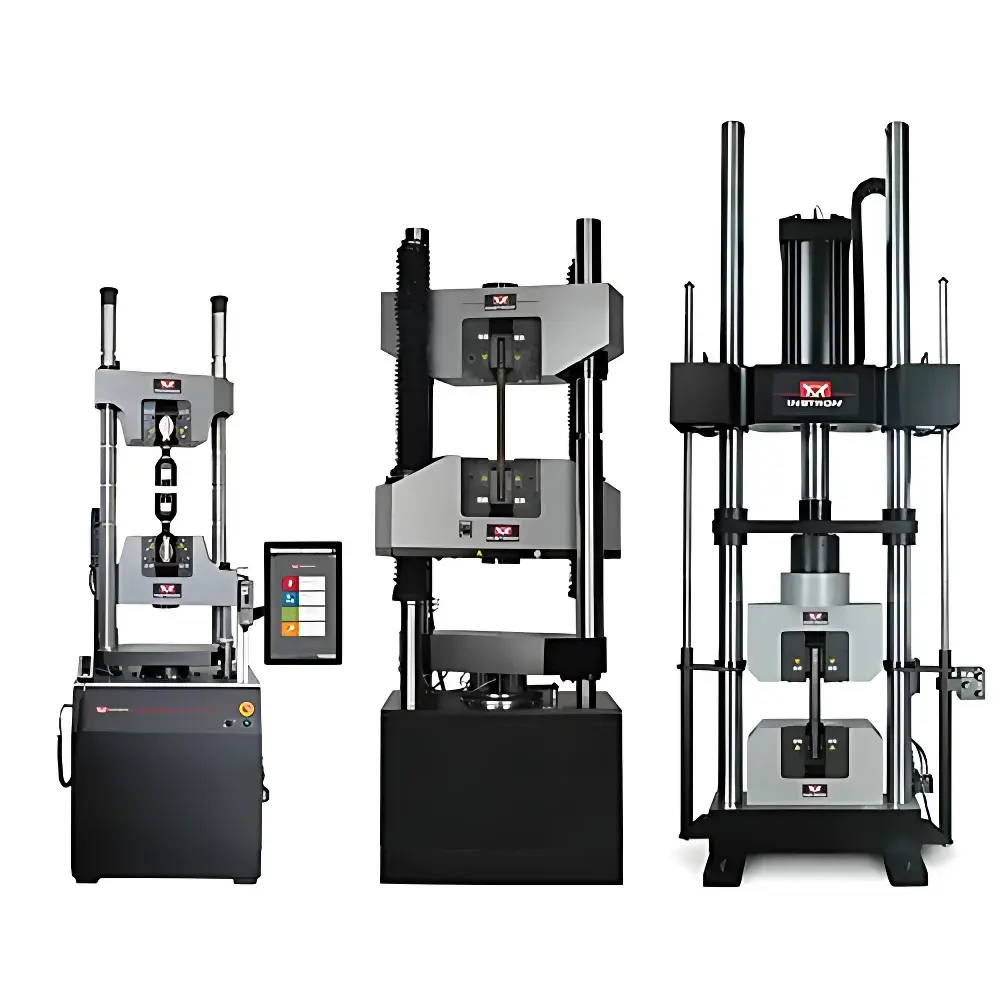
INSTRON Industrial Series Universal Testing System
| Brand | INSTRON |
|---|---|
| Origin | USA |
| Manufacturer Type | Authorized Distributor |
| Origin Category | Imported |
| Model Series | Industrial Series |
| Instrument Type | Hydraulic Universal Testing Machine |
| Control Platform | 5900 Series with V-Series Variable-Pressure Pumping System |
| Load Frame Configuration | Front-Access Hydraulic Grips |
| Load Measurement | High-Accuracy Strain-Gauge Load Cell, Center-Mounted on Loading Axis |
| Data Acquisition | 3 Optional Input Channels + Load & Extension |
| Compliance | ASTM E4, E8/E8M, E9, E21, ISO 6892-1, ISO 7500-1, EN 10002-1, USP <1041>, FDA 21 CFR Part 11 (with optional audit trail module) |
Overview
The INSTRON Industrial Series Universal Testing System is a high-capacity, front-access hydraulic universal testing machine engineered for precision mechanical property evaluation of structural and industrial materials under controlled quasi-static loading conditions. Built upon the proven architecture of the 5900 Series control platform and integrated V-Series variable-pressure hydraulic actuation system, this system delivers robust performance across tensile, compression, flexure, shear, and fastener-specific test protocols. Its core measurement principle relies on closed-loop servo-hydraulic control synchronized with traceable, center-mounted strain-gauge load cells—ensuring load data integrity by eliminating friction-induced artifacts from the actuator column. The front-opening hydraulic grip design enables rapid specimen insertion without incremental crosshead adjustment or actuator jogging, significantly reducing setup time while maintaining alignment fidelity per ASTM E1012 and ISO 9513 requirements.
Key Features
- Front-access hydraulic grips with integrated pressure supply—enabling single-step specimen clamping without crosshead repositioning or manual actuator movement.
- Center-mounted, high-stability strain-gauge load cell directly measuring axial force at the load train’s geometric center—eliminating parasitic moment errors and ensuring compliance with ISO 7500-1 Class 0.5 or better accuracy class.
- V-Series variable-pressure pumping system dynamically modulates hydraulic output: pressure increases proportionally with applied load during testing, then reduces to low-idle state between tests—enhancing energy efficiency and thermal stability.
- 5900 Series control platform providing real-time, high-speed closed-loop control (up to 5 kHz servo update rate) and synchronized acquisition of load, extension, and up to three user-defined analog inputs (e.g., extensometer, temperature, or acoustic emission signals).
- Integrated productivity panel with four programmable soft keys and customizable real-time display zones—supporting operator-guided test initiation, live parameter monitoring (e.g., stress rate, strain rate, modulus), and immediate pass/fail status visualization.
- Precision positioning wheel enabling sub-micron incremental crosshead movement—critical for safe, repeatable specimen alignment and pre-load application without risk of overloading brittle or high-value samples.
Sample Compatibility & Compliance
The Industrial Series accommodates specimens ranging from metallic alloys, composites, concrete, ceramics, and geosynthetic reinforcements to threaded fasteners, weldments, and civil infrastructure components. Standard configurations support ASTM E8/E8M (tensile metals), ASTM C39/C39M (concrete compression), ASTM D790 (flexural plastics), and ISO 6892-1 (metallic tensile testing at ambient temperature). Optional accessories include wedge-action tensile grips (for bars, plates, wires), compression platens with self-aligning spherical seats, three-point and four-point bend fixtures (including rebar-specific tooling), and dedicated fastener test kits compliant with ASTM F606, ISO 898-1, and DIN 267-12. All load cells are factory-calibrated to NIST-traceable standards and support automatic sensor recognition and one-click calibration verification via Bluehill Universal software.
Software & Data Management
Control and analysis are executed through Bluehill Universal software—a validated, 21 CFR Part 11–compliant platform supporting electronic signatures, full audit trail logging, role-based access control, and secure data export (PDF, CSV, XML). The software embeds standardized test methods—including ASTM, ISO, and EN templates—with configurable pass/fail criteria, real-time statistical process control (SPC) charting, and automated report generation featuring embedded metadata (operator ID, environmental conditions, calibration dates). Raw data streams are timestamped at ≥1 kHz resolution and stored in vendor-neutral HDF5 format, ensuring long-term archival integrity and third-party interoperability. Optional IQ/OQ/PQ documentation packages are available for GxP-regulated environments requiring GLP or GMP validation.
Applications
This system serves as a primary mechanical characterization platform in quality control laboratories, R&D centers, and third-party testing facilities engaged in material certification, failure analysis, and regulatory submission support. Typical use cases include yield strength and ultimate tensile strength determination of aerospace-grade titanium alloys; compressive modulus and fracture energy assessment of fiber-reinforced polymer matrices; flexural stiffness evaluation of wind turbine blade composites; axial and wedge tensile verification of Grade 10.9 structural bolts; and shear resistance quantification of adhesive-bonded joints per ASTM D1002. Its modular architecture supports seamless integration with environmental chambers (-70 °C to +300 °C), video extensometry systems, and digital image correlation (DIC) hardware for full-field strain mapping.
FAQ
What standards does this system comply with for load cell calibration and frame alignment?
It meets ISO 7500-1 Class 0.5 for load measurement accuracy and ASTM E1012 for alignment verification, with optional NIST-traceable calibration certificates available.
Can the system perform cyclic or fatigue testing?
No—the Industrial Series is optimized for static and quasi-static tests; for dynamic or high-cycle fatigue applications, INSTRON’s 8800 Series electrodynamic or hydraulic servo systems are recommended.
Is Bluehill Universal software included with the base configuration?
Yes—full-featured Bluehill Universal software is standard, including method templates, reporting modules, and basic 21 CFR Part 11 functionality; advanced audit trail and electronic signature modules require optional licensing.
What maintenance intervals are recommended for the hydraulic system?
Hydraulic fluid and filter replacement is required every 2,000 operating hours or biannually, whichever occurs first; annual verification of pump pressure regulation and grip pressure consistency is advised per INSTRON Service Bulletin SB-5900-04.
Are custom fixture designs supported for non-standard specimens?
Yes—INSTRON’s Application Engineering team provides fixture feasibility review, FEA-based stress analysis, and turnkey fabrication of application-specific tooling under NDA, with full documentation and traceability.



