
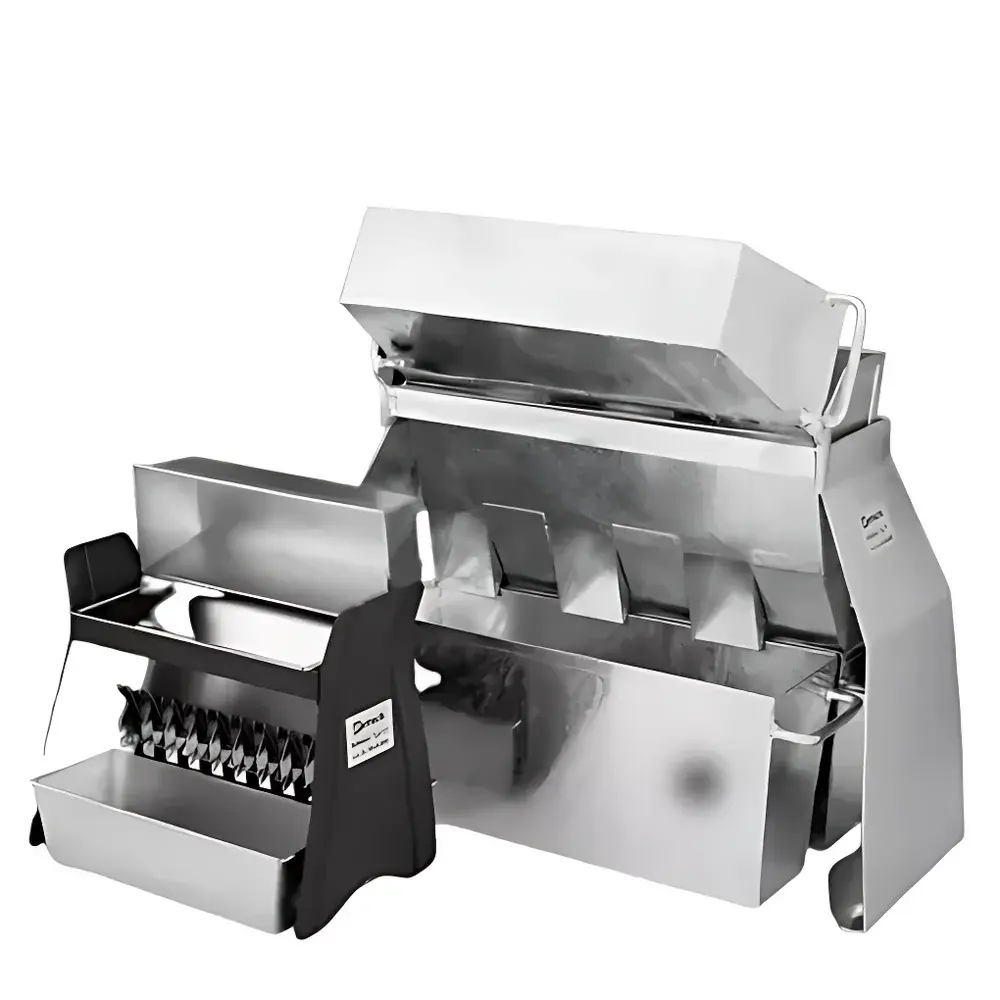
Retsch RT 6.5–75 Trough-Type Sample Divider
| Brand | Retsch |
|---|---|
| Origin | Germany |
| Model | RT 6.5–75 |
| Compliance | DIN 51701 |
| Sample Handling Principle | Manual Trough-Type Division |
| Portability | Benchtop & Field-Deployable |
| Intended Use | Representative Subsampling of Granular, Powdery, and Particulate Bulk Materials |
Overview
The Retsch RT 6.5–75 Trough-Type Sample Divider is a precision-engineered mechanical subsampling device designed for the reproducible reduction of bulk particulate samples while preserving compositional representativeness. Operating on the principle of gravitational trough division—where material flows uniformly across a series of alternating chutes—the instrument implements a fixed splitting ratio (typically 1:8 or 1:16 depending on configuration) in strict accordance with DIN 51701, the German standard governing manual sample division for granular and powdered materials. Unlike rotary or spinning dividers, the RT 6.5–75 employs a static, gravity-fed geometry that eliminates centrifugal bias, vibration-induced segregation, or flow-rate dependency—critical factors when handling cohesive, irregular, or density-heterogeneous materials such as cement slag, metal powders, or agricultural seeds. Its robust stainless-steel construction and modular chute assembly ensure long-term dimensional stability and resistance to abrasion, making it suitable for both laboratory-controlled environments and field-deployed quality control workflows.
Key Features
- Compliance-certified design aligned with DIN 51701 for manual trough-type sample division
- Modular aluminum and stainless-steel frame with corrosion-resistant chute plates and alignment guides
- Fixed-split architecture delivering consistent division ratios without operator-dependent calibration
- Benchtop footprint (650 × 300 × 220 mm) and low mass (<12 kg) enabling transport between lab, plant floor, and field sites
- No electrical power, pneumatics, or moving parts—eliminates maintenance intervals and operational failure modes
- Adjustable feed tray with integrated leveling bubble and sample containment lip to ensure uniform material feed rate and edge control
Sample Compatibility & Compliance
The RT 6.5–75 accommodates dry, free-flowing to moderately cohesive particulates ranging from fine mineral powders (e.g., limestone flour, fly ash) to coarse aggregates (e.g., sand, gravel fractions up to 10 mm), agricultural commodities (whole grains, coffee beans, oilseeds), industrial intermediates (metal powders, polymer granules), and construction materials (cement, blast-furnace slag, lightweight fillers). It is not intended for wet, sticky, fibrous, or highly electrostatic materials requiring fluidized or vibratory feeding. As a reference method tool, its use supports compliance with ISO 14855 (biodegradability testing), ASTM D7429 (plastic particle characterization), and EN 15934 (fertilizer sampling), where representative subsampling is mandated prior to elemental analysis (XRF, ICP-OES), particle size distribution (laser diffraction), or moisture content determination (gravimetric or NIR). The absence of motorized components ensures full compatibility with GLP audit trails and non-instrumented sampling SOPs.
Software & Data Management
The RT 6.5–75 operates entirely without embedded electronics, firmware, or software interfaces. Its functionality is purely mechanical and traceable through documented procedural adherence—not digital logs. Users maintain full auditability via standardized operating procedures (SOPs) that specify feed volume, number of passes, chute orientation, and post-division handling protocols. For laboratories subject to FDA 21 CFR Part 11 or ISO/IEC 17025 requirements, validation documentation—including repeatability studies per ISO 13320 Annex B and inter-operator variability assessments—can be generated using external weighing systems and statistical process control (SPC) software. Retsch provides supplementary technical notes and calibration verification templates compatible with LIMS integration for metadata tagging (e.g., sample ID, lot number, division date, operator ID).
Applications
- Preparation of representative sub-samples for X-ray fluorescence (XRF) analysis of cement clinker and slag composition
- Reduction of heterogeneous soil composites prior to heavy metal extraction and ICP-MS quantification
- Subsampling of bulk fertilizer batches for nutrient assay (N-P-K) and granulometric screening
- Homogenization and division of roasted coffee lots for sensory panel preparation and volatile profiling
- Downstream conditioning of metal powder feedstocks used in additive manufacturing (AM) process qualification
- Quality assurance sampling of pharmaceutical excipients (e.g., microcrystalline cellulose, lactose) under GMP-aligned workflows
FAQ
Does the RT 6.5–75 require calibration or periodic certification?
No—its geometry is fixed and traceable to DIN 51701; however, users must verify chute alignment and surface finish annually using optical leveling tools and visual inspection protocols.
Can it handle samples with high moisture content?
No—moisture levels above 5% w/w may cause bridging or adhesion in chutes; drying or conditioning to equilibrium humidity is recommended prior to division.
Is the splitting ratio adjustable?
No—the RT 6.5–75 delivers a nominal 1:8 division ratio (eight output streams); alternative configurations (e.g., 1:16) require separate chute modules ordered ex-factory.
How is operator variability controlled?
Through standardized feed technique training, use of volumetric scoops or calibrated funnels, and documented pass counts—validated per ISO 565 and ASTM E1444 guidelines.
What cleaning procedures are recommended between sample types?
Dry brushing followed by compressed air purge; for cross-contamination-sensitive applications (e.g., pharmaceuticals), ethanol wipe-down and UV-C exposure of chute surfaces is advised.



