
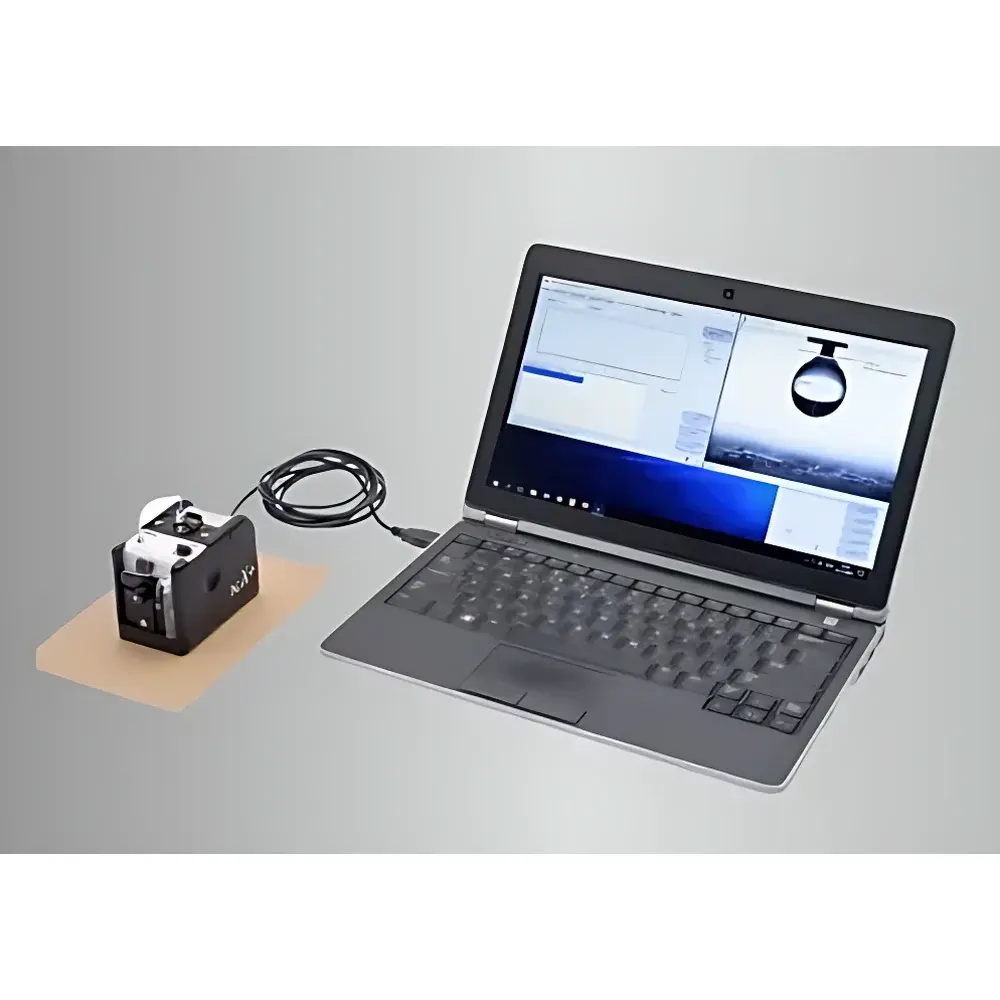
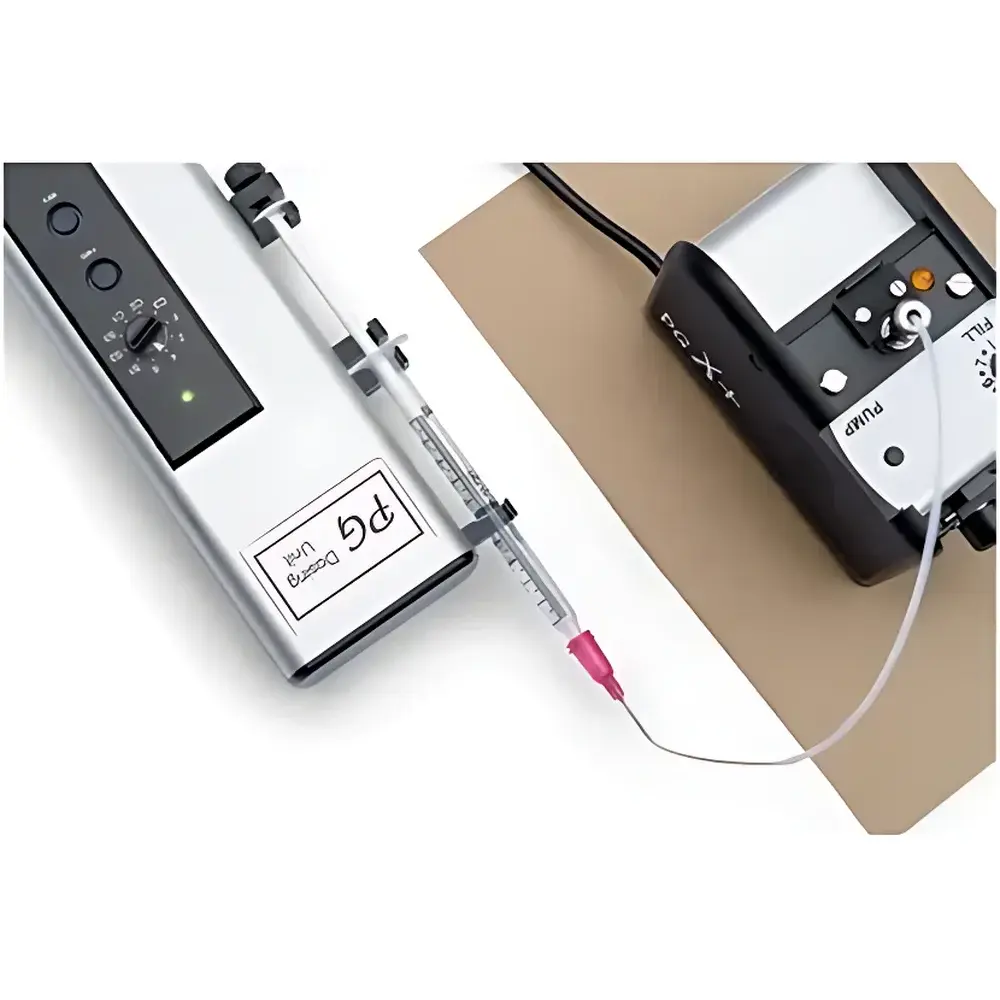
Buchel BV PGX+ Portable Contact Angle Goniometer
| Brand | Buchel BV |
|---|---|
| Origin | Netherlands |
| Manufacturer Type | Authorized Distributor |
| Import Status | Imported |
| Model | 68-76 PGX+ |
| Pricing | Upon Request |
| Dimensions | 90 × 55 × 90 mm (L×W×H) |
| Camera Resolution | 640 × 480 px |
| Frame Rate | 80 fps |
| Minimum Dispensed Droplet Volume | 0.5 µL |
| Contact Angle Range | 5°–180° |
| Accuracy | ±1° |
| Standards Compliance | TAPPI T458, ASTM D-724, ASTM D-5946, GB/T 30447 |
| Interface | USB 2.0 |
| OS Compatibility | Windows XP through Windows 10 (32-bit & 64-bit) |
| Software | PGX+ Suite (surface tension calculation, solid surface energy analysis, dynamic wetting kinetics) |
Overview
The Buchel BV PGX+ Portable Contact Angle Goniometer is a field-deployable, benchtop-compatible optical instrument engineered for quantitative assessment of interfacial wettability between liquids and solid surfaces. Operating on the sessile drop method, it captures high-speed, high-contrast silhouette images of precisely dispensed micro-droplets (down to 0.5 µL) using an integrated CMOS camera (640 × 480 resolution, 80 frames per second). The system computes static contact angles via tangent-based or ellipse-fitting algorithms, and supports time-resolved dynamic measurements—including advancing/receding angles, contact angle hysteresis, droplet spreading kinetics, and adsorption rate profiling—critical for evaluating surface heterogeneity, coating uniformity, and substrate pre-treatment efficacy in packaging material development and quality control.
Key Features
- True portability: Fully self-contained unit housed in a rugged, compact carry case (90 × 55 × 90 mm), including calibrated reference slides, spare pump tubing, syringe tips, and printed user manual.
- Integrated precision microdispensing: Onboard programmable syringe pump enables reproducible delivery of sub-microliter droplets without external controllers or foot pedals.
- Real-time image acquisition: 80 fps capture rate ensures accurate temporal resolution for dynamic contact angle evolution—essential for characterizing rapid wetting phenomena on porous or absorbent substrates such as corrugated board, kraft paper, or metallized films.
- Dual-mode operation: Automated static mode for equilibrium angle determination; dynamic mode for sequential frame-by-frame analysis with timestamped metadata export.
- USB-native connectivity: Plug-and-play interface requires no driver installation—compatible with standard Windows environments (XP through 10, both 32-bit and 64-bit architectures).
- Comprehensive software suite: PGX+ software provides automated baseline detection, multi-point contact angle mapping, surface tension estimation (via pendant drop or Wilhelmy plate modules), Owens-Wendt-Rabel-Kaelble (OWRK) surface energy decomposition, and customizable report generation compliant with internal QA documentation protocols.
Sample Compatibility & Compliance
The PGX+ accommodates flat, rigid, or moderately flexible planar samples up to 100 mm × 100 mm, including laminated films, coated foils, printed cartons, extruded polyolefin sheets, and fiber-based substrates common in food, pharmaceutical, and industrial packaging. Its measurement methodology adheres strictly to internationally recognized standards governing surface wettability characterization: TAPPI T458 (contact angle on paper and paperboard), ASTM D724 (surface wettability of paper), ASTM D5946 (corona treatment level evaluation via water contact angle), and GB/T 30447 (Chinese national standard for surface free energy of polymer films). All calibration routines are traceable to NIST-certified reference standards, and software audit trails support GLP-compliant data integrity requirements.
Software & Data Management
PGX+ software implements a structured project-based file architecture, enabling secure storage of raw image sequences, processed angle profiles, metadata (operator ID, date/time stamp, environmental notes), and derived parameters (hysteresis, spreading coefficient, surface energy components). Export options include CSV for statistical analysis in JMP or Minitab, PDF reports with embedded images and pass/fail thresholds, and XML for integration into LIMS environments. The software enforces role-based access control and maintains immutable electronic records in accordance with FDA 21 CFR Part 11 principles—supporting electronic signatures, change history logs, and user authentication where configured within enterprise IT infrastructure.
Applications
- Corona and plasma treatment verification on PE, PP, PET, and aluminum foil prior to printing or lamination.
- Quantitative evaluation of ink adhesion readiness on recycled fiberboard and barrier-coated paperboard.
- Surface energy mapping across roll-to-roll converted webs to detect treatment non-uniformity or contamination-induced hydrophobic recovery.
- Development and validation of aqueous-based barrier coatings (e.g., starch-PVOH blends) for compostable packaging.
- QC release testing of medical device packaging substrates per ISO 11607-1 Annex B criteria for sealant layer wettability.
- Root-cause analysis of delamination failures by correlating local contact angle anomalies with SEM-EDS elemental distribution maps.
FAQ
Can the PGX+ measure contact angles on curved or textured packaging surfaces?
The instrument is optimized for flat, macroscopically homogeneous surfaces. For slightly curved or embossed substrates (e.g., thermoformed trays), manual stage leveling and localized ROI selection are required—results reflect local wettability but may not represent bulk surface behavior.
Is surface tension calculation limited to pure liquids?
PGX+ supports surface tension determination for pure solvents and binary mixtures using the pendant drop method; accuracy degrades for surfactant-laden or highly viscous formulations due to dynamic shape relaxation effects.
Does the system support automated batch processing of multiple samples?
Yes—through script-enabled workflows in PGX+ software, users can define multi-sample sequences with preset dispensing volumes, exposure times, and analysis templates, reducing operator dependency and inter-test variability.
How often does the pump require recalibration or maintenance?
The integrated syringe pump is factory-calibrated and requires no routine recalibration; replacement of disposable tubing every 6–12 months (depending on usage frequency and solvent compatibility) is recommended to maintain volumetric accuracy.
Can measurement data be exported directly into SAP QM or TrackWise?
Native ERP/LIMS integration is achieved via standardized CSV/XML exports; direct API-level connectivity requires custom middleware configuration managed by qualified IT validation personnel.





