
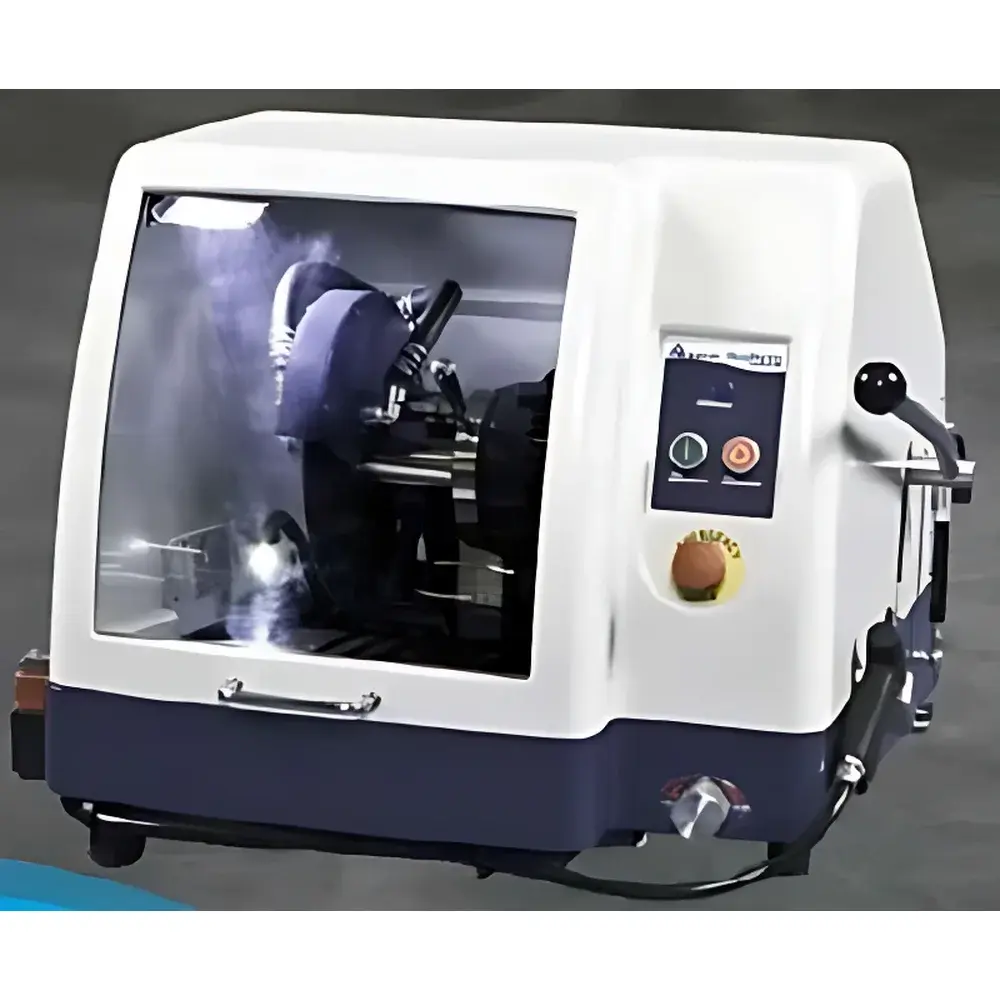
Buehler AbrasiMet 250 Manual Abrasive Cut-Off Machine
| Brand | Buehler |
|---|---|
| Origin | USA |
| Model | AbrasiMet 250 |
| Type | Abrasive Cut-Off Machine |
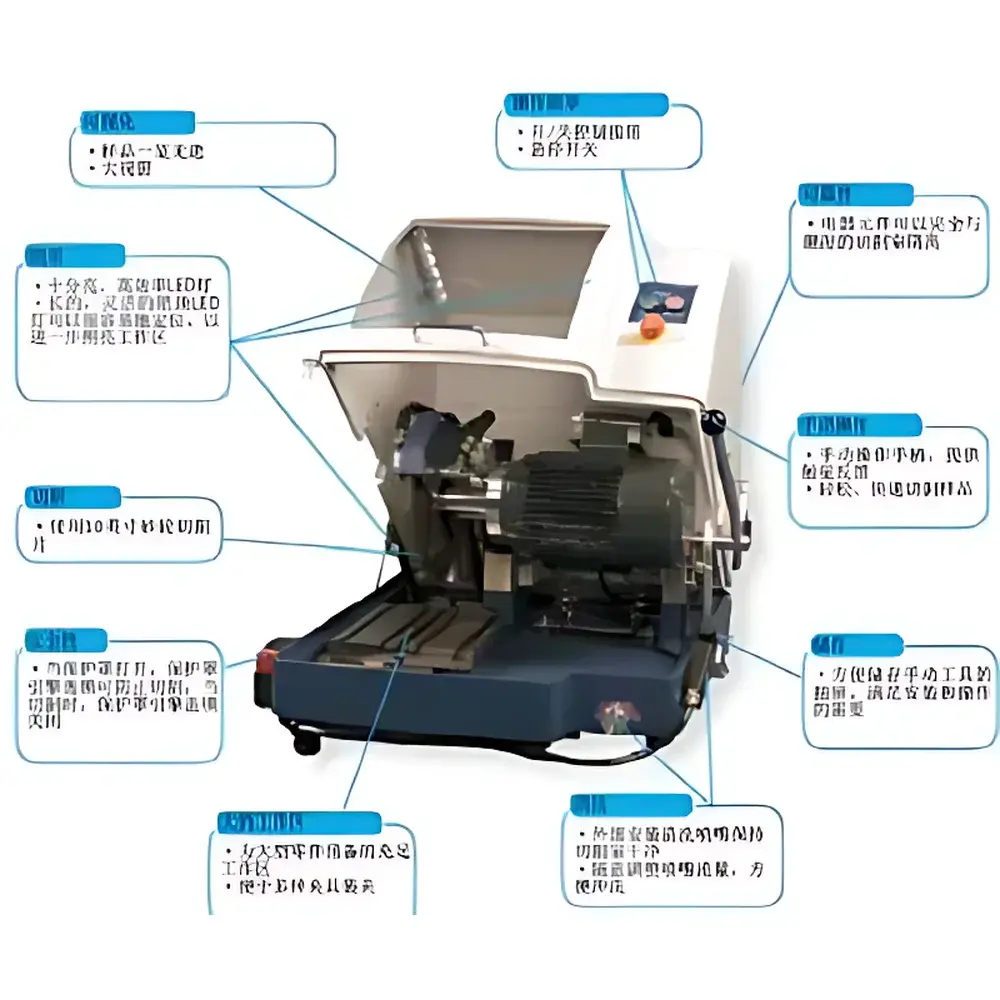
| Lighting | High-visibility LED illumination |
| Work Chamber | Spacious, optimized for sample handling |
| Fixture Compatibility | PetroCut® modular fixture system |
| Accessories | Removable debris basket, adjustable spray hose for coolant delivery |
| Status | Discontinued |
Overview
The Buehler AbrasiMet 250 is a manually operated abrasive cut-off machine engineered for precision sample sectioning in metallurgical, geological, and materials science laboratories. It operates on the principle of high-speed abrasive wheel cutting under controlled coolant application—typically water or water-based emulsion—to minimize thermal damage and preserve microstructural integrity. Designed for reproducible, low-distortion cuts in hard and brittle materials—including metals, ceramics, composites, and rock specimens—the AbrasiMet 250 features a robust cast-iron frame, manually adjustable vertical feed, and a large-diameter abrasive wheel (standard 250 mm) mounted on a rigid spindle assembly. Though discontinued as of 2021, the system remains widely referenced in laboratory method documentation and continues to support standardized preparation workflows aligned with ASTM E3, ISO 14489, and ASTM D7236 (for geological specimen sectioning).
Key Features
- Large observation window with integrated high-luminance, energy-efficient LED lighting—providing uniform illumination across the entire cutting zone without shadowing or glare.
- Spacious work chamber (W × D × H: 305 × 254 × 203 mm) enabling rapid loading/unloading of irregularly shaped or oversized samples, including core samples up to Ø100 mm and 150 mm in length.
- Modular clamping system compatible with Buehler’s PetroCut® fixture suite—allowing precise angular orientation (0°–90°), multi-position indexing, and secure mounting of cylindrical, slab, or irregular geological specimens.
- Adjustable coolant spray nozzle with flexible hose and flow control valve—ensuring targeted delivery to the wheel–sample interface to suppress dust, reduce frictional heating, and extend wheel life.
- Removable stainless-steel debris collection basket positioned beneath the cutting zone—facilitating efficient cleanup and preventing clogging of drainage channels during extended operation.
- Ergonomic manual feed handle with fine-pitch thread mechanism—delivering smooth, vibration-damped downward motion and repeatable positioning accuracy within ±0.2 mm per full rotation.
Sample Compatibility & Compliance
The AbrasiMet 250 accommodates a broad range of sample geometries and material classes: ferrous and non-ferrous metals (e.g., steel, aluminum alloys, titanium), sintered carbides, refractory oxides (Al₂O₃, ZrO₂), silicon wafers, concrete cores, and sedimentary or igneous rock specimens. Its mechanical design conforms to IEC 61000-6-2 (EMC immunity) and UL 61010-1 safety requirements for laboratory electrical equipment. While not certified for automated process validation, its manual operation supports GLP-compliant documentation when integrated into SOPs referencing ASTM E3-22 (“Standard Guide for Preparation of Metallographic Specimens”) and ISO/IEC 17025 clause 7.2.2 (method validation for sample preparation). The absence of programmable logic controllers or digital logging means it does not meet FDA 21 CFR Part 11 requirements for electronic records—but remains suitable for pre-analytical sample conditioning in regulated QC environments where manual intervention is explicitly permitted.
Software & Data Management
The AbrasiMet 250 is a fully manual, non-digital instrument with no embedded firmware, touchscreen interface, or data export capability. All operational parameters—including feed rate, cut depth, and coolant flow—are set and monitored visually by the operator. No software installation, driver configuration, or network connectivity is required. This architecture eliminates cybersecurity vulnerabilities, ensures long-term operational stability, and simplifies maintenance—making it particularly suited for labs prioritizing deterministic repeatability over digital traceability. Documentation of cutting conditions must be recorded externally (e.g., in lab notebooks or LIMS entries) per institutional SOPs governing manual sample preparation steps.
Applications
- Sectioning of metallographic specimens prior to mounting, grinding, and polishing—especially for failure analysis, coating thickness evaluation, and grain structure assessment.
- Preparation of thin sections and slabbed samples from drill cores in geological and petrographic laboratories, often in conjunction with PetroCut® fixtures for oriented cuts parallel or perpendicular to bedding planes.
- Routine trimming of additively manufactured parts to isolate representative cross-sections for porosity analysis or residual stress measurement.
- Cutting of ceramic matrix composites and thermal barrier coatings for interfacial characterization via SEM-EDS or FIB-SEM.
- High-tolerance sectioning of electronic packaging substrates (e.g., AlN, SiC) where minimal kerf loss and edge chipping are critical.
FAQ
Is the AbrasiMet 250 still supported by Buehler for service or spare parts?
Yes—though production ceased in 2021, Buehler maintains an active spare parts inventory for the AbrasiMet 250, including wheels, flanges, coolant hoses, LED assemblies, and clamping components. Field service support is available through authorized regional service centers.
What abrasive wheel specifications are recommended for optimal performance?
Standard configuration uses a 250 × 2.0 × 31.75 mm resin-bonded silicon carbide or aluminum oxide wheel rated for ≤4,500 rpm. Wheel selection must comply with ANSI B7.1 and EN 12413 standards; maximum operating speed must never exceed the wheel manufacturer’s rated limit.
Can the AbrasiMet 250 be used for wet or dry cutting?
It is designed exclusively for wet cutting with continuous coolant flow. Dry operation is prohibited due to excessive heat generation, accelerated wheel wear, and potential ignition risk with organic-bonded wheels.
Does it meet OSHA or EU CE requirements for workplace safety?
When equipped with the standard polycarbonate safety guard, splash shield, and functional emergency stop, the system complies with OSHA 1910.212 and EU Machinery Directive 2006/42/EC Annex I essential health and safety requirements.
How does it compare to the current AbrasiMet 300 model?
The AbrasiMet 300 introduces motorized vertical feed, programmable cut cycles, integrated digital position feedback, and optional vacuum-assisted debris extraction—offering enhanced reproducibility for high-throughput labs. The 250 retains advantages in simplicity, tactile control, and lower total cost of ownership for low-to-medium volume applications.



