
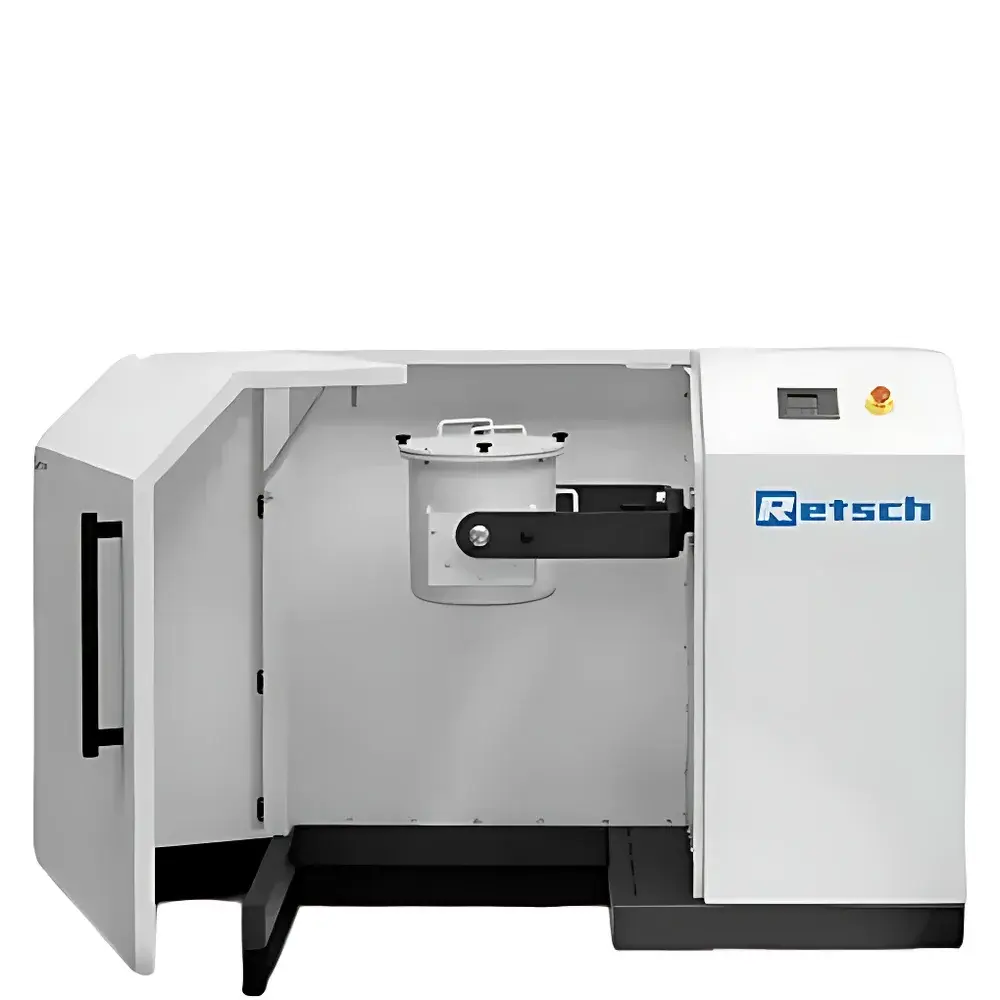
RETSCH TM 300 Drum Mill
| Brand | RETSCH |
|---|---|
| Origin | Germany |
| Model | TM 300 |
| Grinding Type | Dry & Wet |
| Sample Hardness | Hard to Very Hard |
| Max Feed Size | < 20 mm |
| Final Particle Size | < 20 µm |
| Batch Volume Range | 1–20 L |
| Drive | Variable-Speed Electric Motor |
| Grinding Media | Interchangeable Ball or Rod Sets |
| Drum Capacity | 5–43.4 L (standard) |
| Discharge | Tilted Drum with Sealed Gasket & Integrated Sieve Grid (for ball separation) |
| Construction | Heavy-Duty Steel Frame with Mobile Base |
| Safety | Acoustic Enclosure, Emergency Stop Button, Hinged Soundproof Cover |
| Ergonomics | Handle-Fitted Funnel Rail System, Quick-Release Drum Mounting, Integrated Sample Collection Tray |
| Data Interface | Digital Display for Speed, Time, and Direction Control |
Overview
The RETSCH TM 300 Drum Mill is a heavy-duty, industrial-grade laboratory grinding instrument engineered for high-capacity size reduction of hard, brittle, and fibrous materials. Operating on the principle of tumbling attrition—where rotational motion induces cascading impact and shear between grinding media (steel balls or rods) and sample particles—the TM 300 delivers consistent, reproducible particle size distributions across batch volumes ranging from 1 L to 20 L. Its robust cast-steel frame, precision-machined drum housing, and vibration-damped mounting system ensure mechanical stability during extended operation cycles. Designed in accordance with DIN EN ISO 9001 quality management standards and compliant with EU Machinery Directive 2006/42/EC, the TM 300 meets essential safety and performance requirements for routine use in accredited testing laboratories, R&D facilities, and quality control environments.
Key Features
- Variable-speed drive (typically 20–70 rpm range) enables precise optimization of impact energy and grinding kinetics for diverse material classes—from quartz and cement clinker to polymer composites and biological tissues.
- Interchangeable grinding configurations: switch seamlessly between ball mill and rod mill modes using standardized, wear-resistant grinding media sets (e.g., stainless steel, tungsten carbide, or ceramic elements).
- Tilted drum mechanism (up to 45°) with integrated sealing gasket ensures complete, contamination-free discharge while preventing cross-sample carryover; optional sieve grid retains grinding media during unloading.
- Acoustically insulated enclosure reduces operational noise to ≤72 dB(A), supporting compliance with occupational health guidelines (e.g., EU Directive 2003/10/EC on noise exposure).
- Digital control panel displays real-time parameters—including rotational speed, elapsed time, direction (forward/reverse), and programmable pause intervals—enabling full traceability for GLP/GMP-aligned workflows.
- Modular design includes mobile base with locking casters, quick-release drum clamps, and ergonomic funnel rail system for rapid setup, cleaning, and maintenance without tools.
Sample Compatibility & Compliance
The TM 300 accommodates a broad spectrum of inorganic and organic matrices, including but not limited to: ores (e.g., iron, copper, bauxite), construction materials (concrete, slag, limestone, gypsum), catalysts, ceramics, electronic waste, carbon-based substances (coal, coke, charcoal), soils, compost, plant biomass, bone, hydroxyapatite, and synthetic polymers. Its ability to process feed particles up to 20 mm and achieve final fineness below 20 µm makes it suitable for sample preparation prior to XRF, XRD, ICP-OES, SEM-EDS, or leaching assays (e.g., TCLP, EN 12457). All wet-grinding operations are compatible with aqueous or solvent-based media, provided chemical resistance of drum liners (standard stainless steel AISI 304 or optional AISI 316) is verified per application. The instrument conforms to relevant ASTM standards for comminution equipment (e.g., ASTM D2974, D3174) and supports audit-ready documentation under ISO/IEC 17025-accredited testing protocols.
Software & Data Management
While the TM 300 operates via an embedded microcontroller-based interface (no PC dependency), its digital display logs critical operational metadata—including timestamped start/stop events, total runtime, average RPM, and directional cycling history. This data can be manually recorded into LIMS or ELN systems to satisfy FDA 21 CFR Part 11 requirements for electronic records when paired with institutional SOPs governing instrument calibration, preventive maintenance, and user access control. Optional RS-232 or USB connectivity (via third-party interface modules) allows integration into centralized lab automation platforms for remote monitoring and batch reporting.
Applications
- Preparation of homogenized reference materials for geochemical analysis and metallurgical assay.
- Size reduction of heterogeneous environmental samples (e.g., sewage sludge, fly ash, contaminated soils) prior to regulatory leaching tests.
- Routine comminution of catalyst pellets and spent catalysts in petrochemical QA/QC labs.
- Homogenization of composite powders for additive manufacturing feedstock qualification.
- Grinding of pharmaceutical excipients and herbal matrices under cGMP-compliant conditions (when validated per USP & Ph. Eur. general chapters).
- Processing of archaeological or forensic specimens (bone, teeth, charcoal) requiring minimal thermal or oxidative degradation.
FAQ
What is the maximum recommended continuous operating time for the TM 300?
The TM 300 is rated for uninterrupted operation up to 96 hours under standard load conditions; however, thermal management and grinding media wear should be assessed per material-specific protocols.
Can the TM 300 be used for cryogenic grinding?
No—its mechanical architecture and sealing system are not designed for liquid nitrogen cooling; for cryo-applications, RETSCH’s MM series mixer mills are recommended.
Is the drum volume adjustable?
Drum capacity is fixed per unit (standard 5–43.4 L); however, effective batch volume is controlled by fill level (typically 20–30% of drum volume for optimal cascading action).
How often does the grinding media require replacement?
Service life depends on material hardness and cumulative grinding hours; stainless steel balls typically last >500 h in medium-hard applications (e.g., limestone), while tungsten carbide media extend service life in abrasive mineral processing.
Does the TM 300 support automated cleaning cycles?
It does not include built-in cleaning automation; however, the tilting drum and removable liners facilitate manual solvent rinsing or ultrasonic post-processing per ISO 17025 cleanliness validation procedures.



