
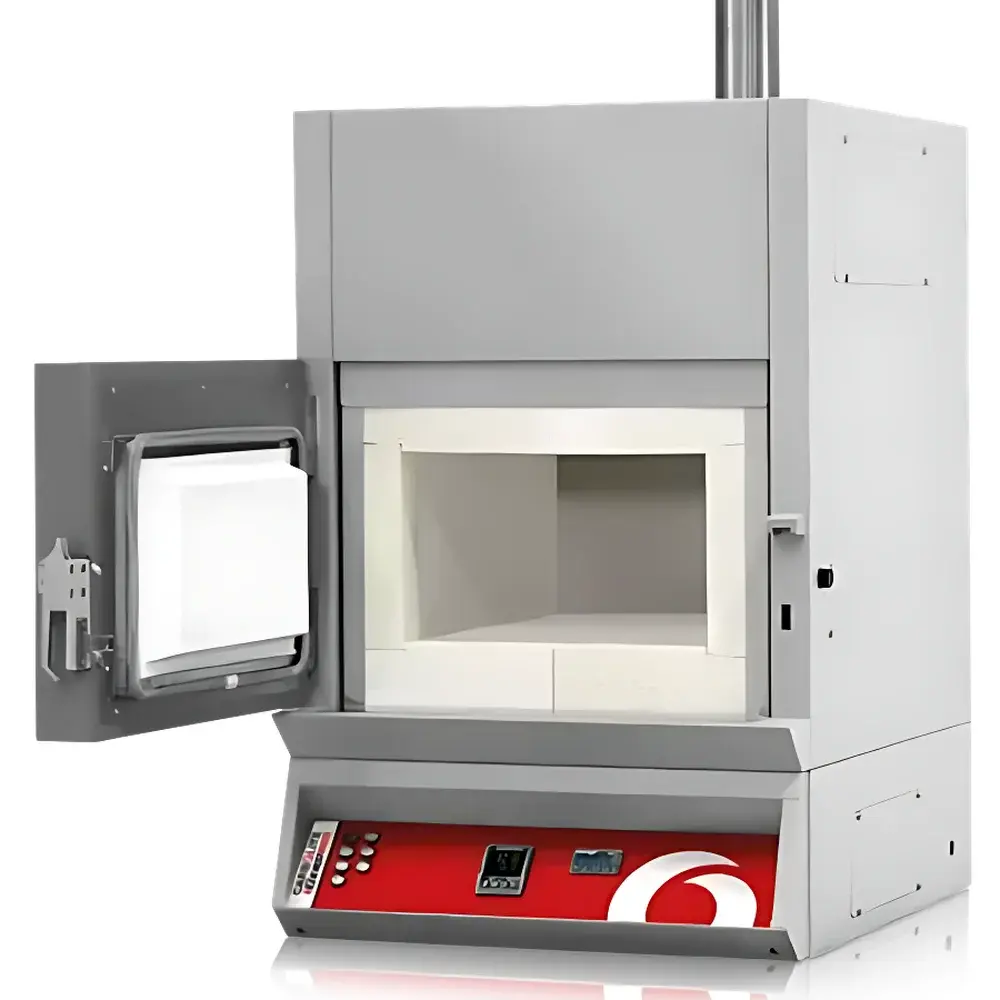
Carbolite Gero ABF Series Ashing Furnace with Afterburner System
| Brand | Carbolite Gero |
|---|---|
| Origin | Germany |
| Instrument Type | Box-type Muffle Furnace |
| Model | ABF |
| Maximum Operating Temperature | 800 °C (Programmable Auxiliary Heating up to 950 °C) |
| Chamber Volume | 28 L |
| Max. Batch Carbon Load | 40 g |
| Construction | Dual-Layer Sample Rack with Handle and Tray |
| Heating Element Protection | Silicon Carbide Floor Plate |
| Power Supply | Three-Phase |
| Control System | EPC3016P1 Programmable Digital Controller |
| Communication Interface | Ethernet (Optional) |
| Safety | Independent Overtemperature Protection Circuit |
| Compliance | Designed for GLP/GMP environments |
Overview
The Carbolite Gero ABF Series Ashing Furnace with Integrated Afterburner System is an engineered solution for high-volume, smoke-intensive ashing applications—particularly suited for biomass, foodstuffs, animal feed, sludge, and other organic matrices with elevated volatile content. Unlike conventional muffle furnaces, the ABF employs a two-stage thermal oxidation process: primary pyrolysis and carbonization occur within the main furnace chamber (rated to 800 °C), while combustible off-gases—including CO, hydrocarbons, and tars—are directed to a secondary afterburner zone where they undergo complete oxidation at elevated temperatures (up to 950 °C under auxiliary heating). This dual-chamber architecture eliminates visible smoke, minimizes odor emissions, and ensures compliance with local exhaust ventilation (LEV) and environmental health & safety (EHS) requirements in modern analytical laboratories.
Key Features
- Dual-stage thermal processing: Primary ashing chamber + dedicated afterburner unit integrated into a single compact footprint.
- 28 L refractory-lined chamber with silicon carbide floor plate—protects heating elements from corrosive ash residues and extends service life.
- Dual-layer sample rack system with ergonomic handles and removable trays, enabling simultaneous loading of heterogeneous or high-mass samples without cross-contamination.
- EPC3016P1 programmable digital controller featuring multi-segment ramp/soak profiles, real-time temperature logging, and configurable alarm thresholds.
- Three-phase power supply ensures stable thermal performance during extended high-load cycles (e.g., overnight ashing of 40 g carbon-equivalent batches).
- Independent overtemperature protection circuit—mechanically isolated from the main control loop—to safeguard critical samples during unattended operation.
- Ethernet communication interface (optional) supports remote monitoring, audit-trail generation, and integration into LIMS or centralized lab automation platforms.
Sample Compatibility & Compliance
The ABF accommodates diverse sample formats including crucibles (Pt, Al₂O₃, quartz), boats, and ceramic dishes—compatible with standard DIN/ISO ashing vessels. Its design meets methodological requirements for standardized ash content determination per ASTM D3174 (coal and coke), ISO 1171 (solid mineral fuels), USP (pharmaceutical residual ash), and EN 15403 (biomass solid fuels). The afterburner’s stoichiometric air management—preheated intake air, post-combustion cooling airflow, and forced-draft exhaust fan—ensures >99.5% destruction efficiency (DRE) for organic vapors, satisfying laboratory emission guidelines aligned with VDI 3872 and TA Luft principles. All electrical and thermal safety systems conform to IEC 61010-1 and CE Machinery Directive 2006/42/EC.
Software & Data Management
The EPC3016P1 controller provides full traceability: each run logs timestamped setpoints, actual chamber temperature, afterburner temperature, elapsed time, and alarm events. Data export is supported via USB or optional Ethernet—enabling CSV or XML output for QA/QC documentation. When configured with Carbolite Gero’s LabLink software suite (sold separately), users gain access to electronic signature support, user-level access controls, and 21 CFR Part 11–compliant audit trails—essential for regulated environments operating under GLP or GMP frameworks. Firmware updates are delivered via secure HTTPS, ensuring long-term validation integrity.
Applications
- Regulatory ash analysis in food safety labs (AOAC 942.05, ISO 2171).
- Residue quantification in pharmaceutical excipients and APIs per USP monographs.
- Calorimetric sample preparation for elemental analyzers (ICP-OES, AAS).
- Pre-treatment of environmental samples (soil, sediment, wastewater sludge) prior to heavy metal extraction.
- Routine quality control of catalyst supports, battery electrode materials, and ceramic precursors.
- Research-scale thermal decomposition studies requiring reproducible oxidative conditions and emission control.
FAQ
What is the maximum allowable carbon load per batch?
The ABF 8/28 is rated for up to 40 g of total carbon content per cycle to maintain complete combustion and avoid soot accumulation in the afterburner.
Can the afterburner temperature be controlled independently?
Yes—the EPC3016P1 controller allows separate setpoint definition for both furnace and afterburner zones, with independent thermocouple inputs and PID tuning.
Is the furnace suitable for halogen-containing samples?
While the ABF handles chloride-rich matrices (e.g., PVC ashing), prolonged use with fluorine- or bromine-based organics requires optional corrosion-resistant chimney lining and post-run chamber cleaning protocols.
Does the system include data recording by default?
Internal event logging is standard; continuous high-resolution data streaming and external file export require activation of the Ethernet option and configuration of the controller’s data capture parameters.
What maintenance intervals are recommended?
Inspection of the afterburner nozzle, exhaust fan bearings, and silicon carbide floor integrity is advised every 200 operational hours—or quarterly for typical lab usage—with full calibration recommended annually per ISO/IEC 17025 guidelines.



