
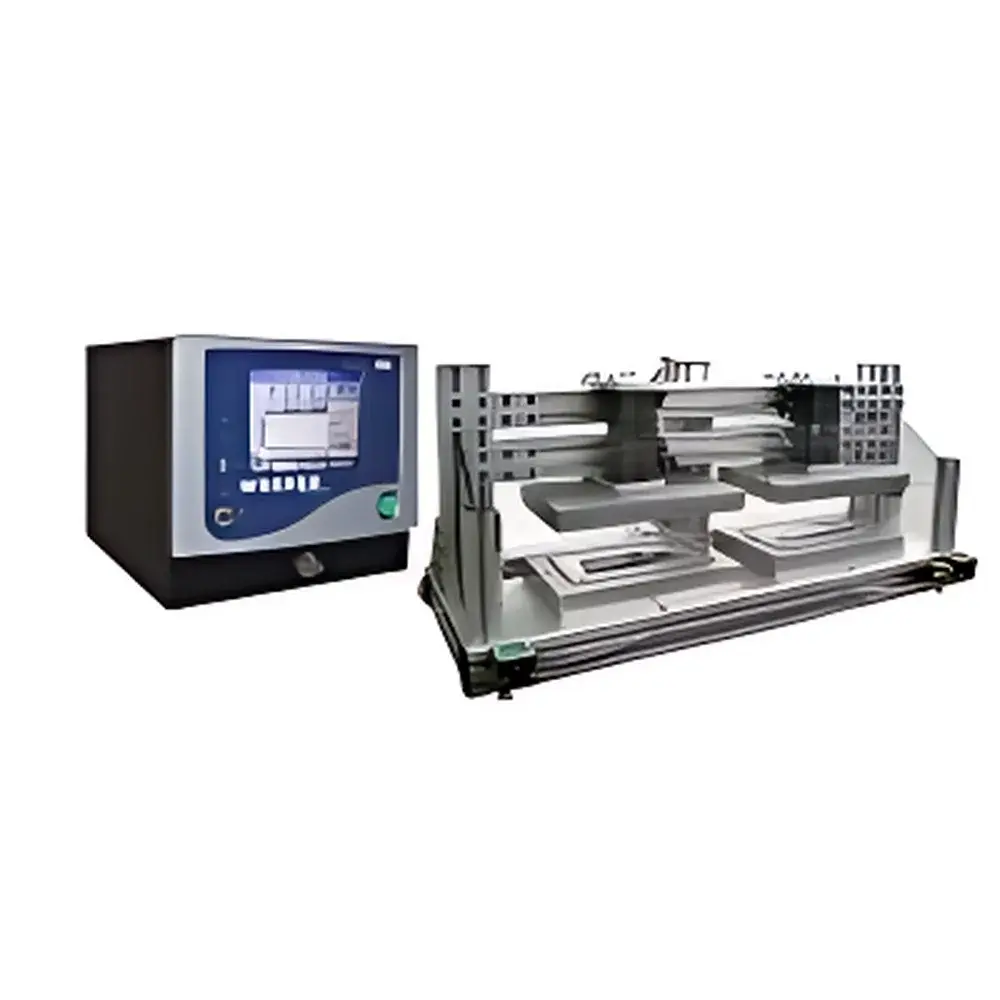
TQC Worker Integra Leak Tester
| Brand | TQC |
|---|---|
| Origin | Guangdong, China |
| Manufacturer Type | Authorized Distributor |
| Country of Origin | China |
| Model | Worker Integra |
| Pressure Range | 15–150 psi |
| Flow Range | 10 cm³/min – 10 L/min |
| Accuracy | ±0.5% FSD (vacuum: ±0.068 |
| pressure/vacuum | ±0.075 at 15 psi |
| Repeatability | <1% |
| Test Modes | Leak, Flow, Occlusion |
| Calibration | NIST-traceable |
| Test Duration | 0–1000 s |
| Power Supply | 90–240 VAC, 50–60 Hz |
| Operating Environment | 10–30 °C |
| Display | 5.7″ QVGA Touchscreen |
| CPU | 32-bit Embedded Processor |
Overview
The TQC Worker Integra Leak Tester is a precision-engineered, microprocessor-controlled leak detection system designed for quantitative, non-destructive integrity verification of sealed components across industrial, medical, and consumer electronics manufacturing. It operates on the principles of pressure decay, vacuum decay, mass flow, and occlusion testing—methods standardized under ASTM F2096, ISO 15528, and USP <1207> for package and device integrity assurance. Unlike qualitative bubble or dye tests, the Worker Integra delivers traceable, repeatable quantitative data in real time, enabling statistical process control (SPC) integration and compliance with FDA 21 CFR Part 11 requirements for electronic records and signatures when paired with validated software protocols.
Key Features
- Multi-mode operation: Simultaneous support for pressure decay, vacuum decay, mass flow, and occlusion (blockage) testing—enabling method flexibility without hardware reconfiguration.
- High-resolution pressure sensing: Dual-sensor architecture with temperature-compensated piezoresistive transducers calibrated to NIST-traceable standards, ensuring stability across ambient fluctuations (10–30 °C).
- Intuitive human-machine interface: 5.7″ QVGA resistive touchscreen with context-sensitive soft keys, multilingual menu navigation (English, German, Chinese), and real-time graphical trend display of pressure/flow profiles.
- Robust embedded architecture: 32-bit RISC processor with deterministic real-time response, flash memory for firmware updates and test method storage (up to 100 user-defined protocols), and hardware watchdog for fault resilience.
- Wide dynamic range: Configurable pressure span from 15 psi to 150 psi (103 kPa to 1034 kPa) and flow measurement from 10 cm³/min to 10 L/min—suitable for both coarse gross-leak screening and fine micro-leak quantification.
- Comprehensive pass/fail logic: Programmable acceptance thresholds per test step, multi-stage decision trees, and automatic result logging with timestamp, operator ID, and environmental metadata.
Sample Compatibility & Compliance
The Worker Integra accommodates rigid, semi-rigid, and flexible non-porous packaging and devices—including injection-molded housings, elastomeric seals, laminated pouches, and multi-lumen catheters—without requiring custom tooling. Its modular test fixture interface supports quick-change adapters for standard ISO 8536-4 luer connections, SAE J2044 ports, and custom pneumatic manifolds. The system meets electromagnetic compatibility (EMC) per IEC 61326-1 and safety requirements per IEC 61010-1. Test methodologies align with ISO 11607-2 (sterile barrier systems), ASTM D4991 (vacuum decay for rigid containers), and FDA guidance on container closure integrity testing (CCIT) for parenteral products. Full audit trail capability satisfies GLP/GMP documentation requirements.
Software & Data Management
Built-in firmware enables local data storage of up to 10,000 test records with full parameter history, including raw sensor traces, pass/fail status, and environmental conditions. Optional PC-based TQC Integrity Suite provides advanced analysis tools: SPC charting (X̄-R, Cpk), batch reporting, PDF certificate generation, and database export (CSV, SQL). When deployed in regulated environments, the system supports 21 CFR Part 11-compliant user authentication, electronic signatures, and immutable audit logs—with configurable retention policies and role-based access control (RBAC).
Applications
- Medical Devices: Validation of endoscope irrigation channels, multi-lumen guidewires, trocar valves, and sterile barrier integrity of Class II/III single-use devices per ISO 11607.
- Automotive: Vacuum decay testing of EGR valve housings, brake master cylinder assemblies, LED headlamp enclosures, and aluminum radiator tubes per SAE J2044 and OEM-specific specifications (e.g., GM W3172, Ford CETP).
- Consumer Electronics: IP67/IP68 ingress protection verification for smartphones, wearables, and IoT enclosures using accelerated pressure decay protocols compliant with IEC 60529 test sequences.
- Food & Beverage Packaging: Non-destructive CCIT of vacuum-sealed coffee pouches, modified-atmosphere trays, and vented cup closures—supporting shelf-life validation per ASTM F2338.
- Industrial Components: Seal verification of hydraulic manifolds, pneumatic solenoid valves, and aerospace composite housings subjected to thermal cycling and vibration stress.
FAQ
What calibration standards does the Worker Integra support?
The instrument is supplied with NIST-traceable calibration certificates for pressure and flow sensors. Field recalibration is performed using certified reference standards per ISO/IEC 17025-accredited procedures.
Can the Worker Integra be integrated into an automated production line?
Yes—it features RS-232, USB Device, and optional Ethernet (TCP/IP) interfaces with Modbus RTU and ASCII command protocols for PLC synchronization and MES data exchange.
Is the system suitable for testing porous or breathable packaging?
No. The Worker Integra is optimized for non-porous, hermetically sealable items. Porous materials require alternative methods such as tracer gas (helium) or high-voltage leak detection per ASTM F2391.
How is test method validation documented?
Each protocol includes IQ/OQ templates aligned with ASTM E2500 and Annex 11. Validation packages cover sensor linearity, repeatability, robustness, and environmental influence studies.
Does the system support multi-step sequential testing?
Yes—up to five programmable stages per test sequence, including pre-pressurization, stabilization, measurement, venting, and purge cycles, with independent timing and threshold settings per stage.
Related Products





