
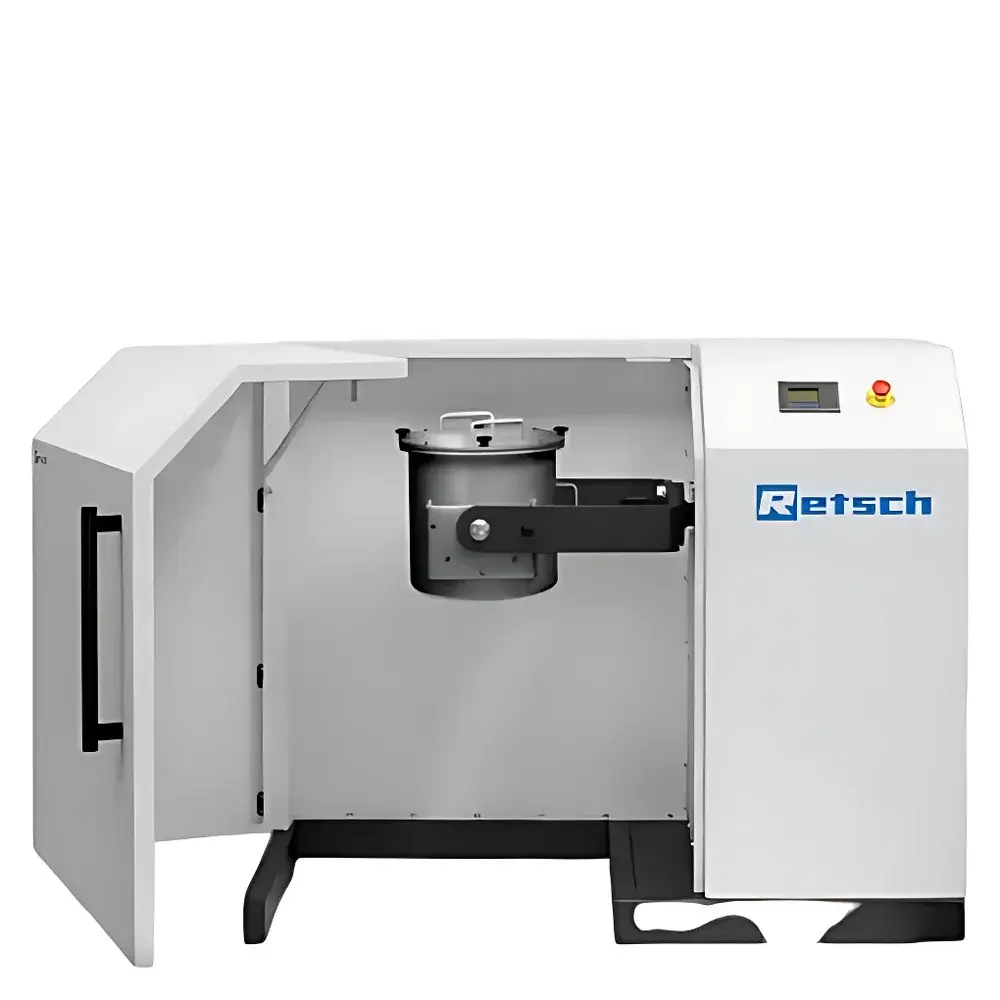
Retsch BT100 Bond Work Index Tester
| Brand | Retsch |
|---|---|
| Origin | Germany |
| Model | BT100 |
| Application | Quantitative grindability assessment of ores and minerals |
| Compliance | Designed in accordance with ASTM E325 and ISO 5074 for Bond Work Index determination |
| Construction | Robust welded steel frame with integrated safety shielding |
| Grinding vessel | Sealed,垫片-sealed stainless steel drum (standard 305 mm × 305 mm) |
| Drive system | Precision-controlled synchronous motor with torque monitoring |
| Safety features | Interlocked acoustic enclosure with emergency stop button and safety cut-off switch |
| Sample handling | Ergonomic rail-guided drum removal system, integrated sieve separator for ball/sample separation, removable collection tray, hand-operated funnel with ergonomic grip |
Overview
The Retsch BT100 Bond Work Index Tester is a precision-engineered laboratory instrument designed specifically for the standardized determination of the Bond Work Index (BWI) of ores and industrial minerals. Based on the classical Bond crushing and grinding theory—formalized in 1952—the BT100 replicates the closed-circuit dry grinding conditions of industrial rod mills and ball mills to quantify the specific energy required (kWh/short ton) to reduce material from an infinite particle size to a P80 of 100 µm. This value serves as a fundamental input parameter for mill power draw calculations, circuit design optimization, and comminution modeling in mineral processing plants. The BT100 implements the standard Bond procedure per ASTM E325–22 (“Standard Test Method for Determining the Bond Ball Mill Work Index”) and ISO 5074:2015 (“Hard coal — Determination of Bond work index”), ensuring traceable, reproducible, and auditable test results compliant with metallurgical QA/QC protocols.
Key Features
- Structurally rigid, welded steel frame with vibration-damped base—engineered for long-term mechanical stability during high-torque grinding cycles.
- Interlocked, sound-attenuating enclosure with automatic power cutoff upon door opening—meets CE machinery directive (2006/42/EC) and OSHA-compliant hearing protection requirements.
- Ergonomic rail-guided drum extraction system with low-friction linear bearings—enables safe, repeatable removal of the 305 mm × 305 mm grinding drum without manual lifting.
- Integrated stainless-steel sieve separator mounted at drum discharge—mechanically isolates grinding media (steel balls or rods) from ground product, eliminating cross-contamination and enabling rapid media recovery.
- Dual-mode operation support: configurable for both Bond Ball Mill Work Index (BBMWI) and Bond Rod Mill Work Index (BRMWI) testing via interchangeable drum liners and charge configurations.
- Digitally monitored drive train with real-time torque feedback and rotational speed regulation (±0.5 rpm)—ensures adherence to the fixed 70 rpm rotational speed mandated by ASTM E325.
Sample Compatibility & Compliance
The BT100 accepts feed samples sized to ≤3.35 mm (−6 mesh), typically prepared using jaw crushers and rotary sample dividers prior to testing. It accommodates a wide range of brittle to semi-brittle geological materials—including iron ore, copper sulfides, bauxite, limestone, phosphate rock, and industrial silicates—provided they exhibit no excessive plasticity or moisture content (>2% w/w). All operational procedures align with GLP principles: test logs include operator ID, date/time stamps, raw mass inputs, screen analysis data (via external Tyler or ISO standard sieves), and final BWI calculation worksheets. The system supports full audit trails when integrated with LIMS-compatible data export (CSV/Excel) and satisfies documentation requirements under ISO/IEC 17025 accredited laboratories.
Software & Data Management
While the BT100 operates as a standalone mechanical tester, its workflow integrates seamlessly into digital lab environments. Raw test data—including initial feed mass, circulating load, screen undersize mass, and number of revolutions—is recorded manually or via optional Retsch LabSuite™ companion software (v3.2+). LabSuite provides preconfigured BWI calculation templates per ASTM E325 Annex A1, auto-generates calibration certificates, stores instrument usage logs, and exports reports in PDF or CSV format with embedded metadata (e.g., operator, calibration status, environmental temperature/humidity). For regulated environments, the software supports 21 CFR Part 11-compliant electronic signatures, role-based access control, and immutable audit trails—facilitating FDA, MSHA, or third-party inspection readiness.
Applications
- Metallurgical testwork for feasibility studies and bankable resource models.
- Plant-level comminution circuit audits and energy efficiency benchmarking (e.g., against Morrell or McIvor models).
- Supplier qualification for abrasive raw materials in cement, fertilizer, and refractory production.
- Research into alternative grinding media, liner materials, or slurry rheology effects on specific energy consumption.
- Training and method validation in university mineral processing laboratories.
FAQ
What standards does the BT100 comply with for Bond Work Index testing?
ASTM E325–22, ISO 5074:2015, and AS 1141.25 (Australia) — all referencing the original Bond equation and standardized test protocol.
Is the grinding drum included with the base unit?
Yes — the BT100 ships with one certified 305 mm × 305 mm stainless-steel drum, including sealing gasket, lift handle, and mounting hardware.
Can the BT100 be used for wet grinding tests?
No — the BT100 is strictly configured for dry grinding per Bond methodology; wet grinding requires separate slurry-based test apparatus (e.g., JK Drop Weight or SMC test systems).
What maintenance is required for long-term accuracy?
Annual verification of drum dimensions, rotational speed calibration, and torque sensor linearity — documented in Retsch’s Maintenance Logbook (Ref. M-LOG-BT100-EN).
Does the system support automated particle size analysis integration?
Not directly — however, the collected ground product is fully compatible with laser diffraction (e.g., Mastersizer), sieve shakers (e.g., RS200), or image analysis systems for P80 determination.



