
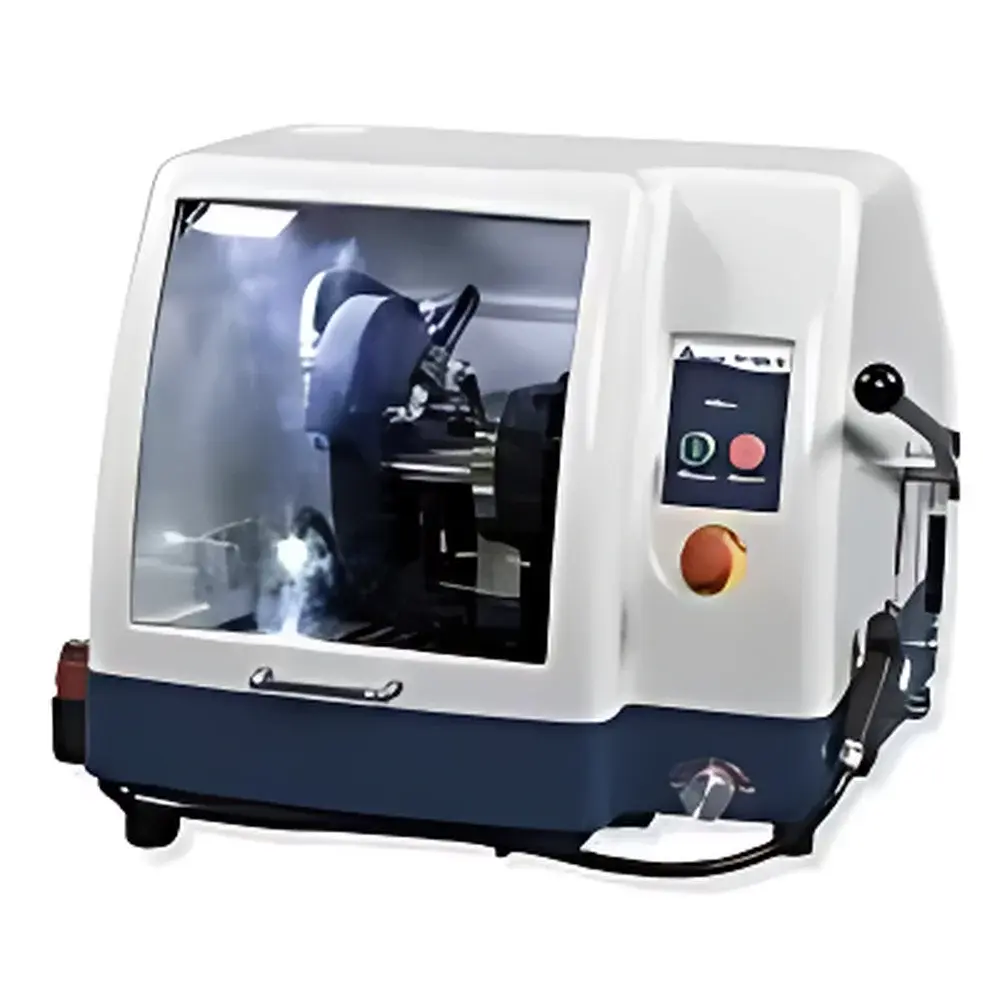
Buehler AbrasiMet 250 Manual Abrasive Cut-Off Machine
| Brand | Buehler |
|---|---|
| Origin | Guangdong, China |
| Manufacturer Type | Authorized Distributor |
| Country of Origin | China |
| Model | AbrasiMet 250 |
| Instrument Type | Abrasive Cut-Off Machine |
| Motor Power | 3 kW (4 HP) |
| Voltage/Frequency | 230 V/50 Hz (13 A) |
| Wheel Speed | 2800 rpm (50 Hz) / 3400 rpm (60 Hz) |
| Lighting | 10 × High-Efficiency LED Lamps + 1 × 457 mm Flexible Gooseneck LED Lamp |
| Sound Pressure Level | ≤76 dB(A) at 1 m (no-load) |
| Coolant Reservoir Capacity | 27 L (7 US gal) |
| Maximum Cutting Capacity | 95 mm (3.75 in) |
Overview
The Buehler AbrasiMet 250 is a manually operated abrasive cut-off machine engineered for precision sample sectioning in metallurgical, geological, and materials science laboratories. Designed around the principles of controlled mechanical abrasion—where a rotating silicon carbide or aluminum oxide grinding wheel removes material via high-speed frictional contact—the AbrasiMet 250 delivers consistent, low-distortion cuts across diverse specimen geometries. Though discontinued, it remains widely referenced in legacy lab protocols and continues to serve as a benchmark for manual cut-off performance due to its robust cast-iron frame, ergonomic workflow integration, and optical transparency during operation. Its architecture supports both routine metallographic specimen preparation and specialized applications such as petrographic thin-sectioning when paired with the optional PetroCut precision mounting stage.
Key Features
- Optimized optical visibility: Equipped with ten fixed high-luminance LED lamps plus a 457 mm flexible gooseneck LED lamp, the cutting chamber provides uniform, shadow-free illumination—critical for real-time assessment of cut line placement, wheel wear, and specimen alignment.
- Spacious open-work area: A generously dimensioned work zone facilitates rapid loading/unloading of irregularly shaped or oversized samples (up to 95 mm diameter), minimizing handling time and operator fatigue.
- Modular clamping system: The standard multi-position vise accommodates round, rectangular, and irregular specimens; optional accessories—including the PetroCut stage—extend compatibility to oriented rock cores and anisotropic geological specimens requiring angular repeatability.
- Integrated coolant management: A 27 L polyethylene reservoir supplies continuous, adjustable flow to the cutting interface, suppressing thermal damage and extending wheel life. A dedicated rinse hose enables post-cut chamber cleaning without disassembly.
- Acoustically optimized operation: Measured at ≤76 dB(A) at 1 meter under no-load conditions, the unit meets ISO 7779 and ANSI S1.13 requirements for laboratory noise exposure, supporting extended daily use in shared facilities.
- Electrical flexibility: Dual-voltage motor configuration (230 V/400 V/460 V) with frequency-specific speed calibration ensures stable wheel rotation (2800 rpm @ 50 Hz, 3400 rpm @ 60 Hz) across global power infrastructures.
Sample Compatibility & Compliance
The AbrasiMet 250 accepts specimens ranging from soft polymers and composites to hardened steels and sintered ceramics. Its clamping geometry supports ASTM E3–22 (Standard Guide for Preparation of Metallographic Specimens) and ISO 14487:2015 (Metallographic specimen preparation — Sectioning). When used with the PetroCut stage, it aligns with ASTM D5777 (Standard Guide for Rock Core Sampling and Handling) for orientation-controlled lithological sectioning. All structural components comply with CE machinery directive 2006/42/EC for mechanical safety, and electrical subsystems conform to IEC 60204-1 for industrial control equipment. Though not validated for GMP environments, its sealed bearing housings and non-porous coolant tray support GLP-aligned maintenance logs and traceable cleaning records.
Software & Data Management
The AbrasiMet 250 operates without embedded firmware or digital control interfaces; all adjustments—including feed rate, depth stop, and coolant flow—are executed manually via calibrated mechanical dials and levers. This analog design eliminates software validation requirements under FDA 21 CFR Part 11 while ensuring long-term operational stability and serviceability. Maintenance logs, calibration checks (e.g., wheel runout verification per ISO 13292), and usage records may be documented externally using laboratory information management systems (LIMS) or paper-based SOPs compliant with ISO/IEC 17025:2017 Clause 7.7 (Control of Equipment).
Applications
- Metallographic specimen sectioning for microstructural analysis (e.g., grain size evaluation per ASTM E112)
- Petrographic thin-section preparation of igneous, metamorphic, and sedimentary rocks
- Failure analysis of welded joints, heat-affected zones, and additive-manufactured components
- Preparation of cross-sections for SEM-EDS, XRF mapping, and hardness testing (e.g., ASTM E384)
- Routine quality control cutting of incoming raw materials and finished parts in foundry and aerospace QA labs
FAQ
Is the AbrasiMet 250 still supported with spare parts and service?
Yes—Buehler maintains a legacy parts inventory for the AbrasiMet series, including wheels, clamps, LED assemblies, and coolant pumps. Authorized distributors provide technical documentation and field service support under extended warranty programs.
Can the machine be retrofitted with automated feed or digital controls?
No. The AbrasiMet 250 lacks provision for motorized feed mechanisms or digital I/O interfaces. Automation upgrades are not feasible; users requiring programmable motion should consider the current-generation Buehler Isomet® 5000 or AbrasiMet® 300 series.
What cutting wheel specifications are recommended?
Standard configurations use 10-inch (254 mm) diameter wheels with 0.040–0.060 inch (1.0–1.5 mm) thickness, rated for ≥6,500 rpm. Buehler recommends silicon carbide (SiC) for ferrous alloys and aluminum oxide (Al₂O₃) for non-ferrous metals and ceramics, per EN 12413:2018.
Does the unit meet OSHA or EU workplace safety standards?
Yes—the integrated wheel guard, emergency stop button, and splash-resistant coolant enclosure satisfy OSHA 1910.215(a)(3) and EU Machinery Directive essential health and safety requirements (Annex I, Section 1.5.8).



