
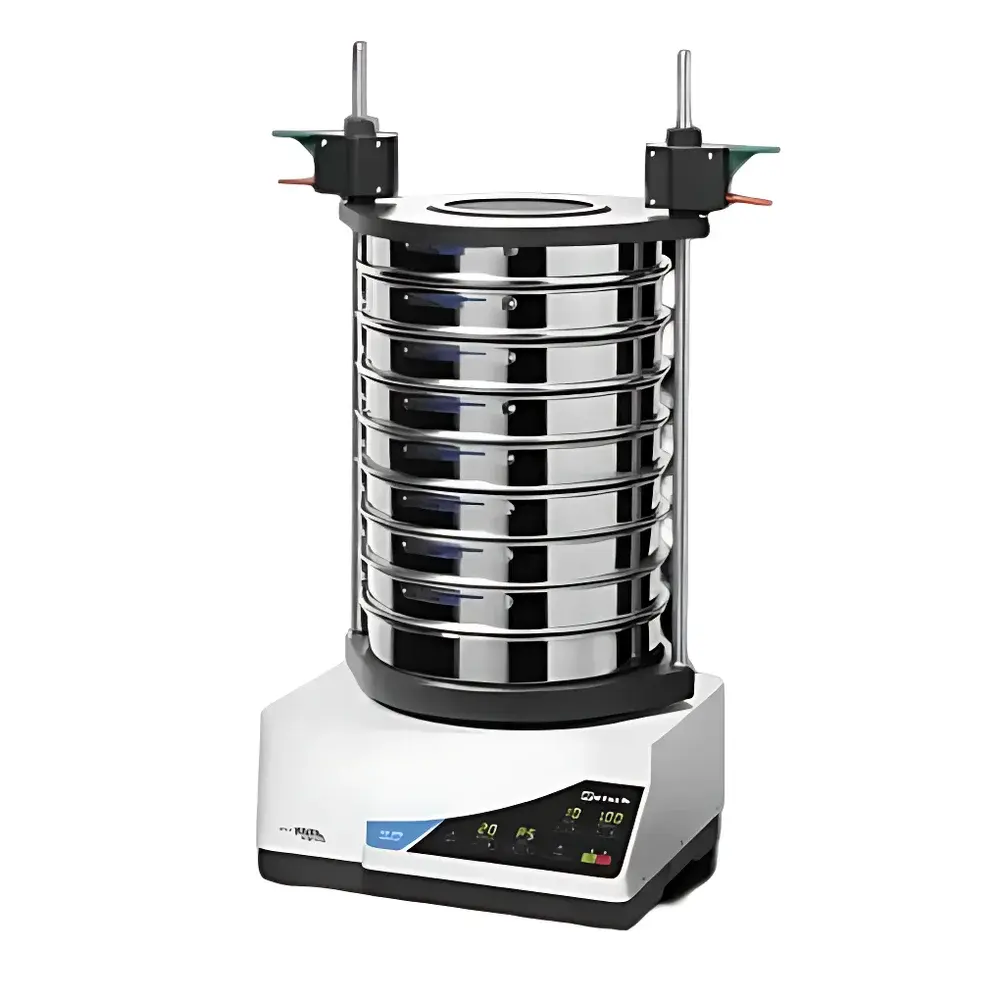
RETSCH AS 300 CONTROL Digital Sieve Shaker
| Brand | RETSCH |
|---|---|
| Origin | Germany |
| Model | AS 300 CONTROL |
| Principle | Electromagnetically Driven 3D Orbital Sieving |
| Measurement Range | 20 µm – 40 mm |
| Max. Sample Load | 6 kg |
| Sieve Stack Height | up to 510 mm |
| Number of Sieve Levels | 11 or 17 |
| Adjustable Parameters | Time (0.1–999.9 min), Amplitude (0.1–3.0 mm), Pause Interval (0–999.9 s) |
| Operating Modes | Continuous or Intermittent |
| Noise Level | <65 dB(A) |
| Sieve Diameter | 305 mm (12") |
| Certified Compliance | ISO 9001, ISO/IEC 17025 (with calibration certificate) |
Overview
The RETSCH AS 300 CONTROL is a high-precision, microprocessor-controlled sieve shaker engineered for reproducible, standardized particle size distribution analysis via dry or wet sieving. It operates on an electromagnetic 3D orbital motion principle—generating controlled horizontal circular oscillation combined with vertical lift—to ensure uniform sample dispersion across the full 305 mm (12″) sieve surface. This kinematic profile minimizes particle segregation and agglomeration, significantly improving sieving efficiency and statistical reliability compared to conventional rotary or tapping shakers. Designed specifically for standard ASTM E11, ISO 3310-1, ISO 2591-1, and USP compliant sieving protocols, the AS 300 CONTROL delivers traceable, auditable results suitable for GLP and GMP-regulated environments. Its robust cast-aluminum housing, sealed electromagnetic drive unit, and maintenance-free operation ensure long-term stability under routine laboratory or production QA/QC use.
Key Features
- Digital parameter control: Fully programmable time (0.1–999.9 min), amplitude (0.1–3.0 mm), and pause interval (0–999.9 s) via intuitive membrane keypad and LCD display.
- High-capacity sieve stack: Supports up to 17 nested sieves with total height up to 510 mm—compatible with all standard 305 mm diameter test sieves per ISO 3310-1 and ASTM E11.
- Optimized 3D orbital motion: Generates consistent g-force distribution (0.1–3.0 g) across the entire sieve surface, enabling rapid, homogeneous stratification—even for abrasive, fibrous, or cohesive materials.
- Low-noise operation: Acoustic emission <65 dB(A) at 1 m distance, meeting occupational safety requirements for open-lab deployment without acoustic enclosures.
- Integrated calibration traceability: Supplied with factory-issued ISO/IEC 17025-accredited calibration certificate; parameters remain verifiable and re-certifiable per ISO 9001 clause 7.1.5.
- Dual-mode flexibility: Seamless transition between dry sieving and wet sieving (with optional liquid-tight sieve frame kit); no mechanical reconfiguration required.
- Ergonomic clamping system: Quick-lock lever mechanism ensures secure, vibration-dampened sieve fixation—reducing operator fatigue and eliminating manual torque variability.
Sample Compatibility & Compliance
The AS 300 CONTROL accommodates diverse particulate matrices—including metal powders, pharmaceutical granules, mineral ores, polymer flakes, ceramic precursors, and food-grade aggregates—within the 20 µm to 40 mm nominal size range. Its electromagnetic drive eliminates mechanical wear, ensuring stable performance across high-load (up to 6 kg) and high-abrasion applications. All operational parameters comply with ISO 2591-1 (sieving methods for determination of particle size distribution), ISO 9001:2015 (clause 7.1.5 on monitoring and measuring resources), and support 21 CFR Part 11 readiness when used with validated RETSCH sieve analysis software (e.g., EVALUATION software v3.x). The instrument meets CE marking requirements under the EU Machinery Directive 2006/42/EC and EMC Directive 2014/30/EU.
Software & Data Management
When paired with RETSCH’s EVALUATION software (USB-connected), the AS 300 CONTROL enables automated method storage (up to 99 user-defined protocols), real-time parameter logging, PDF report generation with digital signatures, and audit-trail-enabled data export (CSV, XML). Software workflows support electronic record retention per ALCOA+ principles and facilitate integration into LIMS or MES platforms. Calibration data, operator ID, timestamp, and environmental metadata (e.g., ambient temperature/humidity if externally logged) are embedded in each result file—ensuring full compliance with FDA 21 CFR Part 11 and EU Annex 11 requirements for regulated laboratories.
Applications
- Pharmaceutical QA/QC: Granule and excipient particle sizing per USP , supporting blend uniformity assessment and tablet compression process validation.
- Materials science R&D: Characterization of additive manufacturing feedstocks (e.g., Ti-6Al-4V, Inconel 718 powders) prior to laser powder bed fusion processing.
- Construction & mining: Aggregate gradation analysis for asphalt and concrete mix design per ASTM C136/C136M and EN 933-1.
- Food & agriculture: Flour, sugar, and spice particle distribution profiling to verify milling consistency and flow behavior.
- Chemical manufacturing: Catalyst support particle sizing and classification verification for fixed-bed reactor loading specifications.
FAQ
What sieve diameters is the AS 300 CONTROL compatible with?
It is exclusively designed for 305 mm (12 inch) diameter test sieves conforming to ISO 3310-1 and ASTM E11 standards.
Can the AS 300 CONTROL perform wet sieving?
Yes—when equipped with the optional wet-sieving adapter kit (including liquid-tight sieve frames and drainage base), it supports standardized wet sieving per ISO 2591-1.
Is the calibration certificate included with delivery?
Yes—a factory-issued, ISO/IEC 17025-accredited calibration certificate is supplied, documenting amplitude, time, and g-force traceability to national standards.
How many sieve levels can be stacked simultaneously?
Up to 17 standard 305 mm sieves may be stacked, with a maximum total height of 510 mm.
Does the instrument support regulatory audit requirements?
Yes—its digital parameter logging, electronic signature capability (via EVALUATION software), and calibration traceability satisfy 21 CFR Part 11, EU Annex 11, and ISO 9001:2015 documentation requirements.



