
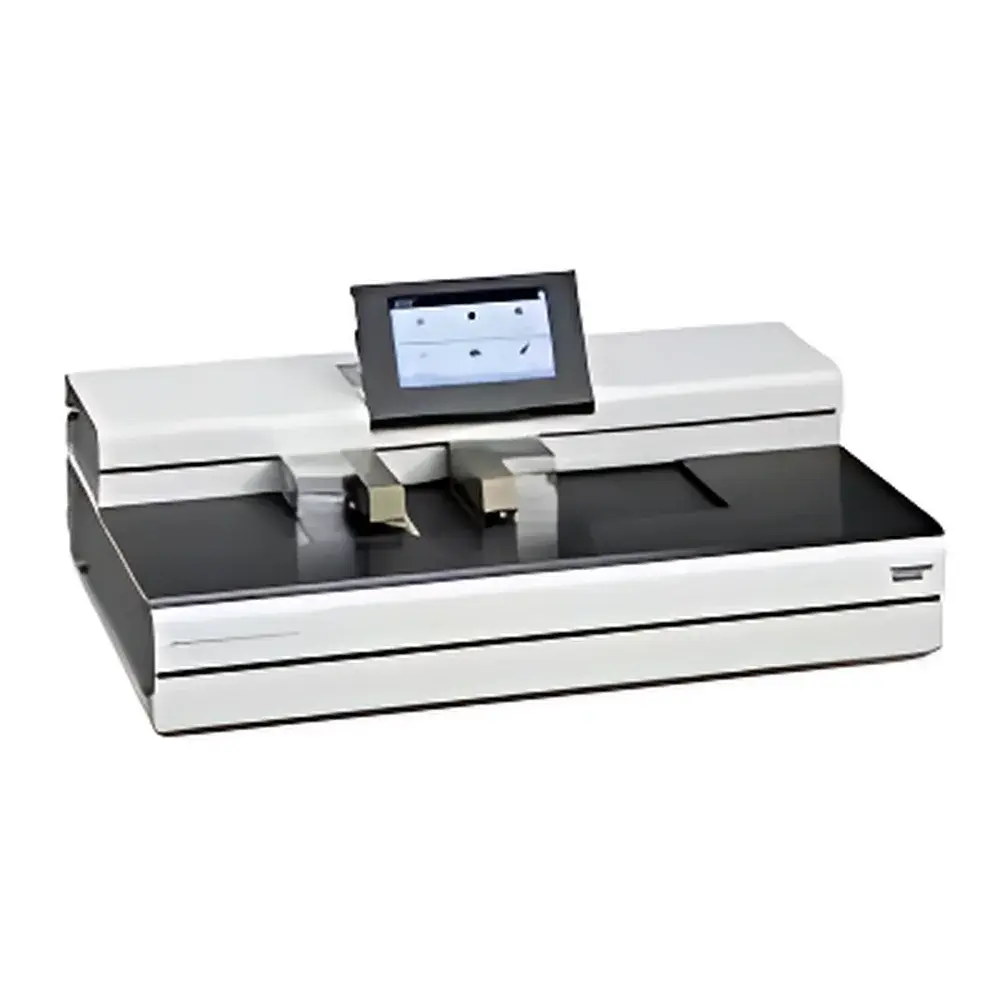
Messmer Büchel 84-56 Horizontal Tensile Strength Tester
| Origin | Guangdong, China |
|---|---|
| Manufacturer Type | Distributor |
| Origin Category | Domestic (China) |
| Model | 84-56 |
| Price Range | USD 700 – 1,400 |
| Test Mode | Constant-Rate Extension (CRE) |
| Maximum Sample Width | 75 mm (3 in) |
| Display | Full-color capacitive touchscreen interface |
| Data Output | Real-time force–extension curve, tensile strength (kN/m), tensile energy absorption (J/m²), tensile stiffness (mN·m) |
| Optional Accessory | Wet Tensile Kit with programmable wetting time (0–300 s) |
Overview
The Messmer Büchel 84-56 Horizontal Tensile Strength Tester is a precision-engineered mechanical testing instrument designed specifically for the quantitative evaluation of tensile properties in flexible sheet materials—primarily paper, board, tissue, nonwovens, films, and thin polymer substrates. Operating on the principle of constant-rate extension (CRE), the system applies a controlled, linearly increasing tensile load to a standardized specimen until rupture occurs. Force is measured via a high-stability load cell, while elongation is tracked using an optical encoder coupled to the crosshead motion. The horizontal configuration conforms to ISO 1924-2, TAPPI T494, and GB/T 12914 standards, ensuring metrological traceability and inter-laboratory reproducibility. Unlike vertical testers, the horizontal orientation eliminates gravitational sag effects during clamping and loading—critical for low-basis-weight or highly extensible samples such as facial tissues or dissolvable hygiene films.
Key Features
- Horizontal CRE architecture compliant with ISO 1924-2 and TAPPI T494 for standardized tensile testing of paper and board
- 75 mm (3-inch) maximum sample width capacity with quick-change jaw sets accommodating 15 mm, 25 mm, and 75 mm specimen widths
- Capacitive full-color touchscreen HMI enabling intuitive parameter setup, real-time graphing, and one-touch test initiation
- Integrated calculation engine delivering immediate post-test reporting of tensile strength (kN/m), tensile energy absorption (J/m²), tensile stiffness (mN·m), and percentage elongation at break
- Modular wet tensile accessory kit—including programmable immersion timer (0–300 s), temperature-controlled water bath (±0.5 °C), and hydrophilic jaw liners—to support ISO 12625-4 and TAPPI T492 for wet strength assessment
- Robust aluminum frame with anti-vibration base plate and precision-ground linear motion rails ensuring long-term mechanical stability and minimal hysteresis
Sample Compatibility & Compliance
The 84-56 accommodates specimens ranging from 15 mm to 75 mm in width and up to 250 mm in length, supporting both longitudinal and transverse testing per ISO 1924-1. It is validated for use with standard grammage ranges (30–500 g/m²) and basis weights typical of printing papers, packaging board, filter media, and disposable hygiene products. All firmware and calibration routines are documented per ISO/IEC 17025 requirements. Test reports include embedded metadata (operator ID, timestamp, environmental conditions per ISO 187), satisfying GLP audit trails. The system supports optional digital signature and electronic record retention aligned with FDA 21 CFR Part 11 when integrated with validated LIMS environments.
Software & Data Management
Embedded firmware provides local storage of ≥1,000 test records with CSV export via USB port. Optional PC-based software (compatible with Windows 10/11) enables advanced statistical analysis—including Weibull distribution fitting for failure probability modeling—and batch report generation compliant with ISO 5725-2 repeatability criteria. Audit logs track all parameter modifications, calibration events, and user logins. Data encryption (AES-256) and role-based access control (admin/operator/viewer) are available upon request for regulated environments.
Applications
- Quality control of paper mills: monitoring tensile strength consistency across production reels
- R&D of fiber-reinforced bioplastics: evaluating strain-to-failure behavior under controlled humidity
- Regulatory submission support for FDA-cleared medical packaging: generating tensile data per ASTM F88 for seal integrity validation
- Wet strength optimization of flushable wipes: correlating wet tensile retention (%) with surfactant formulation
- Recycled fiber characterization: quantifying strength loss after multiple repulping cycles per ISO 1660
- Corrugated board liner evaluation: assessing directional strength anisotropy (MD vs CD) for FE simulation input
FAQ
Does the 84-56 comply with ISO 1924-2 for paper tensile testing?
Yes—the instrument’s horizontal CRE geometry, jaw separation tolerance (±0.1 mm), and speed accuracy (±0.5% of set value) meet all mechanical and procedural requirements specified in ISO 1924-2:2021.
Can it test specimens narrower than 15 mm?
No—minimum supported width is 15 mm; narrower strips require custom tooling not supplied with the standard configuration.
Is calibration traceable to national standards?
Yes—load cell calibration is performed using NIST-traceable deadweight standards; certificate includes uncertainty budget per ISO/IEC 17025.
What environmental conditions must be maintained during testing?
Testing shall occur in a conditioned room per ISO 187 (23 ± 1 °C, 50 ± 2% RH); ambient monitoring data must be recorded in the test report.
Is the wet tensile kit compatible with acidic or alkaline immersion solutions?
The standard kit uses deionized water only; corrosion-resistant stainless-steel components are available as a customization for pH 11 applications.
Related Products





