
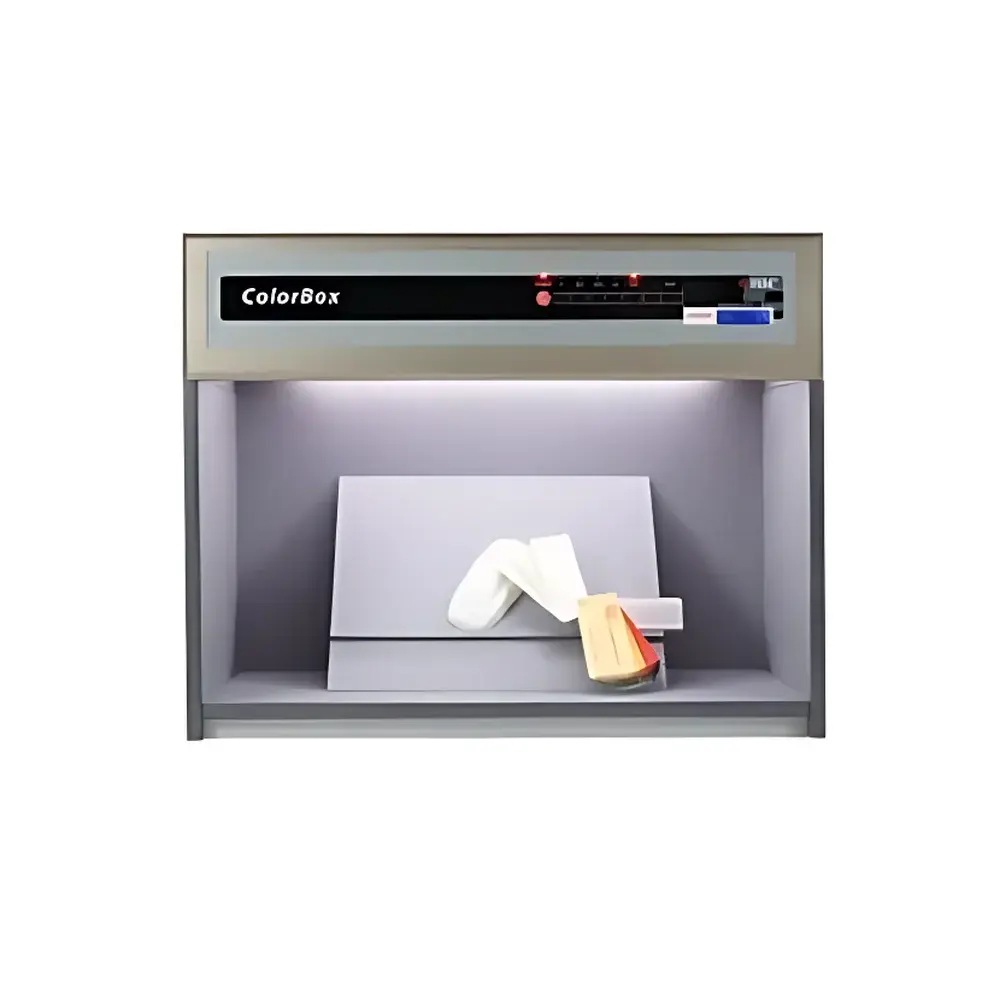
TQC VF0603 Standard Light Booth for Color Assessment
| Brand | TQC |
|---|---|
| Origin | Netherlands |
| Model | VF0603 |
| Construction Material | MDF (Medium-Density Fibreboard) |
| Interior Finish | Munsell N5.5 Gray |
| Viewing Angle | 45° Tilted Observation Table |
| Standard Light Sources | 5 × CIE-Compliant Lamps (D65, TL84, F/A, UV, CWF) |
| Compliance | ASTM D1729, ISO 3664:2009 |
| D65 Lamp Lifetime | 2000 hours |
| Warm-up Time | 4–6 hours |
| Observation Table Dimensions | 400 × 270 mm |
| Distribution Type | Imported (Global Distribution via Authorized Distributors) |
Overview
The TQC VF0603 Standard Light Booth is an engineered color evaluation instrument designed to eliminate metamerism and support objective visual assessment of color under controlled, standardized illumination conditions. Built upon the foundational principles of CIE illuminant simulation and spectral power distribution (SPD) fidelity, this light booth enables reproducible color judgment across diverse material classes—including coatings, inks, plastics, textiles, cosmetics, leather, food packaging, paper, and dyestuffs. Its core function is to replicate specific daylight and artificial lighting environments required by international standards, thereby facilitating reliable color matching, quality control, and supplier-to-manufacturer color communication. The booth’s rigid MDF housing ensures mechanical stability and thermal consistency, while its interior matte finish—Munsell N5.5 gray—minimizes stray light reflection and maintains neutral background contrast essential for accurate hue, saturation, and lightness discrimination.
Key Features
- Five independently switchable CIE-standard light sources: D65 (daylight simulator), TL84 (cool white fluorescent), F/A (incandescent tungsten), UV (ultraviolet for fluorescence detection), and CWF (cool white fluorescent with enhanced green output)
- Electronic ballast with momentary flash switch for rapid lamp activation and minimized flicker-induced visual fatigue
- 45° ergonomically tilted observation table constructed from high-density MDF and finished in Munsell N5.5 gray to ensure chromatic neutrality and consistent viewing geometry
- Robust MDF enclosure with precisely calibrated internal reflectance properties, optimized for uniform irradiance distribution across the viewing area
- D65 lamp life specification of 2000 operational hours—aligned with ISO 3664:2009 recommendations for photometric stability maintenance
- Minimum warm-up period of 4–6 hours prior to critical evaluation to achieve thermal and spectral equilibrium of all lamps
Sample Compatibility & Compliance
The VF0603 accommodates flat or low-relief samples up to 400 × 270 mm on its integrated observation table, making it suitable for coated panels, printed swatches, fabric swatches, cosmetic compacts, plastic injection-molded parts, and laminated packaging substrates. It conforms fully to ASTM D1729 (“Standard Practice for Visual Appraisal of Colors and Color Differences of Objects”) and ISO 3664:2009 (“Graphic technology and photography — Standard viewing conditions”), ensuring metrological traceability in color-critical industries. Its design supports GLP-aligned workflows where documented lighting conditions are mandatory for audit readiness, particularly in regulated sectors such as pharmaceutical packaging, automotive OEM supply chains, and cosmetic product development.
Software & Data Management
While the VF0603 operates as a hardware-only visual assessment station without embedded digital interfaces, it integrates seamlessly into enterprise-level color management ecosystems. Users routinely pair it with spectrophotometers (e.g., Konica Minolta CM-3700A, X-Rite Ci7800) and color software platforms including X-Rite Color iMatch, Datacolor Match Pigment, or GretagMacbeth SpectraLight QC. All lamp selection events and usage logs can be manually recorded in laboratory notebooks or electronic lab notebooks (ELNs) compliant with 21 CFR Part 11 requirements. For GMP environments, lamp replacement dates and calibration verification records must be retained per internal SOPs referencing ISO/IEC 17025 clause 6.4.10.
Applications
- Color formulation validation in paint and ink manufacturing labs
- Batch-to-batch color consistency checks in textile dye houses and apparel QA departments
- Metameric failure analysis during pre-shipment inspection of consumer electronics housings
- Fluorescence screening of optical brighteners in paper and detergent applications
- Regulatory-compliant color approval for FDA-listed medical device packaging
- Supplier qualification audits requiring cross-site color evaluation repeatability
FAQ
Why is a 4–6 hour warm-up period required before performing critical color assessments?
Thermal stabilization of phosphor-coated fluorescent lamps is essential to achieve stable spectral output and correlated color temperature (CCT). Shorter warm-up durations result in measurable CCT drift (>±100K) and luminance fluctuation, violating ISO 3664:2009 photometric stability criteria.
What is the recommended replacement schedule for D65 lamps?
Per ISO 3664:2009 Annex B, D65 simulators must be replaced after 2000 hours of cumulative operation or when spectral deviation exceeds ±5% in the 400–700 nm range—whichever occurs first.
Can the VF0603 be used for evaluating metallic or pearlescent coatings?
Yes, provided viewing geometry remains fixed at 45° and observer position is standardized; however, for gonioapparent materials, supplementary multi-angle measurement using a spectrophotometer is advised to complement visual assessment.
Is the Munsell N5.5 gray interior coating certified to a specific reflectance standard?
The interior surface meets ISO 3664:2009 requirement for non-selective, matte gray with reflectance between 50% and 60% across the visible spectrum, verified via spectrophotometric mapping during factory calibration.
Does TQC provide lamp calibration certificates with each unit?
No—lamp certification is performed at point-of-manufacture and documented in the unit’s Certificate of Conformance (CoC); end-users are responsible for periodic verification using NIST-traceable reference standards.






