
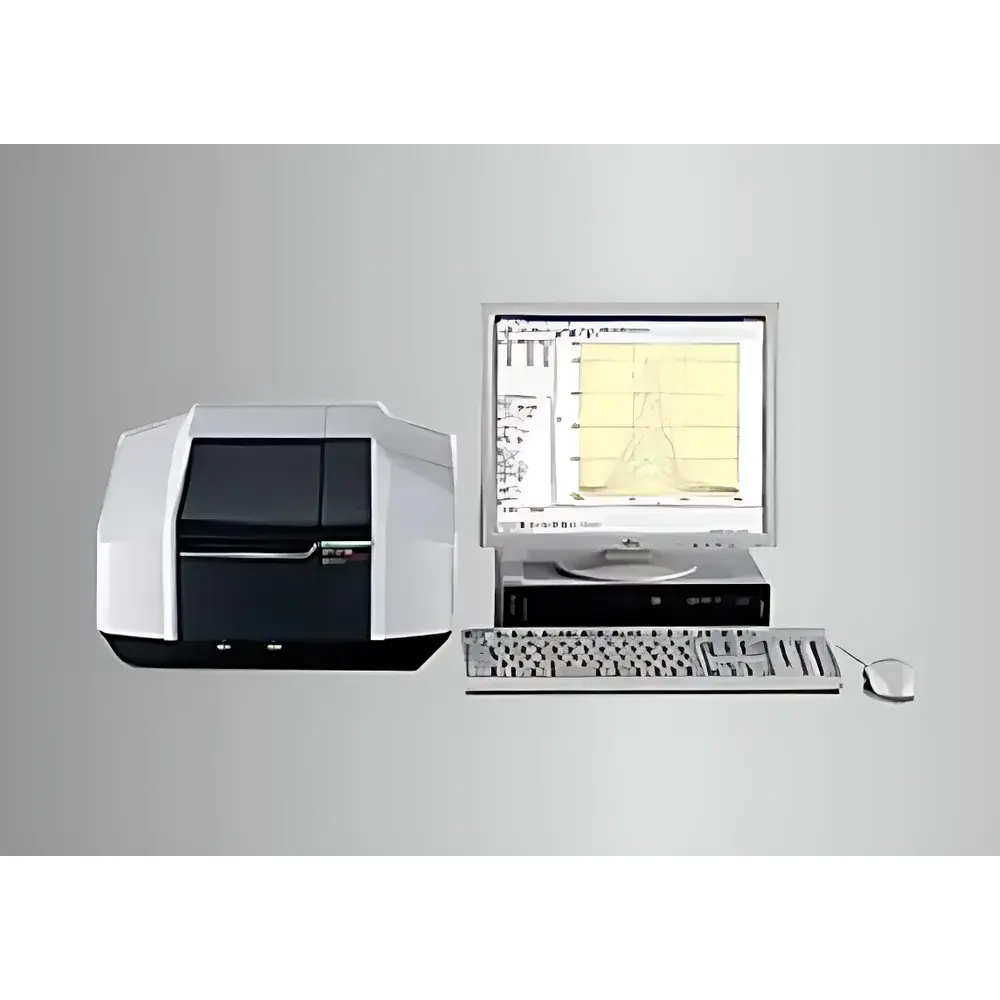
Shimadzu UV-2600/2700 Research-Grade Double-Beam Ultraviolet-Visible-Near-Infrared Spectrophotometer
| Brand | Shimadzu |
|---|---|
| Origin | Japan |
| Model | UV-2600/2700 |
| Optical Design | Double-beam |
| Detector Type | Photodiode Array (PDA) |
| Wavelength Range | 185–1400 nm |
| Spectral Bandwidth | 0.1–5 nm (variable) |
| Wavelength Accuracy | ±0.1 nm |
| Stray Light | < 0.00002% T |
| Absorbance Range (UV-2700) | Up to 8.0 Abs |
| Compliance | JIS K0115, USP <857>, EP 2.2.25, JP General Tests |
Overview
The Shimadzu UV-2600 and UV-2700 are research-grade double-beam ultraviolet-visible-near-infrared (UV-Vis-NIR) spectrophotometers engineered for high-fidelity molecular absorption analysis across demanding academic, pharmaceutical, materials science, and quality control laboratories. Based on Czerny-Turner monochromator architecture with dual gratings and precision optical alignment, these instruments operate on the fundamental principle of Beer-Lambert law-based absorbance quantification, delivering traceable photometric accuracy from deep UV (185 nm) through visible light to the short-wave near-infrared (1400 nm). The UV-2600 achieves extended NIR capability via optional ISR-2600 or ISR-2600Plus integrating spheres—enabling critical characterization of semiconductor thin films, anti-reflective coatings, and photovoltaic materials. The UV-2700 incorporates a tandem monochromator design with Lo-Ray-Light™ holographic diffraction gratings fabricated using Shimadzu’s proprietary etching process, achieving ultra-low stray light (<0.00002% T) and linear photometric response up to 8.0 absorbance units—essential for undiluted high-concentration assays, polarizer transmittance evaluation, and low-transmittance optical component validation.
Key Features
- Double-beam optical path with real-time reference compensation for enhanced baseline stability and long-term measurement reproducibility
- Variable spectral bandwidth (0.1–5 nm) optimized for resolution/sensitivity trade-off in diverse sample matrices
- Photodiode array (PDA) detector enabling rapid full-spectrum acquisition (185–1400 nm) without mechanical scanning delays
- Tandem monochromator configuration (UV-2700) with ultra-low-stray-light holographic gratings certified per ISO 9001 optical manufacturing standards
- Compact footprint—28% reduction vs. legacy UV-2450/2550 models—achieved via thermally isolated fan placement and optimized optical bench layout
- Energy-efficient operation (170 W max), compliant with IEC 62301 standby power requirements
Sample Compatibility & Compliance
The UV-2600/2700 accommodates standard 10-mm cuvettes, microvolume cells (down to 2 µL), solid-sample holders, and fiber-optic probes. With the ISR-2600Plus integrating sphere, diffuse reflectance, total reflectance, and absolute transmittance measurements are supported across the full 185–1400 nm range—critical for characterizing silicon wafers, AR/HR coatings, OLED substrates, and polymer films. Instrument performance verification adheres to internationally recognized protocols: JIS K0115 “General Rules for Molecular Absorption Analysis”, USP “Spectrophotometry and Light-Scattering”, European Pharmacopoeia 2.2.25, and Japanese Pharmacopoeia General Tests. Hardware Confirmation Software—now standard—supports GLP/GMP-compliant instrument qualification, including wavelength accuracy, photometric linearity, stray light, and baseline flatness checks using NIST-traceable standards (e.g., holmium oxide, potassium dichromate, neutral density filters).
Software & Data Management
UVProbe software provides a validated, audit-trail-enabled environment compliant with FDA 21 CFR Part 11 requirements. It supports role-based user access control, electronic signatures, automatic metadata logging (operator ID, timestamp, instrument serial number, method parameters), and immutable data archiving in .spc and .csv formats. Method templates include preconfigured pharmacopeial tests (e.g., USP assay of paracetamol, EP identification of vitamins), kinetic scan modules, multi-component quantitation using classical least-squares (CLS) or partial least-squares (PLS) algorithms, and automated report generation with customizable headers, footers, and compliance statements. All calibration records, performance verification logs, and system suitability test results are stored in encrypted project databases with version history and rollback capability.
Applications
- Pharmaceutical QC/QA: Assay of active pharmaceutical ingredients (APIs), excipient compatibility studies, dissolution testing, and stability-indicating methods per ICH Q2(R2)
- Materials science: Bandgap determination of silicon-based semiconductors, refractive index profiling of multilayer optical coatings, and degradation kinetics of UV-stabilized polymers
- Environmental analysis: Quantification of nitrate, phosphate, and heavy metal complexes in aqueous matrices using EPA-approved colorimetric methods
- Life sciences: Protein concentration (A280), nucleic acid purity (A260/A280), enzyme kinetics (NADH/NADPH monitoring at 340 nm), and cell culture density estimation
- Nanotechnology: Characterization of plasmonic nanoparticle extinction spectra and quantum dot absorption onset
FAQ
What is the maximum absorbance measurable by the UV-2700?
The UV-2700 achieves linear photometric response up to 8.0 absorbance units (corresponding to 0.000001% transmittance), enabled by its tandem monochromator and ultra-low-stray-light optical train.
Can the UV-2600 measure samples beyond 1100 nm?
Yes—when equipped with the ISR-2600Plus integrating sphere, the UV-2600 extends its operational range to 1400 nm, supporting NIR applications such as silicon wafer bandgap analysis and solar cell AR coating evaluation.
Is Hardware Confirmation Software included as standard?
Yes—the UV-2600/2700 ships with Hardware Confirmation Software pre-installed, enabling routine performance verification per JIS K0115, USP , and EP 2.2.25 without additional licensing.
Does UVProbe support 21 CFR Part 11 compliance?
Yes—UVProbe implements electronic signature workflows, audit trails, user authentication, and data integrity safeguards required for regulated environments under FDA, EMA, and PMDA guidelines.
What validation standards are recommended for routine performance checks?
Shimadzu recommends holmium oxide solution (wavelength accuracy), potassium dichromate in 0.005 M H2SO4 (photometric linearity), and certified neutral density filters (stray light assessment), all traceable to NIST or JCSS reference materials.
Related Products





