
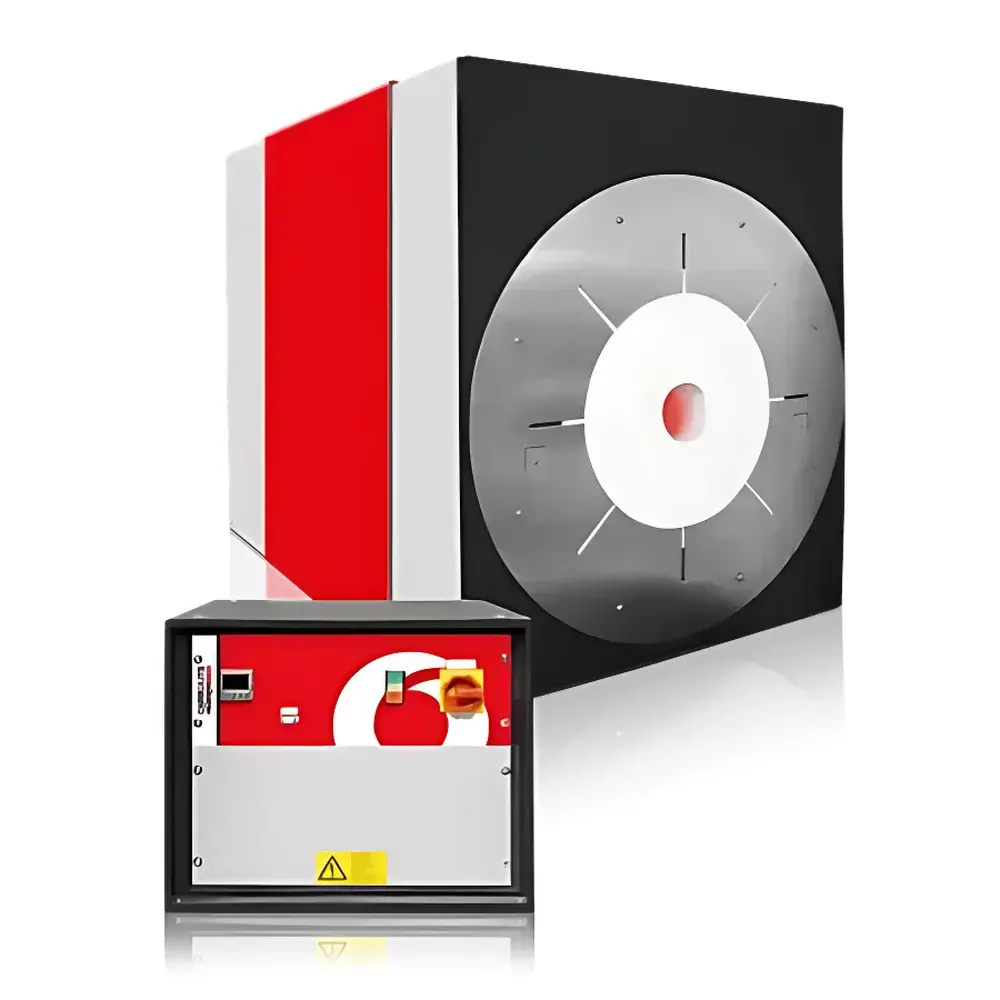
Carbolite Gero HTRH High-Temperature Horizontal Tube Furnace
| Brand | Carbolite Gero |
|---|---|
| Origin | Germany |
| Model | HTRH |
| Instrument Type | Horizontal Tube Furnace |
| Max Operating Temperature | 1800 °C |
| Programmable Controller | 24-Stage (EPC3016P1 for HTRH |
| Over-Temperature Protection | Yes |
| Atmosphere Compatibility | Controlled atmosphere & vacuum (optional) |
| Max Tube OD | 100 mm (in controlled atmosphere), 200 mm (in air) |
| Heating Zone Lengths | 100, 150, 250, 300, 600, 900 mm |
| Heating Element | High-Purity Silicon Molybdenum (MoSi₂) Rods, Vertically Suspended |
| Insulation | Low-Heat-Capacity Ceramic Fiber |
| Cooling | Convection Slots in Rectangular Housing |
| Zone Configuration | Optional 1–3 Independent Heating Zones |
| Control Cabinet Separation | Yes (3 m standard cable |
| Communication Interface | Ethernet (optional), Digital I/O, RS485 |
| Compliance | Designed to meet requirements for ISO/IEC 17025-compliant thermal validation, GLP/GMP-relevant process documentation, and ASTM E220, E1142, and USP <1211> thermal calibration protocols |
Overview
The Carbolite Gero HTRH High-Temperature Horizontal Tube Furnace is an engineered solution for precision thermal processing under inert, reducing, oxidizing, or vacuum conditions. Built upon a robust horizontal configuration, it employs a dual-wall rectangular steel housing with integrated convection cooling slots to maintain structural integrity and operator safety at sustained temperatures up to 1800 °C. Its core architecture centers on high-purity silicon molybdenum (MoSi₂) heating elements—vertically suspended within the furnace chamber—to ensure uniform radiant heat distribution and long-term stability in aggressive thermal cycling environments. The furnace is thermally insulated with low-heat-capacity ceramic fiber modules, minimizing energy consumption while enabling rapid ramp rates and tight temperature stability (±1 °C typical at setpoint). Designed explicitly for laboratory-scale materials synthesis and qualification, the HTRH supports repeatable thermal profiles required in catalyst activation, solid-state reaction kinetics, thin-film deposition (CVD/PVD), fuel cell component sintering, and thermocouple calibration traceable to NIST standards.
Key Features
- Horizontally oriented tube geometry optimized for gas flow uniformity and sample accessibility during dynamic atmosphere processing
- 24-stage programmable digital controllers (EPC3016P1 or CC-T1) with real-time temperature logging, alarm thresholds, and user-defined ramp/soak sequences
- Modular heating zone design: single-, dual-, or triple-zone configurations available to achieve axial thermal gradients as low as ±3 °C over 600 mm heating length
- Separate control cabinet connected via shielded, industrial-grade cable (standard 3 m; optional 6 m), enabling safe remote operation and integration into centralized lab automation systems
- Digital communication interfaces including Ethernet (IEEE 802.3), RS485, and analog 4–20 mA outputs for SCADA, LIMS, or MES connectivity with audit-trail-capable data recording
- Comprehensive over-temperature protection via independent hardware limiter and software-based fail-safe logic compliant with IEC 61508 SIL 2 functional safety principles
Sample Compatibility & Compliance
The HTRH accommodates quartz, alumina, silicon carbide, and molybdenum disilicide (MoSi₂) tubes with internal diameters from 30 mm to 150 mm and lengths up to 1200 mm. Standard tube support fixtures include low-conductivity ceramic end caps and radiation shields to minimize axial heat loss and improve temperature uniformity across the hot zone. For regulated environments, optional vacuum flanges (CF-63 or KF-50), pneumatic gate valves, and residual gas analyzers enable full compliance with ISO 10071:2017 (controlled atmospheres) and ASTM F2456 (vacuum system performance). All controller firmware supports 21 CFR Part 11–compliant electronic signatures, user access levels, and immutable event logs for GxP-aligned workflows.
Software & Data Management
Carbolite Gero’s proprietary FurnaceControl Suite provides browser-based configuration of temperature profiles, real-time multi-channel monitoring, and automated report generation in PDF or CSV formats. Data export includes timestamped thermocouple readings (Type S, R, or B), power consumption metrics, and alarm history with cause codes. The system supports seamless integration with LabArchives, Benchling, and custom Python-based analysis pipelines via RESTful API endpoints. All recorded datasets are stored with SHA-256 checksums and retain full traceability to instrument ID, operator login, and environmental metadata (e.g., ambient humidity, line voltage).
Applications
- Catalyst synthesis and regeneration under H₂/N₂/Ar atmospheres
- Solid oxide fuel cell (SOFC) anode/cathode sintering and electrochemical aging studies
- Thermal calibration of Type R and S thermocouples per ASTM E220 and ISO 5725
- Chemical vapor deposition (CVD) precursor pyrolysis and thin-film growth
- Metal injection molding (MIM) and ceramic injection molding (CIM) debinding and sintering
- High-temperature phase transformation analysis in battery cathode materials (e.g., NMC, LFP)
- Thermal gravimetric analysis (TGA) coupling via integrated mass flow controllers and quadrupole residual gas analyzers
FAQ
What tube materials are compatible with the HTRH at 1800 °C?
Quartz tubes are limited to 1100 °C; for 1800 °C operation, high-purity alumina (Al₂O₃ ≥ 99.8%) or silicon carbide (SiC) tubes are required.
Can the HTRH be validated for IQ/OQ/PQ in a GMP environment?
Yes—Carbolite Gero supplies documented validation protocols, certified reference thermocouples, and temperature mapping reports aligned with ASTM E220 and EU Annex 15.
Is vacuum capability factory-integrated or retrofittable?
Vacuum systems (mechanical pump or turbomolecular pump) are modular options; all HTRH models ship with pre-drilled and sealed vacuum flange ports.
How is temperature uniformity verified across the heating zone?
Uniformity is characterized using a 5-point axial thermocouple array per ASTM E1142; typical specification is ±3 °C over 90% of the nominal heating length.
Does the furnace support automated gas switching between multiple inlet lines?
Yes—the optional 3-channel mass flow controller (MFC) module enables timed, pressure-compensated gas sequencing synchronized with temperature ramps.



