
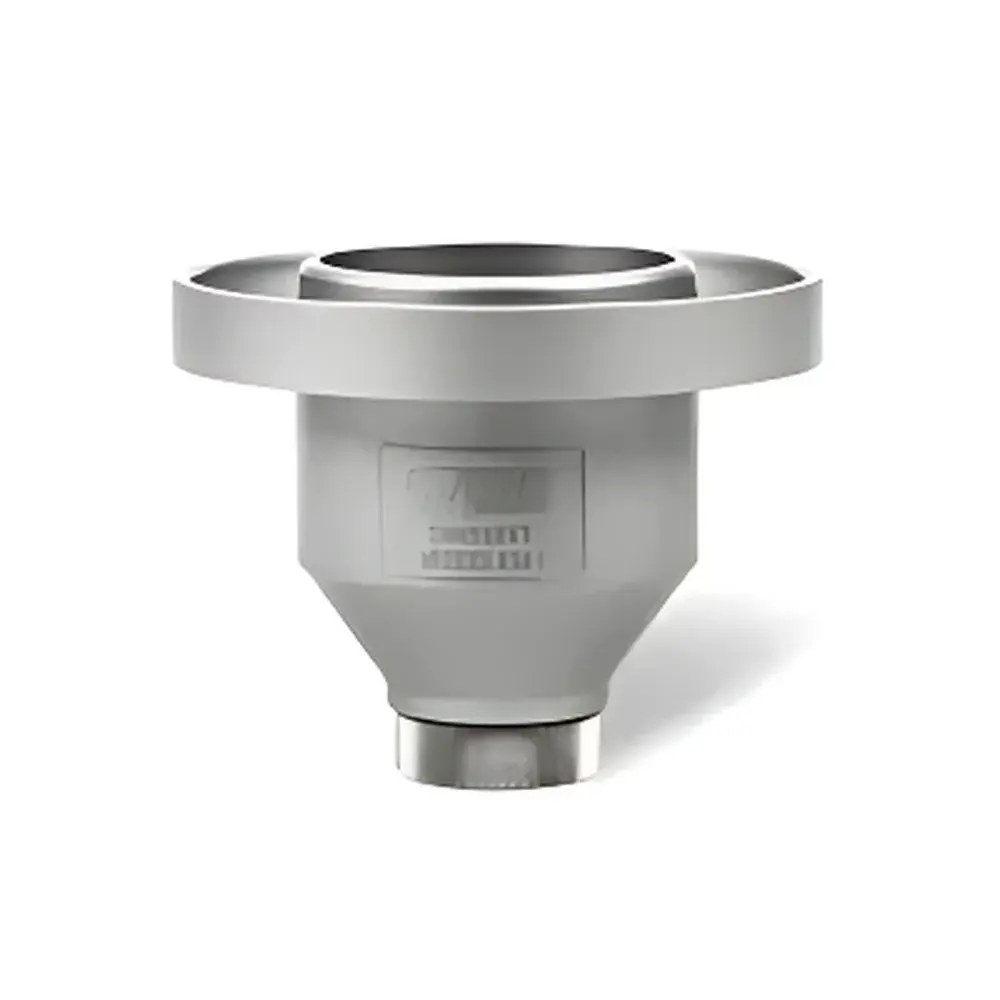
DIN Cup Viscometer (TQC Model DIN Cup)
| Brand | TQC |
|---|---|
| Origin | Guangdong, China |
| Manufacturer Type | Authorized Distributor |
| Country of Origin | China |
| Model | DIN Cup |
| Pricing | Available Upon Request |
| Compliance | DIN 53211 |
Overview
The DIN Cup Viscometer (TQC Model DIN Cup) is a gravity-driven efflux viscometer designed for rapid, standardized measurement of kinematic viscosity in low-to-medium viscosity liquids. Operating on the principle of gravitational flow through a precisely engineered orifice, it delivers repeatable efflux time data that—when correlated with calibration fluids or reference tables—yields kinematic viscosity values in mm²/s (cSt). This instrument conforms strictly to DIN 53211 (German Institute for Standardization), which specifies dimensional tolerances, orifice geometry, cup material requirements, and test procedure protocols for efflux cups used in coatings, inks, adhesives, food products, and lubricants. Unlike rotational or capillary viscometers, the DIN cup provides field-deployable, operator-independent viscosity assessment without external power or complex setup—making it indispensable for inline QC checks, supplier audits, and raw material screening where speed and traceability are critical.
Key Features
- Precision-machined stainless steel or anodized aluminum construction ensures long-term dimensional stability and corrosion resistance against solvents, oils, and aqueous formulations.
- Deep peripheral well around the cup rim captures overflow during filling, preventing spillage onto support fixtures and eliminating measurement errors caused by inconsistent meniscus formation.
- Orifice-centered bottom design eliminates recessed grooves or blind cavities—significantly reducing residue retention and enabling rapid, validated cleaning with common laboratory solvents or hot water.
- Optimized external dimensions ensure mechanical compatibility with TQC’s standardized viscometer stands (e.g., TQC Sheen Stand Series), providing vertical alignment, stable leveling, and hands-free operation during efflux timing.
- Each unit is laser-engraved with a unique serial number for full traceability—supporting internal QA documentation, calibration log maintenance, and audit readiness under ISO/IEC 17025 or GMP-aligned quality systems.
Sample Compatibility & Compliance
The DIN Cup is suitable for Newtonian and near-Newtonian liquids within the typical efflux range of 20–150 seconds (corresponding to approximate kinematic viscosities of 20–200 mm²/s at 23 °C). Common applications include solvent-based paints, nitrocellulose lacquers, printing inks, edible oils, honey, syrups, sauces, and light industrial lubricants. It is not recommended for highly non-Newtonian, thixotropic, or particulate-laden suspensions where shear history significantly affects flow behavior. Compliance with DIN 53211 ensures equivalence with ISO 2431 and ASTM D1200 (for Zahn cups), though direct interconversion requires fluid-specific correlation. The cup satisfies essential requirements for routine QC testing under ISO 9001, IATF 16949, and FDA-regulated food manufacturing environments where viscosity serves as a critical process parameter.
Software & Data Management
As a manual efflux device, the DIN Cup does not incorporate embedded electronics or firmware. However, its output—efflux time in seconds—is fully compatible with industry-standard digital stopwatch systems, automated timing gates (e.g., TQC Auto-Timer), and LIMS-integrated data capture workflows. When paired with calibrated reference oils and temperature-controlled baths (maintained per DIN 53211 §5.2), recorded efflux times can be converted to kinematic viscosity using NIST-traceable calibration curves or manufacturer-provided conversion tables. Full audit trails—including operator ID, ambient temperature, sample batch ID, and cup serial number—are manually or digitally logged to meet GLP/GMP documentation expectations and 21 CFR Part 11 compliance when used within validated electronic record systems.
Applications
- On-site verification of paint and coating viscosity prior to spray application or dip-coating—ensuring consistent film thickness and defect minimization.
- Routine QC of honey and maple syrup batches to confirm compliance with national grading standards (e.g., Codex Alimentarius, USDA Grade A specifications).
- Raw material acceptance testing for mineral oils and transformer fluids, verifying consistency against supplier certificates of analysis.
- Production line monitoring of salad dressings, ketchup, and mayonnaise to maintain target mouthfeel and pumpability.
- Supplier qualification audits where portable, standards-based viscosity assessment is required without laboratory infrastructure.
FAQ
What temperature must the sample be controlled to during testing?
Per DIN 53211, tests shall be conducted at 23 ± 0.5 °C. A thermostatically controlled water bath or climate-stabilized QC room is mandatory for metrologically valid results.
Can the DIN Cup be used for high-viscosity resins or uncured epoxies?
No. Efflux times exceeding 150 seconds indicate viscosity beyond the cup’s validated range; use a lower-orifice DIN cup (e.g., DIN 4) or rotational rheometry instead.
How often should the cup be recalibrated or certified?
Physical dimensional verification is recommended annually or after 500 uses; certification against reference oils should accompany each major maintenance cycle per ISO/IEC 17025 Clause 6.5.
Is cleaning validation required between samples?
Yes—especially when switching between chemically incompatible materials. Residue carryover must be verified via blank runs or FTIR swab testing in regulated environments.
Does TQC provide traceable calibration certificates with purchase?
Yes—certificates of conformance (including orifice diameter measurement reports and DIN 53211 compliance statement) are supplied with each serialized unit upon request.





