
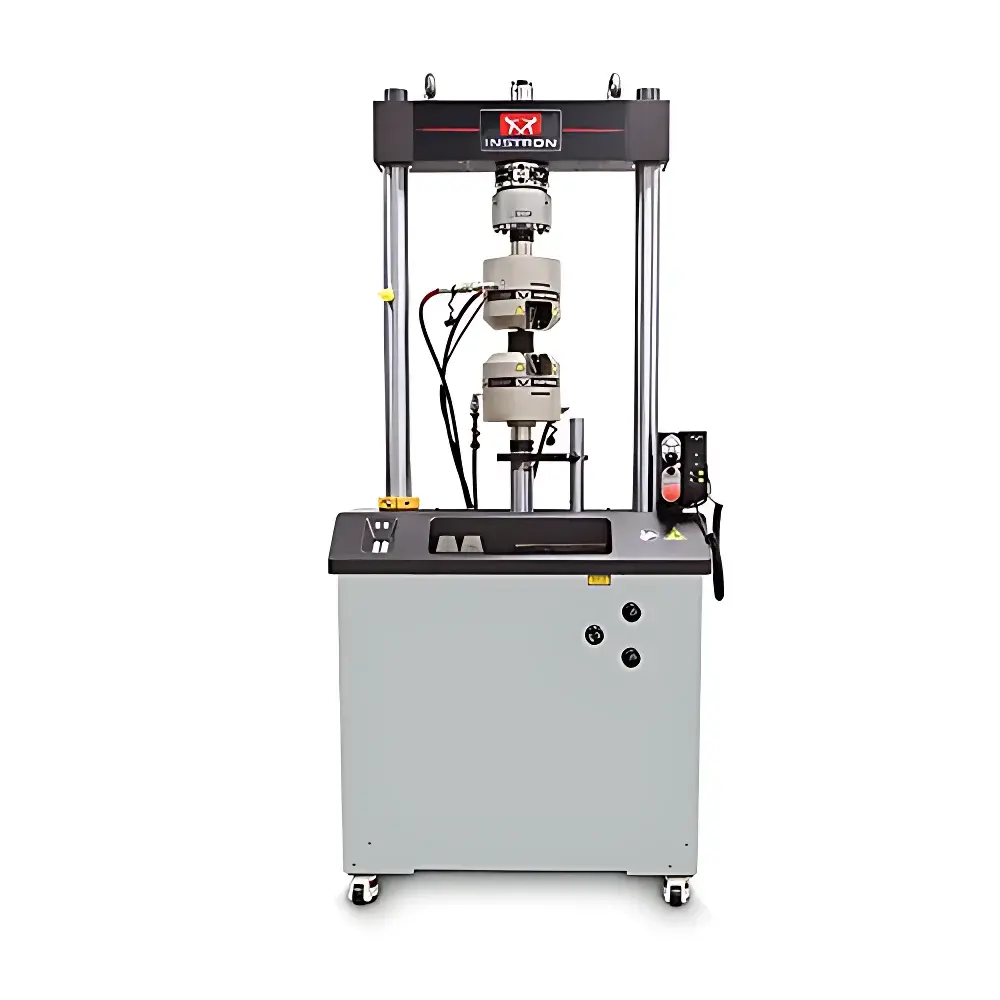
Instron 8801 & 8802 Floor-Mounted Electro-Hydraulic Servo Fatigue Testing Systems
| Brand | Instron |
|---|---|
| Origin | USA |
| Instrument Type | Electro-Hydraulic Servo Fatigue Testing System |
| Model Series | 8801 / 8802 |
| Frame Configuration | Floor-Mounted |
| Control System | 8800MT Digital Controller |
| Load Cell Technology | Dynacell™ Patented Integrated Load Cell |
| Software Suite | WaveMatrix™ 3, Bluehill® Universal, Bluehill Fracture, LCF3 |
| Compliance | ASTM E4, E8, E606, E647, E1820 |
Overview
The Instron 8801 and 8802 floor-mounted electro-hydraulic servo fatigue testing systems are engineered for high-fidelity mechanical characterization of advanced materials and structural components under both static and dynamic loading conditions. These systems operate on the principle of closed-loop servo-hydraulic actuation, delivering precise force, displacement, and strain control across a broad frequency spectrum—from quasi-static rates up to 100 Hz in high-cycle fatigue (HCF) and down to sub-0.1 Hz for low-cycle fatigue (LCF), thermomechanical fatigue (TMF), and fracture mechanics applications. Designed for laboratory integration without structural modification, both models feature self-contained hydraulic power units, floor-standing load frames with optimized stiffness-to-mass ratios, and modular test space configurations. The 8801 employs a moving-column architecture for compact footprint and rapid reconfiguration, while the 8802 utilizes a fixed-column, high-rigidity frame optimized for precision alignment—critical for composite laminate testing, component-level validation, and crack propagation studies requiring minimal parasitic motion.
Key Features
- Electro-hydraulic servo actuation with real-time digital control via the Instron 8800MT controller, supporting synchronized data acquisition at up to 10 kHz across all analog input channels
- Dynacell™ integrated load cell technology—patented design eliminating mechanical linkages between actuator and load train to minimize inertial artifacts and improve phase fidelity in dynamic tests
- Hydrostatic bearing actuators offering superior lateral stiffness and reduced friction hysteresis compared to conventional rolling-element bearings
- T-slot test table with configurable mounting options and optional extended table sizes (up to 1200 mm × 1200 mm) for large-component or multi-specimen setups
- Motorized, hydraulically assisted crosshead adjustment with automatic locking mechanism and position repeatability within ±5 µm
- Stiffness-based PID tuning algorithm eliminating the need for pre-test cycling—enabling rapid system calibration and reducing setup time by up to 40% versus conventional methods
- 19-bit analog-to-digital resolution for all sensor inputs—including extensometers, clip gauges, and thermocouples—ensuring high signal integrity in low-amplitude fatigue regimes
Sample Compatibility & Compliance
These systems accommodate specimens ranging from miniature metallic coupons (ASTM E606-compliant smooth or notched specimens) to full-scale aerospace subcomponents, polymer composites, biomedical implants, and welded joints. Standard configurations support tensile, compression, bending, torsion, and push-pull axial testing modes. Optional environmental chambers (−70 °C to +350 °C), pneumatic grips, hydraulic wedge grips, and high-temperature extensometry extend applicability to thermomechanical fatigue and elevated-temperature creep–fatigue interaction studies. All hardware and software modules comply with ISO/IEC 17025 requirements for testing laboratories, support GLP/GMP audit trails when configured with Bluehill® Universal’s 21 CFR Part 11 module, and meet essential clauses of ASTM E4 (force verification), E647 (crack growth rate), and ISO 1099 (fatigue testing of metallic materials).
Software & Data Management
Control and analysis are unified through Instron’s modular software ecosystem. The 8800MT controller hosts embedded firmware for real-time waveform generation, adaptive amplitude control, and specimen protection logic (e.g., automatic shutdown upon load deviation >±3% of setpoint). WaveMatrix™ 3 provides dedicated dynamic test sequencing—including block loading, spectrum loading, and variable-amplitude fatigue—with built-in compliance correction and hysteresis loop analysis. Bluehill® Universal delivers intuitive test method authoring, automated reporting per ASTM/ISO templates, and raw data export in HDF5 and CSV formats. Specialized add-ons include Bluehill Fracture for J-integral and CTOD calculations per ASTM E1820, and LCF3 for strain-controlled low-cycle fatigue life prediction using Manson–Coffin and Morrow corrections. All software modules support role-based user access, electronic signatures, and full audit trail logging compliant with FDA 21 CFR Part 11 Annex 11 requirements.
Applications
- High-cycle fatigue evaluation of turbine blades, landing gear alloys, and automotive suspension components per SAE AIR4501B and ASTM E466
- Low-cycle fatigue and ratcheting behavior of pressure vessel steels and nuclear-grade welds under cyclic plasticity conditions
- Crack initiation and propagation resistance in fiber-reinforced polymer composites using compact tension (CT) and single-edge notched bend (SENB) configurations
- Thermomechanical fatigue simulation of thermal barrier coatings via out-of-phase temperature–load cycling
- Biomedical device validation—including fatigue life assessment of orthopedic implants per ISO 14801 and cardiovascular stents per ISO 14049
- Qualification testing of additive-manufactured metal parts where microstructural anisotropy influences fatigue threshold behavior
FAQ
What distinguishes the 8801 from the 8802 model?
The 8801 features a moving-column frame for space-efficient operation and fast test setup changes; the 8802 uses a fixed-column, ultra-high-rigidity architecture optimized for alignment-critical applications such as composite testing and fracture mechanics.
Can these systems perform thermomechanical fatigue (TMF) testing?
Yes—when integrated with programmable environmental chambers and synchronized thermal profiling via WaveMatrix™ 3, both models support in-phase and out-of-phase TMF protocols per ASTM E2368.
Is 21 CFR Part 11 compliance available?
Yes—Bluehill® Universal software offers optional 21 CFR Part 11 configuration with electronic signatures, audit trail, and role-based access controls validated per IQ/OQ protocols.
What is the maximum recommended test frequency for LCF applications?
The systems support stable closed-loop control down to 0.001 Hz for strain-controlled LCF, with optimal performance maintained between 0.01–5 Hz depending on specimen geometry and actuator stroke.
Are third-party sensors and fixtures supported?
Yes—the 8800MT controller accepts industry-standard analog and digital signals (e.g., LVDTs, RTDs, IEPE accelerometers) and interfaces seamlessly with ISO-standard T-slot tooling and ASTM-compliant grip assemblies.



