
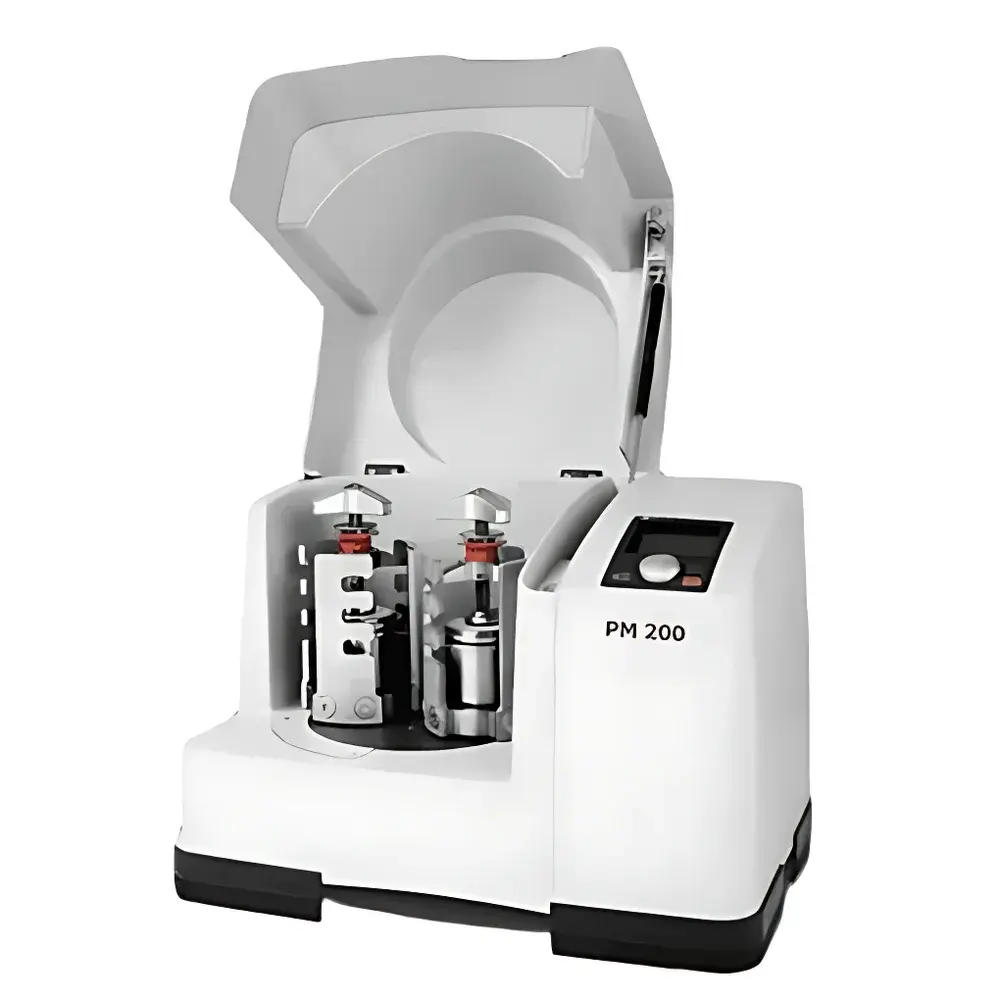
RETSCH PM 200 Planetary Ball Mill
| Brand | RETSCH |
|---|---|
| Origin | Germany |
| Model | PM 200 |
| Instrument Type | Planetary Ball Mill |
| Sample Suitability | Hard, brittle, fibrous, and soft materials |
| Max. Feed Size | < 4 mm |
| Final Particle Size | < 0.1 µm (colloidal grinding) |
| Batch Capacity | max. 2 × 50 mL |
| Speed Range | up to 650 rpm |
| Grinding Stations | 2 |
| Temperature & Pressure Monitoring | optional GrindControl kit |
| Atmosphere Control | available with gas-tight lids |
| Programmable Protocols | yes |
| Grinding Vessel Materials | stainless steel, agate, zirconia, tungsten carbide, PTFE |
| Grinding Media Options | stainless steel, agate, zirconia balls (e.g., 7 × 20 mm, 50 × 10 mm) |
Overview
The RETSCH PM 200 Planetary Ball Mill is a high-energy, dual-station laboratory mill engineered for reproducible, ultra-fine comminution of hard, brittle, fibrous, and temperature-sensitive materials. Operating on the principle of planetary motion—where grinding jars rotate around their own axis while simultaneously revolving around a central sun wheel—the PM 200 generates centrifugal accelerations up to 95 g, enabling efficient mechanical activation, alloying, amorphization, and colloidal-size reduction via impact, shear, and friction forces. Designed for research-grade applications in materials science, geochemistry, pharmaceutical development, catalysis, and nanotechnology, the instrument delivers consistent sub-100 nm particle distributions under controlled dry or wet grinding conditions. Its robust cast-aluminum housing, precision-machined gear train, and vibration-damped base ensure long-term operational stability and minimal energy loss—critical for GLP-compliant method development and inter-laboratory comparability.
Key Features
- Dual grinding stations supporting independent or synchronized operation—ideal for comparative studies or parallel sample processing
- Speed range of 30–650 rpm with digital speed control and real-time RPM monitoring for precise kinetic parameter optimization
- GrindControl option enables in-situ measurement and logging of internal jar temperature and pressure during milling—essential for exothermic reactions or mechanochemical synthesis
- Gas-tight grinding vessel lids compatible with inert (N₂, Ar), reducing (H₂), or reactive atmospheres—supports air-sensitive synthesis and oxidation-controlled processing
- Pre-programmable grinding protocols (up to 99 cycles) with automatic start/stop, pause/resume, and directional reversal functions to minimize thermal buildup and improve homogeneity
- Wide compatibility with certified grinding media and vessels: stainless steel (12–250 mL), agate (12–125 mL), zirconia (12–250 mL), tungsten carbide, and PTFE—each traceable to ISO 8502-3 and ASTM E11 standards for contamination control
Sample Compatibility & Compliance
The PM 200 accommodates diverse sample matrices—including metallic alloys, ceramic precursors, geological specimens (e.g., limestone, iron ore, kaolinite), biological tissues (bone, hair, plant matter), polymers, catalysts, and electronic waste—without cross-contamination when appropriate vessel/media combinations are selected. All grinding vessels meet DIN EN ISO 17025 requirements for dimensional accuracy and surface finish. For regulated environments, the system supports audit-trail-enabled software (via optional RETSCH Software Pro) compliant with FDA 21 CFR Part 11 for electronic records and signatures. Routine calibration verification follows ASTM E2909 (Standard Guide for Mechanical Alloying and Milling) and ISO 13320:2020 (Laser diffraction particle size analysis—method validation).
Software & Data Management
When paired with RETSCH Software Pro (optional), the PM 200 integrates into centralized lab data workflows. The software allows full protocol definition—including speed ramps, dwell times, directional switching, cooling intervals, and GrindControl threshold triggers—with encrypted storage of all run metadata (timestamp, operator ID, vessel ID, energy input, thermal profile). Export formats include CSV, PDF, and XML for LIMS integration. All user actions are logged with immutable timestamps, satisfying GLP/GMP documentation requirements for method validation, equipment qualification (IQ/OQ/PQ), and regulatory submissions.
Applications
- Mechanochemical synthesis of MOFs, solid-state electrolytes, and metastable phases
- Top-down nanomaterial production (e.g., graphene oxide dispersion, nano-cement hydration studies)
- Homogenization and dispersion of pigments, coatings, and composite feedstocks
- Preparation of XRD- and SEM-ready powders from refractory minerals and metallurgical slags
- Cell disruption and extraction support for proteomics and metabolomics workflows
- Recycling process development: liberation of critical metals from e-waste and spent catalysts
FAQ
What is the minimum achievable particle size with the PM 200?
Under optimized wet-grinding conditions using zirconia vessels and media, the PM 200 routinely achieves median particle sizes (D₅₀) below 100 nm—verified by laser diffraction (ISO 13320) or TEM imaging. Final size distribution depends on material hardness, brittleness, and specific energy input.
Can the PM 200 be used for cryogenic grinding?
Yes—when equipped with liquid nitrogen-cooled jackets (available as accessory) and compatible low-temperature vessels (e.g., hardened steel or tungsten carbide), it supports cryo-milling of thermolabile polymers and biological samples.
Is the instrument suitable for GMP-regulated quality control labs?
With GrindControl, Software Pro, and documented IQ/OQ protocols, the PM 200 meets core requirements for analytical method transfer and routine QC grinding across pharmaceutical, cosmetic, and food safety laboratories.
How is cross-contamination prevented between runs?
Vessels and media are cleaned per SOPs using ultrasonic baths and validated solvent rinses; RETSCH provides traceable cleaning verification kits aligned with USP Analytical Instrument Qualification.
What maintenance is required for long-term reliability?
Biannual gear lubrication, annual torque verification of drive couplings, and periodic calibration of speed sensors using NIST-traceable tachometers—fully documented in the included Maintenance Logbook and supported by RETSCH’s global service network.



