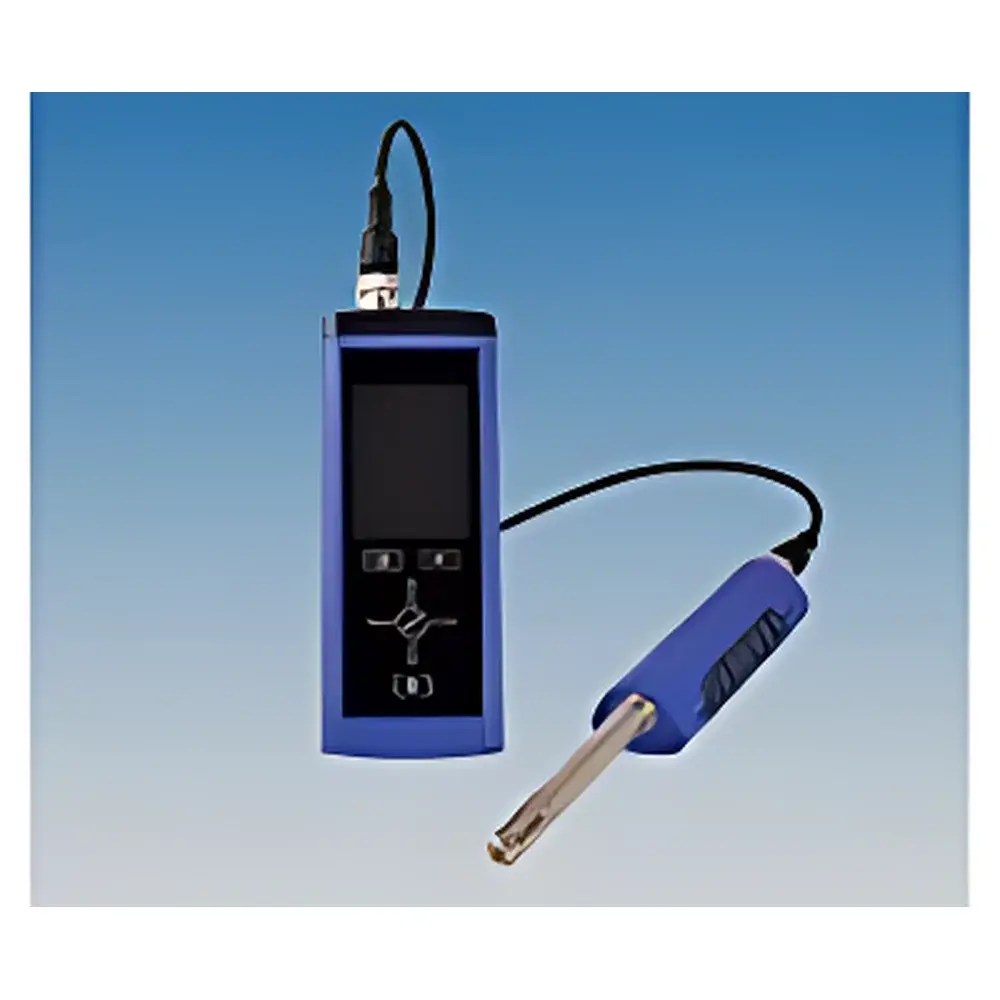
Pall WS19 Portable Dissolved Water Sensor
| Brand | Pall |
|---|---|
| Model | WS19 |
| Type | Portable Capacitive Moisture-in-Oil Sensor |
| Measurement Principle | Dielectric Constant-Based Water Activity (aw) and ppm Detection |
| Dimensions | 62 mm W × 170 mm L × 34 mm D (2.4″ × 6.7″ × 1.3″) |
| Weight | 0.21 kg (0.45 lb) |
| Battery Life | Up to 200 hours |
| Operating Temperature | Probe: −40°C to +120°C (−40°F to +248°F) |
| Controller & Display Unit | 0°C to +50°C (32°F to 122°F) |
| Probe Cable Length | 2 m (6.6 ft) |
| Fluid Compatibility | Mineral oils, synthetic hydrocarbons, polyalphaolefins (PAOs), diesters, and phosphate esters *excluding aerospace-grade phosphate esters* |
| Accuracy | ±2% RH (0–90% RH), ±3% RH (90–100% RH) |
| Traceability | NIST-, PTB-, and BEV-traceable calibration |
| Compliance | IEC 61326-1:2005, IEC 61326-2-1:2005, EN 61326-1:2006 |
Overview
The Pall WS19 Portable Dissolved Water Sensor is an industrial-grade, handheld instrument engineered for rapid, on-site quantification of dissolved water concentration in lubricating oils, hydraulic fluids, and insulating transformer oils. Unlike ultrasonic or radar-based water level gauges — which measure free surface water height in tanks — the WS19 employs a calibrated capacitive sensing principle grounded in dielectric constant measurement. It determines water activity (aw) and estimates equilibrium water concentration (ppm) by detecting subtle shifts in the oil’s permittivity caused by polar water molecules dispersed at molecular scale. This makes it uniquely suited for predictive maintenance programs where early detection of moisture ingress—prior to phase separation or hydrolytic degradation—is critical to asset reliability. Designed for field use across power generation, wind turbine gearbox monitoring, hydraulics maintenance, and transformer fleet management, the WS19 delivers laboratory-grade repeatability without requiring sample extraction or lab submission.
Key Features
- True portable architecture: Integrated probe, controller, and backlit LCD display in a single ergonomic unit weighing only 0.21 kg.
- Wide operational temperature envelope: Sensor tip rated from −40°C to +120°C enables direct in-line or sump probing under extreme thermal conditions.
- NIST-, PTB-, and BEV-traceable calibration certificate supplied with each unit, ensuring metrological integrity for ISO/IEC 17025-aligned quality systems.
- Robust electromagnetic compatibility per IEC 61326-1:2005 and IEC 61326-2-1:2005, validated for use in electrically noisy environments such as substations and pump stations.
- Chemically resistant probe housing compatible with mineral oils, PAOs, diesters, and non-aerospace phosphate esters — explicitly excluding water-based fluids and aviation-grade fire-resistant hydraulic fluids.
- 2-meter shielded coaxial probe cable minimizes signal attenuation and EMI coupling during extended deployment in machinery enclosures or remote sumps.
Sample Compatibility & Compliance
The WS19 is validated for use with hydrocarbon-based and synthetically formulated industrial oils meeting ASTM D6971 (Standard Test Method for Determination of Water in Used Lubricating Oils by Coulometric Karl Fischer Titration) and IEC 60814 (Insulating liquids — Oil-impregnated paper and pressboard — Determination of water content — Coulometric Karl Fischer method) reference frameworks. It is not intended for aqueous emulsions, glycol-based coolants, or MIL-PRF-83282/87257 aerospace hydraulic fluids due to dielectric interference and material incompatibility. Device compliance includes EN 61326-1:2006 for electrical emissions and immunity, supporting integration into facilities operating under EU Machinery Directive 2006/42/EC and requiring CE marking for instrumentation deployed in Zone 2 hazardous locations (non-certified for Zone 1).
Software & Data Management
While the WS19 operates as a standalone field instrument with real-time LCD readout (displaying %RH, estimated ppm, and temperature), optional USB data logging firmware (sold separately) enables time-stamped export of measurement series to CSV format. All stored records include operator ID fields, probe serial number, ambient temperature stamp, and calibration validity status — supporting audit readiness for GLP, GMP, and ISO 55001 asset management frameworks. The firmware enforces user-accessible calibration lockout after expiration date, and maintains full traceability logs compliant with FDA 21 CFR Part 11 requirements when used with validated PC-based acquisition software.
Applications
- Turbine lube oil monitoring: Detect moisture accumulation before oxidation catalyst activation or varnish formation begins.
- Hydraulic system health assessment: Identify seal leakage or breather failure in mobile and stationary equipment prior to servo valve stiction.
- Transformer oil condition surveillance: Correlate water activity trends with dielectric strength (ASTM D877/D1816) and interfacial tension (ASTM D971) for risk-based maintenance scheduling.
- Compressor oil diagnostics: Quantify condensation-related saturation in air and gas compression systems operating under cyclic thermal loads.
- Wind turbine gearbox fluid analysis: Conduct routine checks during scheduled servicing without draining or offline lab turnaround delays.
FAQ
Can the WS19 measure free water or only dissolved water?
It measures dissolved water concentration and water activity (aw) via dielectric response; it does not detect free-phase water droplets or interface levels.
Is calibration required before each use?
No — factory calibration is stable for 12 months under normal operating conditions; annual recalibration against traceable standards is recommended per ISO/IEC 17025 guidelines.
Does the sensor require immersion in oil, or can it be used in vapor phase?
It must be fully immersed in the liquid phase; vapor-phase or headspace measurements are outside its design scope.
What maintenance is needed for the probe?
Wipe clean with lint-free cloth after use; avoid solvents incompatible with FKM or PEEK housing materials; inspect cable shielding integrity before high-voltage proximity deployments.
Can data be integrated into CMMS or SCADA platforms?
Yes — via optional ASCII-over-USB output mode, enabling direct ingestion into Maximo, SAP PM, or Ignition SCADA systems using standard Modbus RTU mapping templates.