
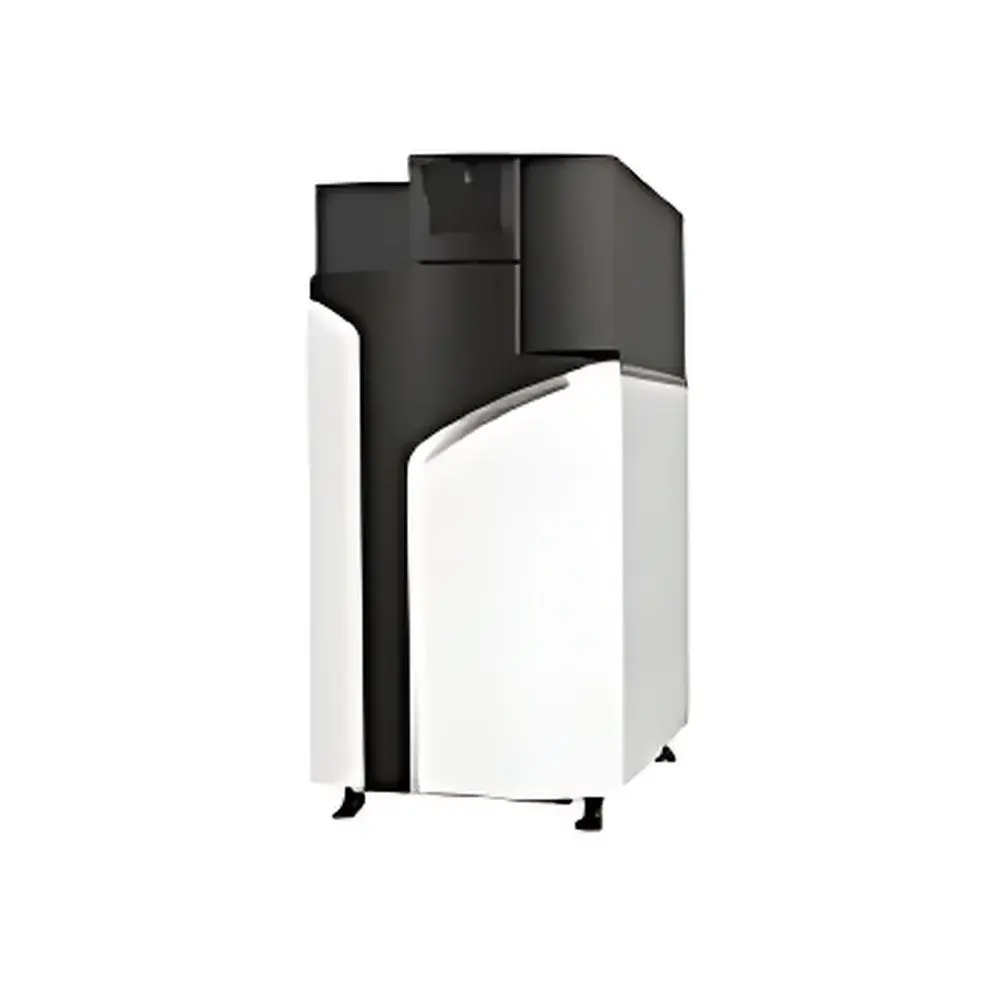
Shimadzu LCMS-9030 Quadrupole Time-of-Flight Mass Spectrometer
| Origin | Guangdong, China |
|---|---|
| Manufacturer Type | Authorized Distributor |
| Origin Category | Domestic (PRC) |
| Model | LCMS-9030 |
| Pricing | Upon Request |
Overview
The Shimadzu LCMS-9030 Quadrupole Time-of-Flight Mass Spectrometer is a high-resolution, high-mass-accuracy hybrid instrument that integrates a robust RF-only quadrupole mass filter with an orthogonal acceleration time-of-flight (oa-TOF) analyzer. Engineered for precision in both qualitative and quantitative workflows, it operates on the fundamental principle of mass separation via quadrupole ion transmission followed by energy-focused ion acceleration into a field-free flight tube, where mass-to-charge (m/z) values are determined from ion time-of-flight—enabling sub-ppm mass accuracy and resolving power exceeding 30,000 FWHM (at m/z 556). Designed for seamless coupling with ultra-high-performance liquid chromatography (UHPLC), the system delivers comprehensive molecular characterization across diverse sample matrices without compromising throughput or reproducibility.
Key Features
- Hybrid Q-TOF architecture combining a high-transmission quadrupole mass filter with an orthogonal acceleration TOF analyzer for simultaneous precursor selection and high-resolution detection
- UFgrating™ ion optics: A patented grating-based ion beam conditioning system that enhances ion transmission efficiency and spatial coherence prior to acceleration
- iRefTOF™ reflectron technology: An intelligent, dynamically optimized reflectron enabling extended flight path compensation and improved mass resolution across wide m/z ranges (50–2,000 Da)
- UF-FlightTube™: Ultra-fast acceleration region with precisely controlled extraction fields, minimizing kinetic energy spread and improving mass accuracy and peak shape fidelity
- High-speed data acquisition: Up to 30 spectra per second in full-scan mode with centroided data output, supporting rapid LC gradient methods and transient peak analysis
- Integrated dual-mode ion source: Electrospray Ionization (ESI) and Atmospheric Pressure Chemical Ionization (APCI) with automated switching and real-time polarity switching
Sample Compatibility & Compliance
The LCMS-9030 supports broad sample compatibility—including small molecules, peptides, metabolites, lipids, and polar/non-polar pharmaceuticals—across biological fluids (plasma, urine, tissue homogenates), environmental extracts, food matrices, and synthetic intermediates. Its vacuum architecture and ion source design accommodate variable flow rates (50 nL/min–2 mL/min) and solvent compositions typical of reversed-phase, HILIC, and ion-pairing LC separations. The system complies with ISO/IEC 17025 requirements for analytical laboratory competence and supports audit-ready operation under GLP and GMP environments. Data integrity is maintained through secure user authentication, electronic signatures, and full 21 CFR Part 11–compliant audit trails when used with Shimadzu LabSolutions Insight software.
Software & Data Management
Controlled via Shimadzu LabSolutions Insight v2.x, the LCMS-9030 provides integrated method development, real-time data acquisition, post-run processing, and reporting. Key software capabilities include automatic calibration validation, formula prediction (with isotopic pattern matching), MS/MS spectral library searching (NIST, mzCloud, and custom libraries), and quantitative workflow support (internal standard calibration curves, QC sample tracking, and batch reprocessing). Raw data files (.qgd format) are stored in vendor-neutral, open-accessible structures compatible with third-party tools such as Skyline, Compound Discoverer, and MS-DIAL. All processing parameters, calibration logs, and instrument status reports are timestamped and archived within the database for full traceability.
Applications
- Non-targeted screening and structural elucidation of unknown compounds in environmental monitoring and food safety testing
- Metabolomics and lipidomics profiling requiring high mass accuracy and retention time alignment across large sample cohorts
- Impurity identification and degradation product characterization in pharmaceutical development (ICH Q3B/Q5C compliant)
- Peptide mapping and post-translational modification analysis in biopharmaceutical quality control
- Forensic toxicology workflows involving multi-analyte panels with low-abundance biomarkers
- Regulatory submissions requiring documented mass accuracy, resolution, and repeatability per ASTM E2981 and ISO 13877 standards
FAQ
What is the typical mass accuracy performance of the LCMS-9030 under routine calibration conditions?
Mass accuracy remains ≤ 2 ppm RMS error over 48 hours using internal lock mass correction with standard calibrants (e.g., sodium formate cluster ions).
Does the LCMS-9030 support tandem MS (MS/MS) experiments?
Yes—the quadrupole serves as a precursor ion selector, enabling data-dependent and targeted MS/MS acquisition with collision-induced dissociation (CID) in the hexapole collision cell.
Is the system compatible with high-flow LC systems (e.g., 2 mL/min) without source modifications?
Yes—the dual-mode ion source includes a heated nebulizer and adjustable gas flows optimized for flow rates up to 2 mL/min in APCI mode and 1 mL/min in ESI mode.
Can raw data be exported in open formats for third-party processing?
Yes—raw .qgd files can be converted to mzML or mzXML using Shimadzu’s free Q1 Converter tool, preserving all metadata and scan-level annotations.
What maintenance intervals are recommended for optimal long-term performance?
Daily vacuum system checks, weekly ion source cleaning, and quarterly calibration verification are advised; full reflectron and detector diagnostics are performed during annual preventive maintenance visits.






