
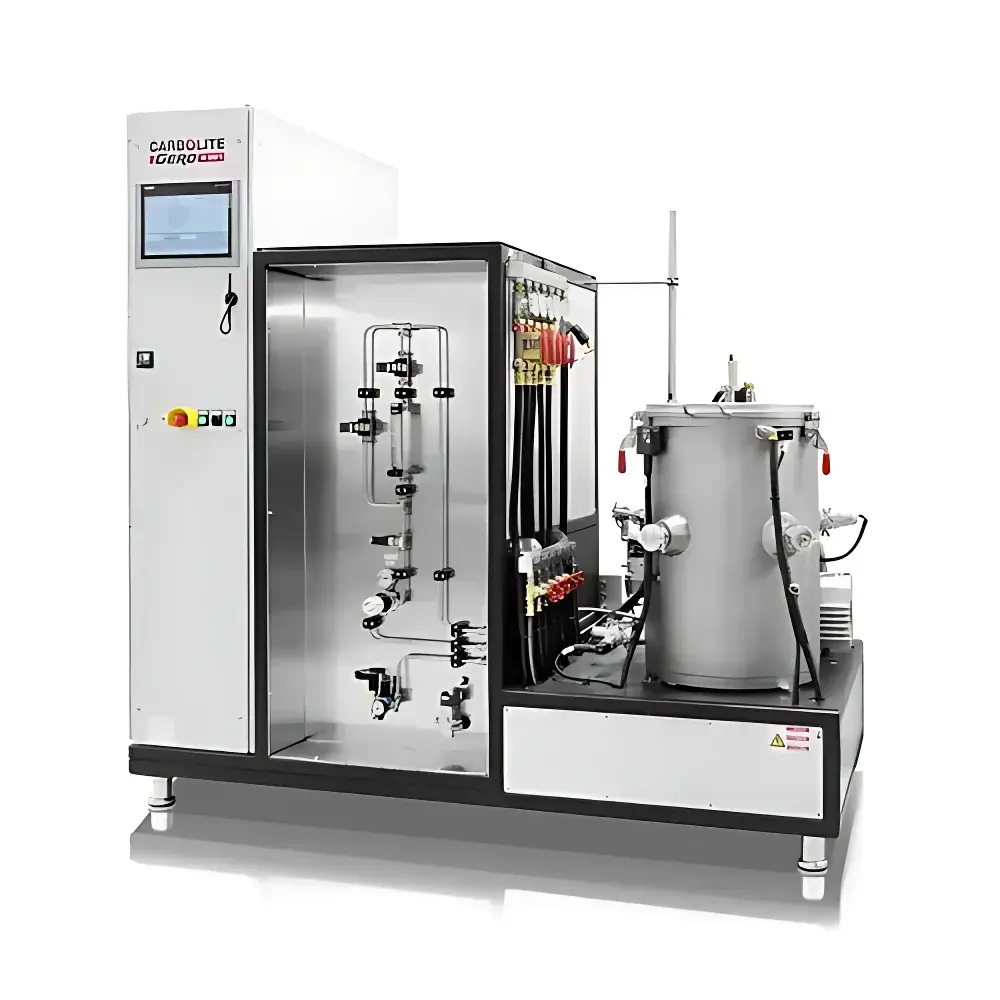
Carbolite Gero LHTM/W High-Temperature Metal Tube Furnace
| Brand | Carbolite Gero |
|---|---|
| Origin | Germany |
| Instrument Type | Tube Furnace |
| Max Temperature | 2200°C |
| Construction | Molybdenum/Tungsten Heating Elements + Multi-Layer Metallic Radiation Shields |
| Vacuum Performance | ≤5×10⁻⁶ mbar (base vacuum) |
| Pressure Range | 10⁻³ to 100 bar (optional high-pressure configuration) |
| Temperature Uniformity | ±10 K (single-zone, small-volume chamber) |
| Cooling | Integrated Water-Cooled Outer Jacket |
| Compliance | Designed for GLP/GMP-aligned R&D environments, compatible with ASTM E1112 and ISO 9001 traceability workflows |
Overview
The Carbolite Gero LHTM/W is a high-precision, compact metal tube furnace engineered for demanding high-temperature thermal processing under controlled atmosphere or ultra-high vacuum (UHV) conditions. Based on a robust all-metal construction—featuring molybdenum (LHTM) or tungsten (LHTW) heating elements and up to nine concentric metallic radiation shields—the system delivers exceptional thermal stability, rapid thermal response, and long-term operational integrity at temperatures up to 2200°C. Its cylindrical geometry, combined with single-zone resistive heating and optimized element placement, ensures axial and radial temperature uniformity of ±10 K across the working zone—a critical specification for reproducible sintering, annealing, and reactive synthesis protocols. The integrated water-cooled outer jacket isolates thermal energy from external surfaces while maintaining structural rigidity and enabling safe operation in confined laboratory spaces. Unlike ceramic-furnace alternatives, the LHTM/W’s fully metallic hot zone eliminates outgassing sources, supporting UHV applications down to ≤5×10⁻⁶ mbar and enabling precise hydrogen partial pressure control (10⁻³–1000 mbar), making it suitable for metallurgical research, advanced ceramics development, and additive manufacturing feedstock conditioning.
Key Features
- Metallic hot zone architecture: Molybdenum (LHTM) or tungsten (LHTW) heating elements with nine-layer reflective metallic insulation—ensuring low radiative heat loss and extended component lifetime at extreme temperatures.
- Integrated water-cooled outer shell: Provides mechanical stability, thermal containment, and operator safety without compromising footprint—ideal for benchtop integration in university labs and industrial R&D facilities.
- Single-zone precision heating: Optimized element geometry and positioning yield ±10 K temperature uniformity across the cylindrical chamber; supports repeatable thermal profiles for MIM, CIM, and powder metallurgy processes.
- High-pressure compatibility: Optional safety-rated pressure vessel configuration certified for operation up to 100 bar—enabling overpressure sintering, gas-assisted densification, and reactive hot isostatic pressing (HIP) pre-studies.
- Modular vacuum & gas handling: Configurable with turbomolecular pumping stations, cold traps, and mass flow controllers (MFCs); supports automated gas sequencing, leak-tightness verification per ISO 20483, and residual gas analysis readiness.
Sample Compatibility & Compliance
The LHTM/W accommodates cylindrical samples up to standard tube diameters (e.g., Ø25–60 mm), including crucibles, graphite boats, and custom atmosphere-controlled sample holders. Its metallic construction ensures compatibility with aggressive atmospheres (H₂, CO, NH₃, CH₄) and ultra-clean vacuum environments—critical for oxide-free metal processing and contamination-sensitive semiconductor precursor synthesis. The furnace meets mechanical design requirements aligned with PED 2014/68/EU for pressure equipment and supports audit-ready documentation per FDA 21 CFR Part 11 when paired with validated software packages. All electrical interfaces comply with IEC 61000-6-3 (EMC) and IEC 61000-6-4 (immunity) standards. Vacuum integrity is verified using helium leak detection (ASTM E499) during factory acceptance testing.
Software & Data Management
Two control paradigms are available: a manual interface with tactile push-button actuation of valves and pumps (rotameter-based gas flow regulation), and an automated touchscreen HMI with programmable ramp-soak profiles, real-time PID tuning, and integrated mass flow control. Both versions log timestamped temperature, pressure, gas composition, and power consumption data in CSV-compatible format—supporting post-run statistical process analysis (SPC), IQ/OQ documentation, and alignment with ISO/IEC 17025 quality management systems. Optional Ethernet/IP or Modbus TCP connectivity enables centralized monitoring within lab-wide SCADA frameworks and facilitates electronic record retention compliant with ALCOA+ principles.
Applications
- Thermal processing of refractory metals and alloys (Mo, W, Nb, Ta) requiring inert or reducing atmospheres.
- Sintering and debinding of MIM/CIM green parts under precisely controlled partial pressures.
- High-temperature annealing of semiconductor substrates and epitaxial layers under UHV conditions.
- Thermal decomposition, carburization, nitridation, and silicidation reactions in sealed quartz or metal ampoules.
- Pre-sintering and hot consolidation trials for additively manufactured metal components.
- Controlled-atmosphere drying and outgassing of ultra-high-purity optical and sensor materials.
FAQ
What vacuum level can the LHTM/W achieve with standard configuration?
Base vacuum ≤5×10⁻⁶ mbar is attainable using a turbomolecular pump with cryo-trap; ultimate performance depends on pump selection, bake-out protocol, and chamber history.
Can the furnace operate under hydrogen atmosphere at elevated temperatures?
Yes—hydrogen partial pressure is controllable from 10⁻³ to 1000 mbar; full-system leak testing and material compatibility validation (per ISO 15649) are recommended prior to first use.
Is temperature uniformity verified per ASTM E220?
While not supplied with formal ASTM E220 calibration certificates by default, the furnace’s ±10 K uniformity is validated via multi-point thermocouple mapping during FAT; third-party calibration services are available upon request.
Does the system support remote monitoring and control?
Standard Ethernet connectivity enables remote access to live process data and limited parameter adjustment via secure HTTPS interface; full supervisory control requires optional OPC UA gateway integration.
What maintenance intervals are recommended for the heating elements and radiation shields?
Under typical usage (≤1800°C, <5 cycles/week), molybdenum elements require inspection every 1,200 operating hours; tungsten elements extend service life to ≥2,000 hours—both supported by Carbolite Gero’s global spare parts network and technical field service.



