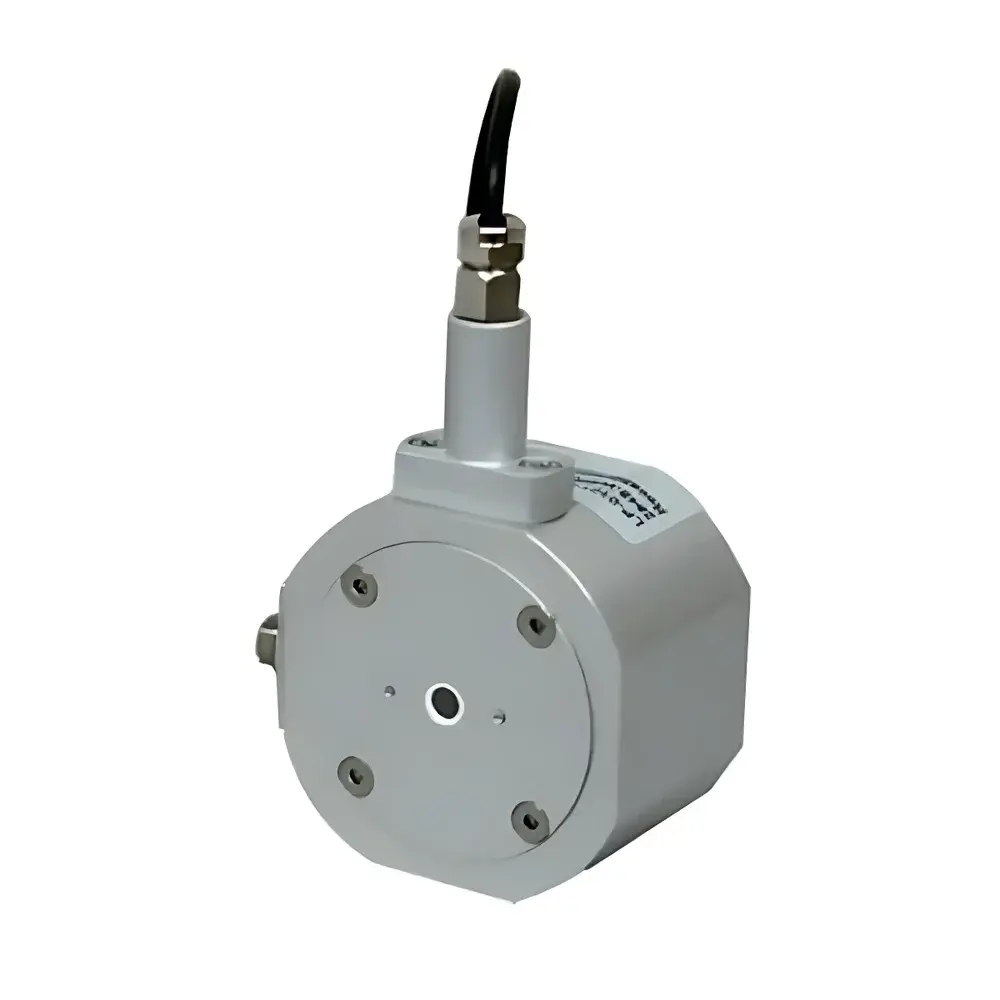
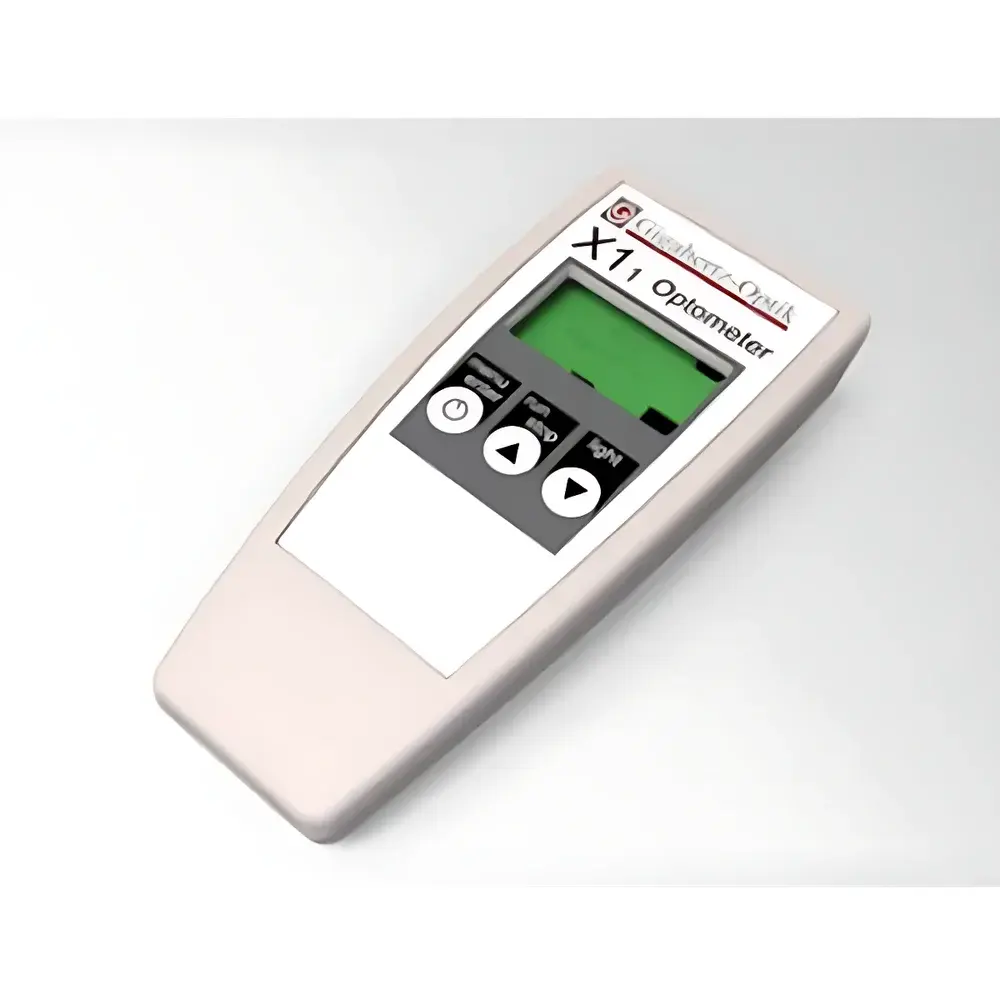
Gigahertz Optik P-9710 Series Optical Power and Energy Meter
| Brand | Gigahertz Optik |
|---|---|
| Origin | Germany |
| Model | P-9710 Series (with interchangeable ISD integrating sphere & LP flat-surface detectors) |
| Spectral Range | 400–1100 nm (Si), 800–1800 nm (InGaAs) |
| Power Range | 0.25 nW to 14.6 W (dependent on detector configuration) |
| Measurement Modes | CW power, pulsed energy, radiant dose, peak-to-peak, Blondel-Rey luminous intensity, data logging |
| Detector Technologies | Dual-photodiode (ns-resolved pulse analysis), integrating sphere (ODM98 BaSO₄ or PTFE-coated, Ø16 mm to Ø300 mm), flat-surface Si photodiode (Ø7 mm) |
| Calibration | NIST-traceable, factory-supplied calibration certificate with spectral responsivity data per detector head |
| Compliance | ISO/IEC 17025 accredited calibration, CE marked, RoHS compliant |
| Interface | USB 2.0, analog output (0–10 V), optional RS-485 |
| Software | Instrument Control Software (ICS) v5.x with real-time plotting, statistical analysis, batch export, and audit trail support |
Overview
The Gigahertz Optik P-9710 Series Optical Power and Energy Meter is a modular, laboratory-grade radiometric measurement system engineered for precision, traceability, and operational flexibility across photonics R&D, laser safety verification, optical component characterization, and industrial process monitoring. Built upon Gigahertz Optik’s decades of expertise in photonic metrology, the P-9710 functions as a universal optometer—capable of quantifying radiant flux (W), pulse energy (J), irradiance (W/m²), radiant exposure (J/m²), and time-resolved optical power profiles—with full spectral correction applied via detector-specific responsivity curves. Its core architecture employs low-noise transimpedance amplification, high-stability analog signal conditioning, and 24-bit ADC resolution to ensure reproducible measurements across six orders of magnitude (sub-nanowatt to multi-watt levels). Unlike single-detector benchtop meters, the P-9710 decouples the metering electronics from the sensor head, enabling seamless interchangeability among >20 calibrated detector types—including integrating spheres (16 mm to 300 mm diameter), flat-surface photodiodes, and thermopile-based options—without recalibration or software reconfiguration.
Key Features
- Modular detector interface supporting over 20 NIST-traceable, application-optimized sensor heads—including Si and InGaAs integrating spheres (ODM98 coating), flat-field photodiodes, and thermopile sensors
- Wide spectral coverage: 400–1100 nm (silicon), 800–1800 nm (InGaAs), with wavelength-specific calibration data embedded in each detector’s EEPROM
- Dynamic range up to 14.6 W (CW) and down to 0.25 nW (100 ms integration, SNR ≥ 50), achieved via auto-ranging circuitry and dual-gain amplification stages
- Pulse-resolved measurement capability using dual-photodiode technology (e.g., P-9710-4 + ISD-1.6-SP-Vxx), enabling ns-scale temporal profiling of laser diodes and LEDs without external oscilloscopes
- Comprehensive measurement modes: continuous wave (CW) power, single-pulse and burst-mode energy, radiant dose (J/cm²), peak-to-peak amplitude, Blondel-Rey luminous intensity (for photobiological safety assessments), and time-series data logging at user-defined intervals
- Real-time analog output (0–10 V) synchronized with digital acquisition, facilitating integration into automated test stands and closed-loop control systems
Sample Compatibility & Compliance
The P-9710 accommodates diverse optical sources—from low-power VCSELs and quantum cascade lasers to high-energy Nd:YAG and fiber-coupled diode lasers—via physically optimized detector geometries. Integrating spheres (ISD series) provide uniform spatial response for divergent, multimode, or non-collimated beams; flat-surface detectors (LP-9901) enable precise spot-size-limited measurements required for laser safety compliance (IEC 60825-1, ANSI Z136.1). All detectors are supplied with individual calibration certificates compliant with ISO/IEC 17025, including spectral responsivity tables referenced to NIST SRM standards. The system meets CE marking requirements under the EU Electromagnetic Compatibility Directive 2014/30/EU and RoHS 2011/65/EU. For regulated environments, firmware supports GLP/GMP-aligned operation: user access levels, electronic signatures, and full audit trails (including parameter changes, calibration events, and measurement exports) are recorded within the ICS software and exportable as CSV or PDF reports.
Software & Data Management
Instrument Control Software (ICS) v5.x serves as the native interface for configuration, acquisition, visualization, and reporting. It provides real-time waveform display with adjustable timebase and vertical scaling, statistical overlays (mean, std dev, min/max over user-defined windows), and live FFT analysis for modulation assessment. Data is stored in a structured SQLite database with timestamped metadata (detector ID, wavelength, integration time, operator ID). Batch export supports CSV, Excel (.xlsx), and MATLAB (.mat) formats. For regulatory compliance, ICS implements FDA 21 CFR Part 11–compatible features: role-based login, electronic signatures for critical actions (e.g., calibration acceptance), immutable audit logs, and automatic backup to network drives. Optional API (DLL and Python bindings) enables integration into LabVIEW, MATLAB, or custom Python-based automation frameworks.
Applications
- Laser safety certification: Radiant exposure and irradiance measurements per IEC 60825-1 Annex A for Class 1–4 laser product classification
- Optical component validation: Transmission/reflection loss testing of filters, lenses, and coatings using calibrated reference detectors
- LED and VCSEL characterization: Pulse energy stability, droop analysis, and thermal roll-off profiling under pulsed DC drive conditions
- Fiber optic transmitter testing: Coupled power verification for single-mode and multimode telecom transceivers (1310/1550 nm)
- Photovoltaic R&D: Spectrally corrected irradiance mapping for solar cell QE and IV curve generation
- Biophotonics instrumentation: Quantification of excitation light dosage in fluorescence microscopy and optogenetics setups
FAQ
Is the P-9710 compatible with third-party integrating spheres or detectors?
No. Only Gigahertz Optik–certified detector heads (e.g., ISD, LP, TS series) are supported, as each contains embedded calibration coefficients and electrical interface protocols required for accurate spectral correction and range switching.
Can the system measure ultrafast laser pulses (e.g., femtosecond Ti:sapphire)?
The P-9710 supports pulse energy measurement down to ~10 ns pulse width with appropriate integrating sphere detectors (e.g., ISD-3P-Si). For sub-ns pulses, thermopile-based detectors or external fast photodiodes with oscilloscope coupling are recommended.
How often does the system require recalibration?
Gigahertz Optik recommends annual recalibration for ISO/IEC 17025 traceability. Stability data shows typical drift <±0.5% per year for Si detectors under controlled lab conditions.
Does the software support automated compliance reporting for IEC 60825-1?
Yes—ICS includes preconfigured report templates aligned with IEC 60825-1 Annex A requirements, automatically populating measured values, uncertainty budgets, and pass/fail determinations based on selected laser class and exposure duration.
What is the maximum sampling rate for time-series logging?
At full 24-bit resolution, the internal ADC supports up to 100 Hz continuous logging; higher rates (up to 1 kHz) are achievable in reduced-resolution mode or via analog output streaming to external DAQ hardware.