
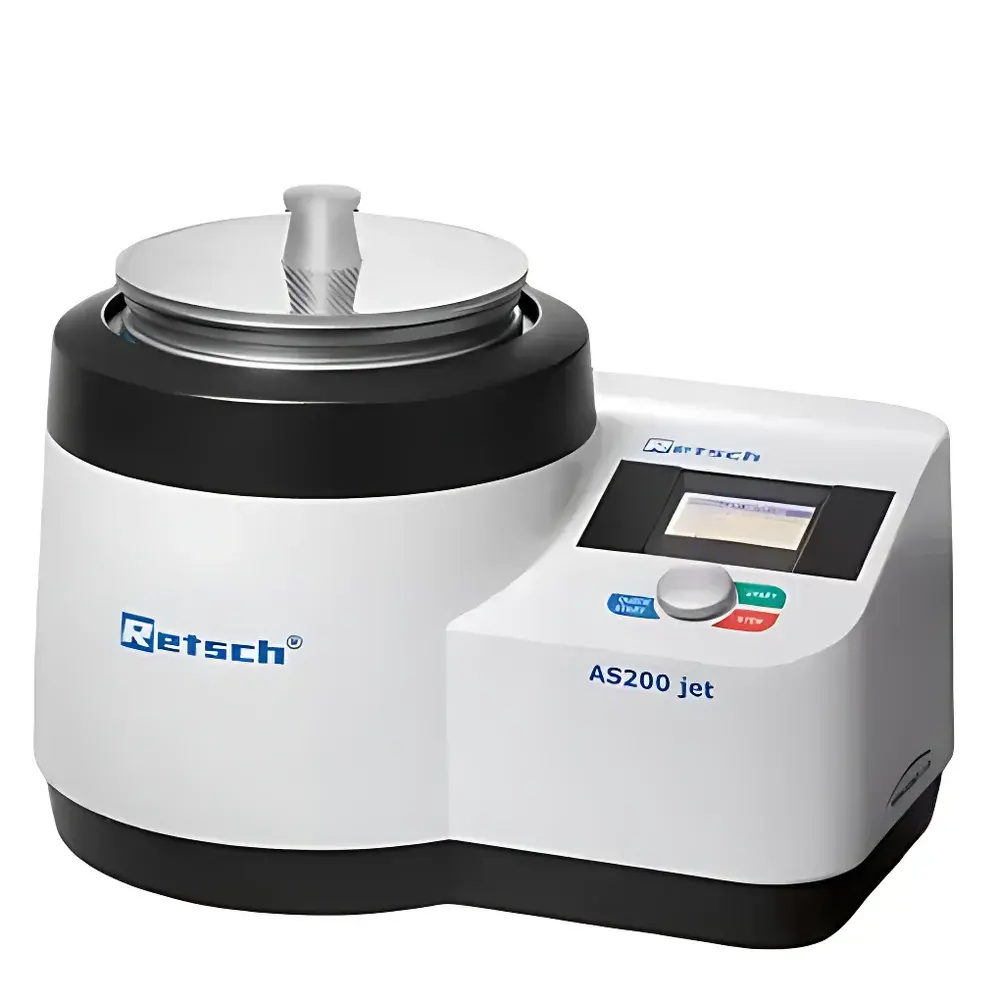
Retsch AS 200 JET Air Jet Sieve Analyzer
| Brand | Retsch |
|---|---|
| Origin | Germany |
| Model | AS 200 JET |
| Principle | Air jet sieving (vibratory-assisted pneumatic dispersion) |
| Measurement Range | 10 µm – ~4 mm |
| Maximum Sample Load | 0.3–100 g |
| Sieve Stack Capacity | 1 sieve (2 fractions with cyclone attachment) |
| Adjustable Parameters | Sieving time, vacuum pressure, nozzle rotational speed |
| Compliance | ISO 9001, ISO 2591-1, ISO 4787, ASTM E11, USP <786> |
| Optional Accessories | Automatic vacuum regulator, EasySieve software (RS232), 2-inch analysis sieves, cyclone separator, acoustic enclosure |
Overview
The Retsch AS 200 JET Air Jet Sieve Analyzer is an advanced, microprocessor-controlled particle size distribution analyzer engineered for precise dry-sieving of fine and ultra-fine powders. Unlike conventional vibratory or mechanical sieving systems, the AS 200 JET employs a high-velocity rotating air jet—generated by a tangentially positioned nozzle—to fluidize and disperse agglomerated particles against the mesh surface. This principle, standardized under ISO 2591-1 and ASTM E11 for air jet sieving, ensures effective deagglomeration without mechanical abrasion or sample degradation. The instrument integrates controlled vacuum suction via an integrated pump or external vacuum source, enabling dynamic regulation of negative pressure across the sieve. Its design targets laboratories requiring reproducible, operator-independent results for materials ranging from pharmaceutical excipients and metal powders to cement, toner, and ceramic precursors—particularly where electrostatic cohesion or moisture-induced agglomeration compromises conventional sieving fidelity.
Key Features
- Open Mesh technology: Eliminates mesh clogging by dynamically adjusting airflow geometry relative to sieve aperture orientation, significantly improving throughput and repeatability for cohesive sub-50 µm fractions.
- Digitally adjustable parameters: Independent real-time control of sieving duration (0.01–99.99 min), vacuum pressure (0–30 kPa), and nozzle rotational speed (0–300 rpm) via intuitive front-panel interface.
- Cyclone-enabled dual-fraction collection: Integrates seamlessly with a stainless-steel cyclone separator to split material into coarse and fine fractions—essential for compliance with ISO 4787 volumetric calibration protocols and USP particle size reporting requirements.
- Ergonomic, maintenance-free architecture: Tool-free sieve mounting, sealed bearing system, and acoustic enclosure option reduce ambient noise to ≤65 dB(A); no lubrication or periodic alignment required.
- GLP-compliant operation: Stores up to 10 user-defined Standard Operating Procedures (SOPs) with timestamped parameter recall; optional EasySieve software provides full audit trail, electronic signature support, and 21 CFR Part 11–ready data export (CSV, PDF, XML).
Sample Compatibility & Compliance
The AS 200 JET accommodates sample masses from 0.3 g (for high-value nanomaterials) to 100 g (bulk industrial powders), supporting standard 203 mm (8″) woven-wire or electroformed sieves—as well as 200 mm (7.87″) and 1″/2″ analytical sieves via dedicated adapters. It meets critical regulatory benchmarks including ISO 9001 calibration traceability, ISO 2591-1 methodology validation for air jet sieving, and ASTM E11 specification for test sieve construction. When configured with automatic vacuum regulation and EasySieve software, the system satisfies GMP/GLP documentation requirements for pharmaceutical QA/QC labs, particularly in dissolution testing support, blend uniformity assessment, and inhalable particle characterization per USP .
Software & Data Management
EasySieve software (optional, RS232-connected) transforms raw sieving data into auditable, compliant reports. It enables remote instrument control, real-time parameter monitoring, and automated calculation of cumulative undersize distributions (d10, d50, d90), span, and relative standard deviation (RSD). All measurement sessions are logged with operator ID, date/time stamp, environmental conditions (if external sensors are connected), and full parameter history—enabling full traceability during FDA or EMA inspections. Export formats include CSV for LIMS integration, PDF for SOP archiving, and XML for enterprise data warehousing.
Applications
- Pharmaceutical development: API particle sizing for bioavailability optimization and regulatory filing (ICH Q5A, Q6A).
- Advanced materials R&D: Characterization of battery cathode/anode powders, additive manufacturing metal feedstocks (e.g., Ti-6Al-4V, Inconel 718), and catalyst supports.
- Quality assurance in construction materials: Cement fineness testing per EN 196-6 and ASTM C204.
- Food & cosmetics: Solubility-driven particle distribution analysis of milk powder, starch derivatives, and micronized pigments.
- Environmental testing labs: Soil particulate fractionation and airborne dust respirability screening.
FAQ
What standards does the AS 200 JET comply with for regulatory submissions?
It conforms to ISO 2591-1, ASTM E11, USP , and ISO 4787—making it suitable for inclusion in FDA IND/NDA filings and EMA marketing authorization applications.
Can the AS 200 JET be integrated into a fully automated lab workflow?
Yes—via RS232 or optional Ethernet module, it interfaces with LIMS, MES, and robotic sample handling platforms using Modbus RTU or ASCII command protocol.
Is calibration verification supported out-of-the-box?
The instrument includes built-in reference weight calibration checks and supports certified reference materials (e.g., NIST SRM 1990) for routine performance qualification per ISO/IEC 17025.
How does the Open Mesh function improve repeatability compared to static air jet systems?
By synchronizing nozzle rotation with mesh geometry, it eliminates standing wave formation and localized overloading—reducing inter-operator RSD to ≤1.8% for D50 measurements on silica nanoparticles (15 µm median).
Does the cyclone configuration affect measurement accuracy for sub-30 µm fractions?
No—cyclone cut-point is independently validated at 5 µm (±0.5 µm) using PSL standards; fine-fraction recovery exceeds 99.2% when paired with HEPA-filtered vacuum exhaust.



