
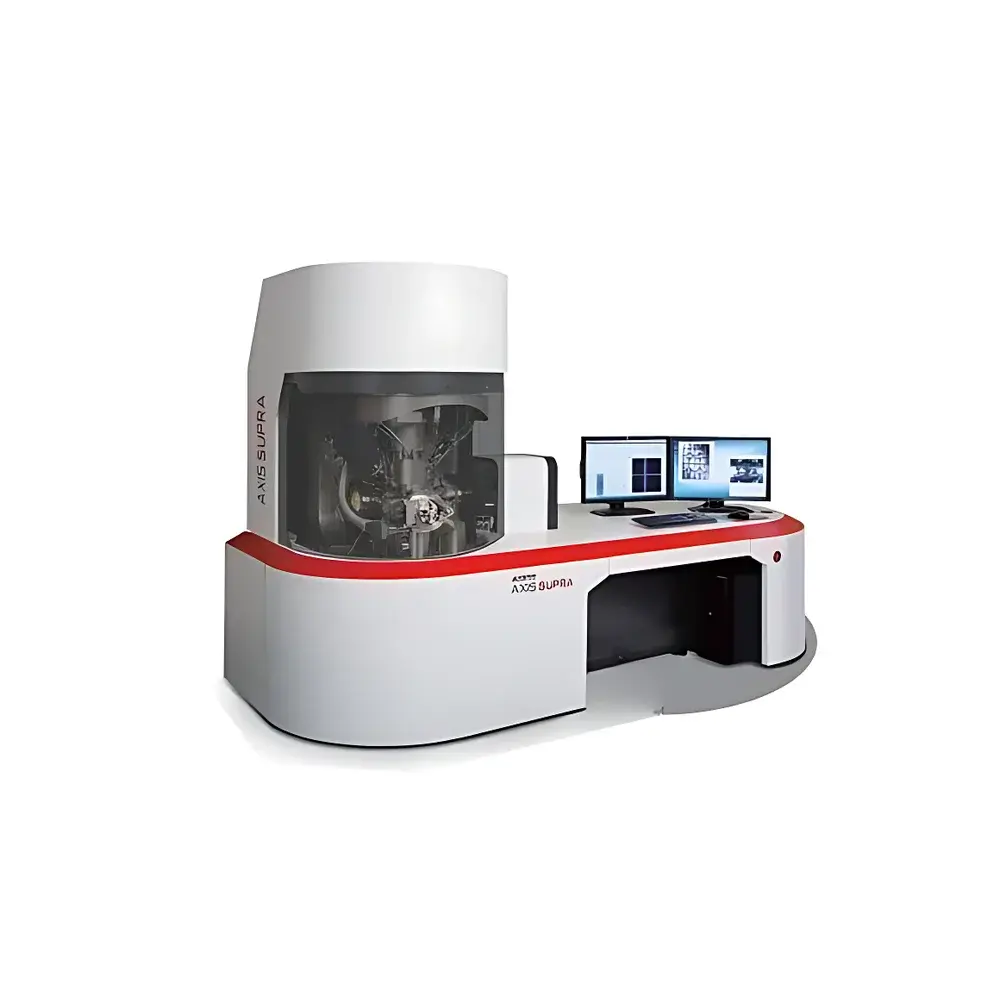
Shimadzu AXIS SUPRA X-ray Photoelectron Spectrometer
| Brand | Shimadzu |
|---|---|
| Origin | Japan |
| Model | AXIS SUPRA |
| Power Source | Monochromated Al Kα (standard), optional Al/Ag dual anode |
| Detector | Patented 2D delay-line detector |
| Analyzer | Large-radius double-focusing hemispherical analyzer |
| Charge Neutralization | Patented source-neutralizer with shadow-free operation |
| Sample Stage | Motorized XYZ stage with optical microscope pre-alignment |
| Vacuum System | Ultra-high vacuum (UHV) <5×10⁻⁹ mbar in analysis chamber |
| Spatial Resolution | <10 µm imaging mode |
| Energy Resolution | ≤0.45 eV (Ag 3d₅/₂, pass energy 20 eV) |
| Sensitivity | ≥100,000 cps/eV for Ag 3d at 10 µm spot |
Overview
The Shimadzu AXIS SUPRA is a high-performance, ultra-high vacuum (UHV) X-ray Photoelectron Spectrometer (XPS) engineered for quantitative surface chemical analysis, depth profiling, and high-resolution chemical state mapping. Operating on the principle of photoemission—where monochromatic X-rays eject core-level electrons from sample surfaces—the instrument measures kinetic energy distributions to determine elemental composition, chemical bonding environment, oxidation states, and lateral distribution with nanoscale surface sensitivity (typically 1–10 nm probing depth). Designed for research laboratories and industrial R&D centers requiring regulatory-compliant surface characterization, the AXIS SUPRA integrates advanced hardware architecture—including a large-radius double-focusing hemispherical energy analyzer and a patented 2D delay-line detector—to deliver simultaneous energy and spatial information without mechanical scanning. Its UHV analysis chamber (<5×10⁻⁹ mbar) ensures minimal surface contamination during acquisition, supporting reproducible measurements under GLP- and GMP-aligned workflows.
Key Features
- Monochromated X-ray Source: Standard Al Kα monochromator delivers high spectral purity and reduced background; optional Al/Ag dual-anode configuration enables flexible excitation for enhanced sensitivity across diverse elements (e.g., Ag L₃ for low-Z species or Al Kα for transition metals).
- Large-Radial Hemispherical Analyzer: Dual-focusing geometry provides superior energy resolution (≤0.45 eV FWHM on Ag 3d₅/₂ at 20 eV pass energy) while maintaining high transmission efficiency.
- 2D Delay-Line Detector: Captures full kinetic energy spectra and emission angle data in parallel—enabling rapid survey scans (<5 s), high-throughput mapping, and angle-resolved XPS (AR-XPS) without stage movement.
- Shadow-Free Charge Neutralization: Proprietary source-based neutralizer dynamically compensates for surface charging on insulating or topographically complex samples (e.g., polymers, oxides, patterned semiconductors), eliminating positional bias and enabling quantitative analysis without conductive coating.
- Integrated Optical Microscope: Motorized 10×–100× zoom optics mounted in the load-lock chamber allow precise pre-vacuum positioning of multi-sample holders; coordinates are automatically transferred to the analysis chamber for repeatable, unattended analysis.
- Modular Anode Design: Replaceable monochromator anode targets extend operational lifetime and maintain consistent photon flux—critical for long-term calibration stability and inter-laboratory comparability.
Sample Compatibility & Compliance
The AXIS SUPRA accommodates solid samples up to 50 mm in diameter and 20 mm in height, including conductive substrates, thin films, catalysts, battery electrodes, corrosion layers, and biofunctionalized surfaces. Its automated sample transfer system supports batch analysis of up to 12 positions per holder. All vacuum protocols comply with ISO 27498 (surface chemical analysis — vocabulary) and ASTM E1521 (standard guide for XPS). Data acquisition and processing meet FDA 21 CFR Part 11 requirements when deployed with Shimadzu’s certified software suite, including electronic signatures, audit trails, and user-access controls aligned with GLP and ISO/IEC 17025 quality management frameworks.
Software & Data Management
Analysis is performed using Shimadzu’s proprietary CASA (Curve Analysis Software for XPS) v6.x, which supports peak fitting with Shirley/Tougaard background subtraction, quantification via Scofield sensitivity factors, chemical state deconvolution, and spatial overlay of elemental maps. Raw data is stored in VAMAS format (ISO 14976), ensuring interoperability with third-party tools (e.g., CasaXPS, Kratos Vision). The software includes built-in reporting templates compliant with ISO 18115-1 (surface chemical analysis — terminology) and supports export to PDF, CSV, and CDF for LIMS integration. Audit logs record operator ID, timestamp, parameter changes, and calibration history—fully traceable for regulatory submissions.
Applications
- Surface oxidation state analysis of Li-ion battery cathodes (e.g., Ni²⁺/Ni³⁺/Ni⁴⁺ ratio in NMC materials)
- Quantitative depth profiling of atomic-layer-deposited (ALD) dielectrics using Ar⁺ sputtering coupled with charge-compensated XPS
- Chemical mapping of polymer blend phase separation at <10 µm resolution
- Corrosion product identification on stainless steel or aluminum alloys exposed to accelerated aging environments
- Functional group distribution on plasma-treated biomedical polymer surfaces (e.g., -OH, -COOH, -NH₂ density gradients)
- Interface chemistry characterization of perovskite solar cell stacks (e.g., TiO₂/CH₃NH₃PbI₃ interface dipole formation)
FAQ
What vacuum level is maintained in the analysis chamber during acquisition?
The analysis chamber achieves and sustains ultra-high vacuum conditions below 5×10⁻⁹ mbar, verified by ion gauge and confirmed prior to each analytical sequence.
Can the AXIS SUPRA perform angle-resolved XPS (AR-XPS)?
Yes—the 2D delay-line detector and motorized sample tilt stage (±75°) support fully automated AR-XPS for non-destructive probing of stratified interfaces and surface enrichment phenomena.
Is the optical microscope integrated into the vacuum path?
No—the microscope resides in the load-lock chamber and operates at atmospheric pressure; it is used exclusively for pre-pump alignment and coordinate registration.
How is charge neutralization calibrated for heterogeneous samples?
The source-neutralizer employs real-time feedback from secondary electron emission intensity, adjusting electron/ion flux independently for each analysis position—no manual intervention required.
Does the system support automated multi-point analysis across a single sample?
Yes—users define grid patterns or coordinate lists via CASA; the motorized stage executes sequential analysis with automatic focus and charge compensation at each location.




