TQC SP7310 Surface Salt Test Kit
| Brand | TQC |
|---|---|
| Origin | Netherlands |
| Manufacturer Type | Authorized Distributor |
| Origin Category | Imported |
| Model | SP7310 Surface Salt Test Kit |
| Pricing | Available Upon Request |
| Measurement Range | 0.1–20,000 mg/m² (DSP method) |
| Resolution | 0.1 mg/m² (DSP method) |
| Accuracy | ±1% of reading |
| Temperature Range | 0–50 °C |
| Automatic Temperature Compensation (ATC) | 0–50 °C |
| Reference Temperature | 25 °C |
| Auto Power-Off | After 8.5 minutes |
| IP Rating | IP67 |
| Auto-Calibration Point | 84 μS/cm |
| Test Patch Area | 12.5 cm² |
| Patch Material | Latex membrane |
| Compliance | ISO 8502-6, ISO 8502-9, ISO 17025-accredited test patches |
Overview
The TQC SP7310 Surface Salt Test Kit is a field-deployable, standardized solution for quantitative assessment of soluble salt contamination—primarily chloride, sulfate, and nitrate ions—on steel and concrete substrates prior to protective coating application. It implements the Bresle method as defined in ISO 8502-6 and ISO 8502-9, where a pre-weighed, adhesive latex patch is sealed onto the surface to form a closed chamber. Distilled water is injected into the chamber, dissolving surface salts; the resulting extract’s electrical conductivity is measured using a calibrated digital conductivity meter. Since conductivity correlates linearly with total dissolved ion concentration under controlled conditions, the kit converts µS/cm readings into mass-based surface contamination (mg/m²) via algorithmic calculation aligned with ISO 8502-9 Annex A. This metrological approach ensures traceability, repeatability, and comparability across global asset integrity programs—including marine, offshore, pipeline, and industrial infrastructure projects.
Key Features
- Integrated digital conductivity meter with automatic temperature compensation (ATC) and auto-calibration at 84 µS/cm—ensuring consistent accuracy across ambient conditions from 0 to 50 °C.
- ISO 17025-accredited latex test patches (12.5 cm² active area), manufactured to strict dimensional and adhesion tolerances for reliable seal integrity and minimal edge leakage.
- Full compliance with ISO 8502-6 (Bresle method procedure) and ISO 8502-9 (calculation methodology), supporting audit-ready documentation for ISO 9001, ISO 14001, and ISO 55001-aligned quality management systems.
- IP67-rated housing for dust and immersion resistance—enabling operation in harsh environments including shipyards, blast rooms, and humid coastal zones.
- High-resolution measurement capability (0.1 mg/m²) and ±1% reading accuracy—significantly exceeding the performance envelope of qualitative test strips or handheld meters without integrated DSP algorithms.
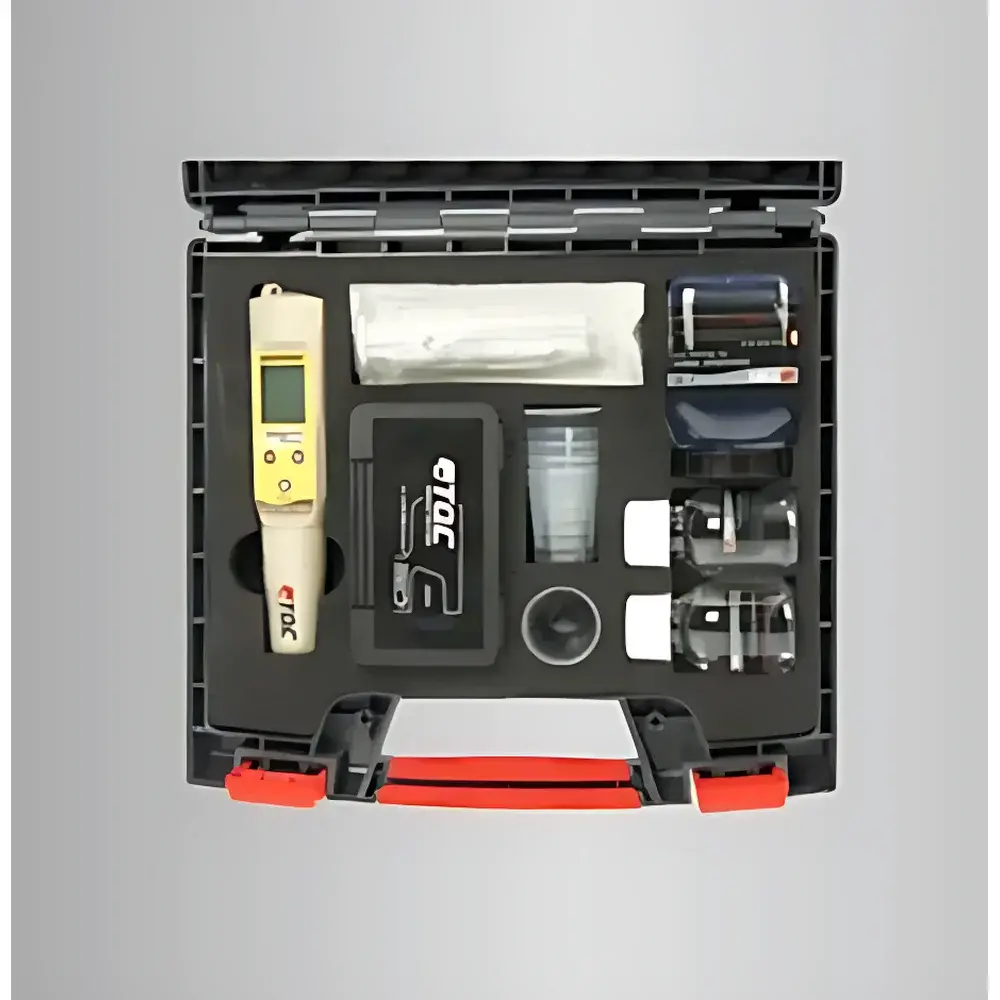
- Pre-configured accessories: 25 certified test patches, ASTM-grade distilled water, NIST-traceable calibration solution (84 µS/cm), cleaning solution, 100 mL graduated beaker, precision syringe, and laminated operational manual with step-by-step DSP workflow diagrams.
Sample Compatibility & Compliance
The SP7310 kit is validated for use on abrasive-blasted carbon steel, weathering steel, stainless steel, and reinforced concrete surfaces. It supports both direct sampling (DSP) and indirect sampling protocols per ISO 8502-9, accommodating variations in surface profile, roughness, and residual moisture. All consumables—including latex patches and calibration standards—are supplied with documented uncertainty budgets and lot-specific certificates of conformance. The system meets requirements for GLP-compliant reporting when paired with optional data logging software (see Software & Data Management). Test results are admissible in third-party inspection reports accepted by classification societies (e.g., DNV, ABS, LR) and regulatory bodies enforcing SSPC-SP12, NACE SP0108, and IMO PSPC guidelines.
Software & Data Management
While the SP7310 operates as a standalone field instrument, its conductivity meter features an RS-232 interface compatible with TQC’s optional LogView Pro software (sold separately). This enables automated data capture, timestamped result logging, batch export to CSV or PDF, and generation of audit trails compliant with FDA 21 CFR Part 11 and ISO/IEC 17025 clause 7.7. Calibration events, operator ID, ambient temperature, and patch lot numbers can be embedded directly into each record—supporting full traceability in GMP and critical infrastructure QA/QC workflows.
Applications
- Prefabrication and commissioning of offshore platforms, FPSOs, and subsea structures.
- Pre-coating verification on pipeline girth welds and field joint coatings per API RP 5LW and ISO 21809-3.
- Condition monitoring of blast-cleaned steel during maintenance turnarounds in petrochemical refineries and power generation facilities.
- Validation of hydroblast or ultra-high-pressure waterjet cleaning efficacy on aged concrete bridge decks and tunnel linings.
- Assessment of soluble salt carryover from recycled abrasives or contaminated rinse water in closed-loop surface preparation systems.
FAQ
What standards does the SP7310 kit comply with?
It conforms fully to ISO 8502-6 (test procedure), ISO 8502-9 (data calculation), and uses ISO 17025-accredited test patches. It also supports alignment with SSPC-SP12, NACE SP0108, and IMO PSPC requirements.
How often must the conductivity meter be recalibrated?
Calibration is recommended before each testing session or after every 10 measurements—whichever occurs first—using the supplied 84 µS/cm standard. Field recalibration takes less than 60 seconds.
Can the latex patches be reused?
No. Each patch is single-use only to prevent cross-contamination and ensure measurement integrity. Discard after extraction and record the used patch lot number for traceability.
Is distilled water included with the kit?
Yes—the kit includes ASTM D1193 Type IV distilled water in sealed, tamper-evident vials to eliminate variability from on-site water sources.
What maintenance is required for long-term reliability?
Rinse the conductivity probe with deionized water after each use; gently wipe dry with lint-free tissue. Store the meter and patches in the provided protective case. Avoid prolonged exposure to solvents or abrasive cleaners on the probe surface.