
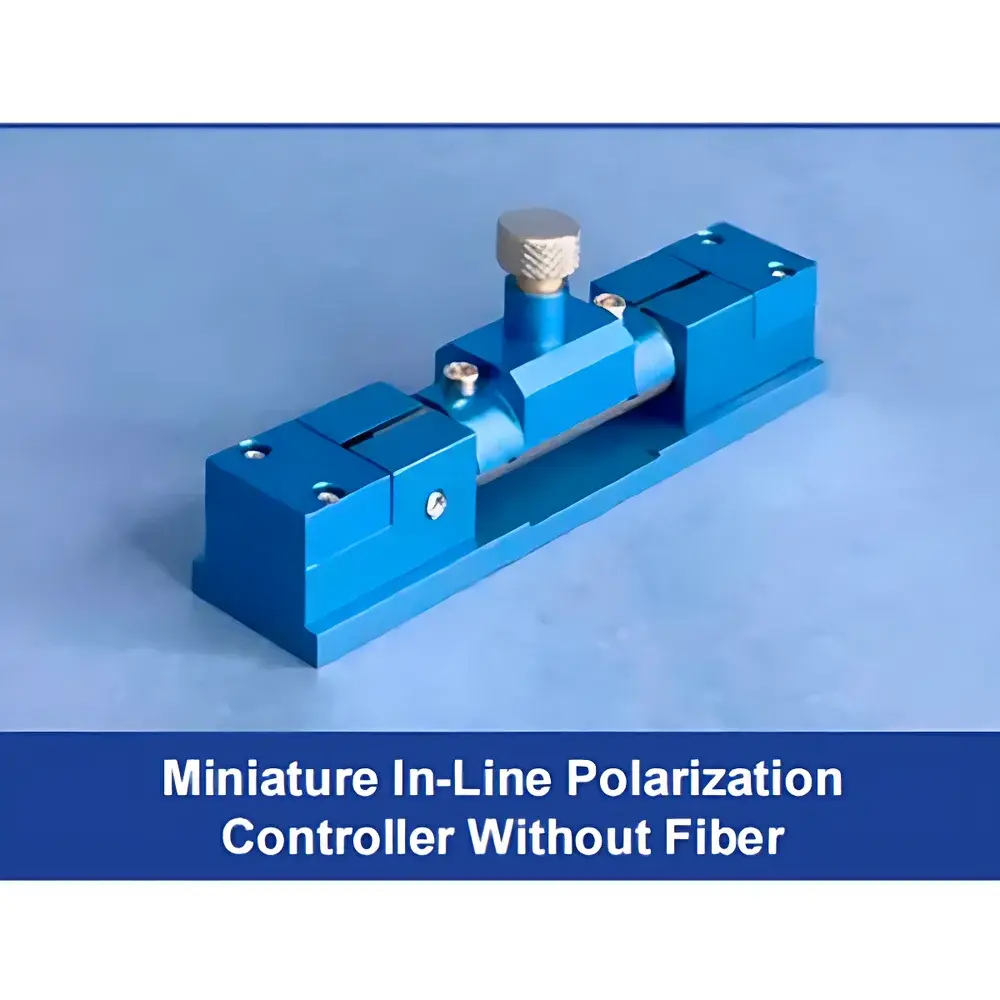
OZ Optics FPC-1000 Series Fiber Polarization Controller
| Brand | OZ Optics |
|---|---|
| Model | FPC-1000 |
| Type | In-Line Mechanical Fiber Polarization Controller |
| Operating Wavelength Range | 400–2200 nm |
| Fiber Compatibility | Standard Single-Mode Fiber (SMF) only |
| Insertion Loss | < 0.1 dB |
| Return Loss | > 40 dB |
| Polarization Extinction Ratio (PER) | > 40 dB (achievable within seconds) |
| Mechanism | Adjustable pressure-induced birefringence via rotating clamping fixtures |
| Waveplate Analogy | Equivalent to tunable quarter- or half-wave retardation |
| Housing Options | Standard benchtop, compact mini-housing, and OEM in-line configurations |
| Not Compatible With | Multimode fiber (MMF) or polarization-maintaining fiber (PMF) |
Overview
The OZ Optics FPC-1000 Series Fiber Polarization Controller is a precision mechanical device engineered for deterministic manipulation of the state of polarization (SOP) in single-mode optical fibers. It operates on the principle of stress-induced birefringence: by applying controlled, directional mechanical pressure onto the fiber cladding via calibrated rotating clamps, the device locally modifies the refractive index tensor in the core region—effectively transforming the stressed fiber segment into a dynamically tunable waveplate. This mechanism enables full Poincaré sphere coverage, allowing any input SOP to be converted to any desired output SOP with high repeatability and sub-second response. Unlike electro-optic or liquid crystal-based controllers, the FPC-1000 exhibits zero intrinsic insertion loss, negligible back reflection (< −40 dB), and broadband spectral neutrality across 400–2200 nm—making it ideal for applications demanding high-fidelity polarization control without signal degradation or wavelength-dependent artifacts.
Key Features
- Zero inherent insertion loss ( 40 dB return loss)
- Full Stokes vector control: continuous, repeatable mapping across the entire Poincaré sphere
- Wavelength-agnostic operation from visible (400 nm) through near-infrared (2200 nm)
- Compact mechanical architecture—available in standard benchtop, miniaturized housing, and OEM in-line configurations
- No active electronics or power supply required; fully manual, tactile adjustment with calibrated rotation scales
- Robust design optimized for integration into interferometric setups, laser cavities, and metrology systems requiring long-term stability
- Compatible exclusively with standard single-mode fiber (e.g., SMF-28, HI1060); not intended for PMF or multimode fiber
Sample Compatibility & Compliance
The FPC-1000 is designed for use with industry-standard single-mode fibers having 125 µm cladding diameter and acrylate or polyimide coatings. It is not compatible with polarization-maintaining fibers (e.g., PANDA, Bow-tie) or multimode fibers due to fundamental differences in modal structure and stress-response behavior. All units undergo factory calibration using NIST-traceable polarimetry and are supplied with individual test reports documenting PER, insertion loss, and angular repeatability. The device complies with IEC 61300-2-40 (fiber optic connector durability) and meets RoHS Directive 2011/65/EU requirements. For regulated environments—including ISO/IEC 17025-accredited labs and FDA-regulated optical subsystems—the controller supports GLP-compliant documentation workflows when integrated with validated SOP management software.
Software & Data Management
While the FPC-1000 is a manually operated instrument, its deterministic mechanical response enables seamless integration into automated test platforms. When paired with motorized rotation stages (e.g., Thorlabs K10CR1 or Newport CONEX-CC), it can be controlled via LabVIEW, Python (PyVISA), or MATLAB using standard SCPI commands. OZ Optics provides API-compatible configuration files and sample scripts for closed-loop SOP stabilization routines. All calibration data—including retardation vs. clamp angle curves and PER maps—are delivered in CSV and HDF5 formats to support traceable data archiving per 21 CFR Part 11 requirements. Audit trails for parameter adjustments can be logged externally via timestamped serial communication or analog voltage monitoring.
Applications
- Polarization alignment for coupling light into polarization-sensitive devices (e.g., lithium niobate modulators, Faraday isolators, nonlinear crystals)
- Compensation of polarization drift in fiber-optic interferometers (Michelson, Mach–Zehnder) and distributed acoustic sensing (DAS) systems
- Characterization of polarization-dependent loss (PDL) in passive components such as WDM filters, circulators, and FBGs
- Stabilization of cavity polarization states in narrow-linewidth fiber lasers and frequency combs
- SOP conditioning upstream of optical coherence tomography (OCT) sample arms to maximize interference fringe visibility
- Calibration reference in Mueller matrix polarimetry and depolarization analysis systems
FAQ
Is the FPC-1000 suitable for polarization-maintaining (PM) fiber?
No. The device relies on induced birefringence in standard single-mode fiber and cannot override the built-in birefringence axis of PM fiber.
What is the typical time required to achieve >40 dB extinction ratio?
Under manual operation, stable high-extinction output states are typically achieved within 2–5 seconds.
Can the FPC-1000 be used in vacuum or elevated temperature environments?
Yes—units with polyimide-coated fiber and stainless-steel housings are available for operation from −40 °C to +85 °C and under vacuum conditions down to 10⁻⁶ Torr.
Does OZ Optics provide custom fiber length or connectorization options?
Yes. Custom FC/APC, SC/APC, or bare-fiber pigtails with lengths from 0.5 m to 3 m are available upon request, with full IL/RL/PER certification.
How is long-term stability verified during manufacturing?
Each unit undergoes 72-hour thermal cycling (−5 °C to +65 °C) followed by SOP repeatability testing at three wavelengths (633 nm, 1310 nm, 1550 nm) to ensure < ±0.5° azimuthal drift over 1000 adjustment cycles.





